Before changing greenhouse feed in response to a plant test, check that the result is being compared with the right specimen, chemical fraction and reference. A leaf analysis, a dried-petiole test and a fresh-sap reading can each be useful without being interchangeable.
Put the two reports side by side before interpreting an apparent rise or fall. The immediate decision is whether they belong in the same comparison, should remain separate series, or need clarification or a new sample. The nutrition adviser should make the crop response decision after that check.
Begin with the plant part and growth stage
A report headed “tomato tissue” leaves important questions unanswered. Was the sample a whole leaf, leaf blade, petiole or expressed sap? Which leaf position was selected, and at what physiological stage? Record the laboratory’s actual specimen description rather than replacing it with a broader label.
UF/IFAS plant-tissue guidance stresses that the sampled plant part must correspond to the tissue used to develop the interpretation data. It also organizes interpretation by crop and sampling stage. Its regional ranges should not become universal greenhouse sufficiency limits.
Keep cultivar, crop block, stage and sampling purpose together. Routine monitoring and a comparison between symptomatic and apparently normal plants are different questions. Neither should silently replace the other in a trend chart.
If last month’s sample came from a different plant part or stage, retain it with that description. Do not force a continuous line through the two results and call the difference a nutrient decline.
Fresh sap and dried tissue have different reporting bases
The UF/IFAS petiole sap-testing guide warns that values for dried-petiole nitrate-nitrogen cannot simply be transformed into fresh-sap concentrations. Fresh-sap interpretation needs an appropriate fresh-sap reference.
Record whether a result is based on fresh material, dry matter, an extract or expressed sap. Ask the laboratory to define any unexplained abbreviation. A numerical conversion between units cannot repair a mismatch in the specimen or analytical basis.
Likewise, total nitrogen and nitrate-nitrogen do not describe the same measured fraction. A total-N result includes nitrogen forms beyond the nitrate fraction. Keep the analyte name attached to every value, including when data are exported from a laboratory PDF into a spreadsheet.
The same unit can hide a different analyte
Consider these blank report entries. They are a reading exercise, not measured crop results:
| Report field | Report A | Report B |
|---|---|---|
| Specimen | Fresh petiole sap | Fresh petiole sap |
| Reported analyte | Nitrate, NO3 | Nitrate-nitrogen, NO3-N |
| Reported unit | mg/L | mg/L |
| Value | ____ | ____ |
| Reference basis | To be confirmed | To be confirmed |
Both rows use mg/L, but one expresses nitrate mass and the other the nitrogen portion of nitrate. UF/IFAS explicitly distinguishes nitrate and nitrate-N readings. Ask the laboratory or adviser to confirm any conversion and the matching reference. Do not compare the raw numbers solely because their units look identical.
That question is separate from fresh-versus-dried comparison. Even a correctly converted nitrate label does not make a fresh-sap result equivalent to a dried-petiole result.
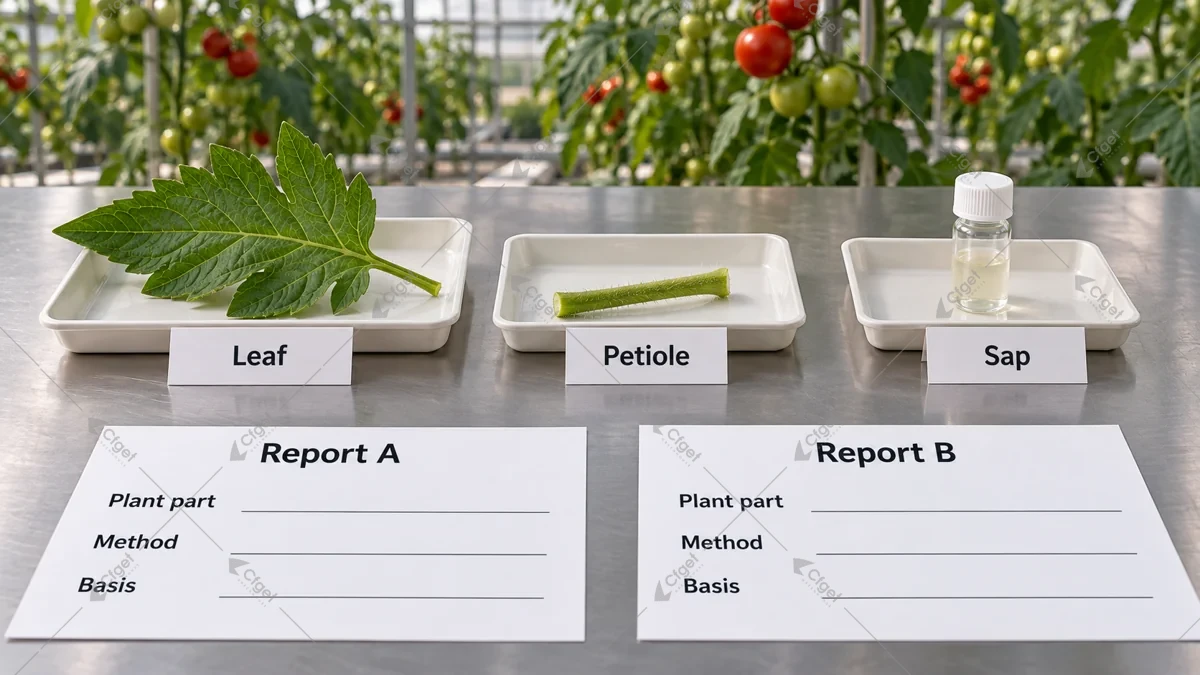
Use a two-report compatibility card
Download the report comparison card. Complete it before interpreting the difference. Use the actual laboratory wording in the first pass, then record clarifications without erasing the original description.
| Comparison field | Report A | Report B |
|---|---|---|
| Crop context | Crop, cultivar, block, stage and purpose | Same fields |
| Reference tissue | Plant part and leaf position | Same fields |
| Sampling context | Date, time, zone and relevant recent foliar products | Same fields |
| Method and basis | Laboratory method; fresh, dry, sap or extract basis | Same fields |
| Measured fraction | Exact analyte, total or ionic fraction, value and unit | Same fields |
| Interpretation | Exact reference source, tissue, stage and method applicability | Same fields |
| Decision | Comparable under the chosen interpretation; separate series; or clarification/re-sampling needed | |
Have the adviser identify the specific comparison that is valid. Two reports may support separate observations about the crop without supporting a direct numerical trend. Record that limited conclusion rather than reducing the entire review to a pass or fail.
Keep paired samples separate and traceable
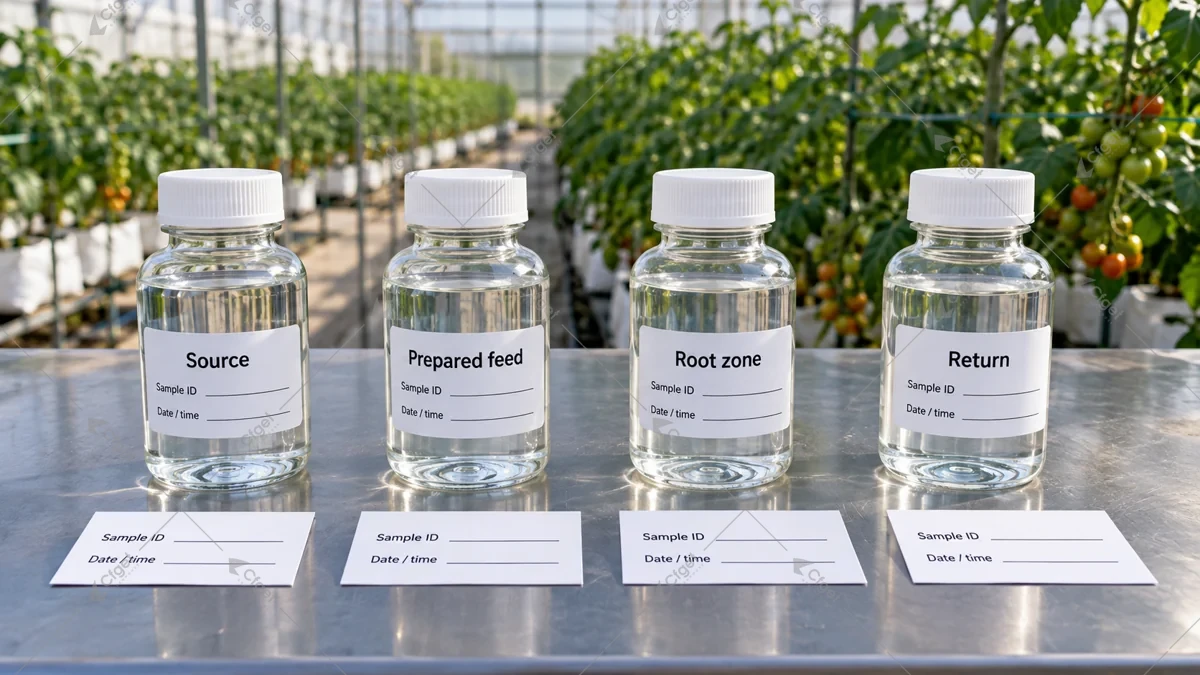
If the adviser requests symptomatic and reference plants, use a paired-sample map to preserve their identities. Record where each group came from, the observed condition and why the comparison group was selected. Do not combine them into one sample that loses the distinction.
Ask the laboratory for its instructions before collection and shipment. Record recent foliar products and possible residues so the laboratory can advise on appropriate handling. Do not apply a generic washing procedure to every sample; the analytical purpose and laboratory method govern preparation.
Keep collection details linked to the report number. When a laboratory asks for clarification, retain its response beside the card so a later reviewer can understand why a comparison was accepted or rejected.
Choose the next step the evidence supports
Comparable under the chosen interpretation: give the adviser the reports and matching crop context. A comparable result is evidence for assessment, not an automatic feed-adjustment instruction.
Different series: retain each result with its own method and reference. Continue monitoring under a defined method if the adviser considers it useful; do not splice the histories together.
Clarification or re-sampling needed: identify the missing field, responsible laboratory or adviser, and next action. Ask for a replacement sample only under the agreed protocol, without inventing a universal sampling frequency.
The substrate EC methods guide covers a different specimen and comparison problem. Plant-tissue interpretation should stay tied to the plant part and analytical fraction actually measured. A careful report check can prevent an apparent change in numbers from becoming an unsupported change in crop nutrition.