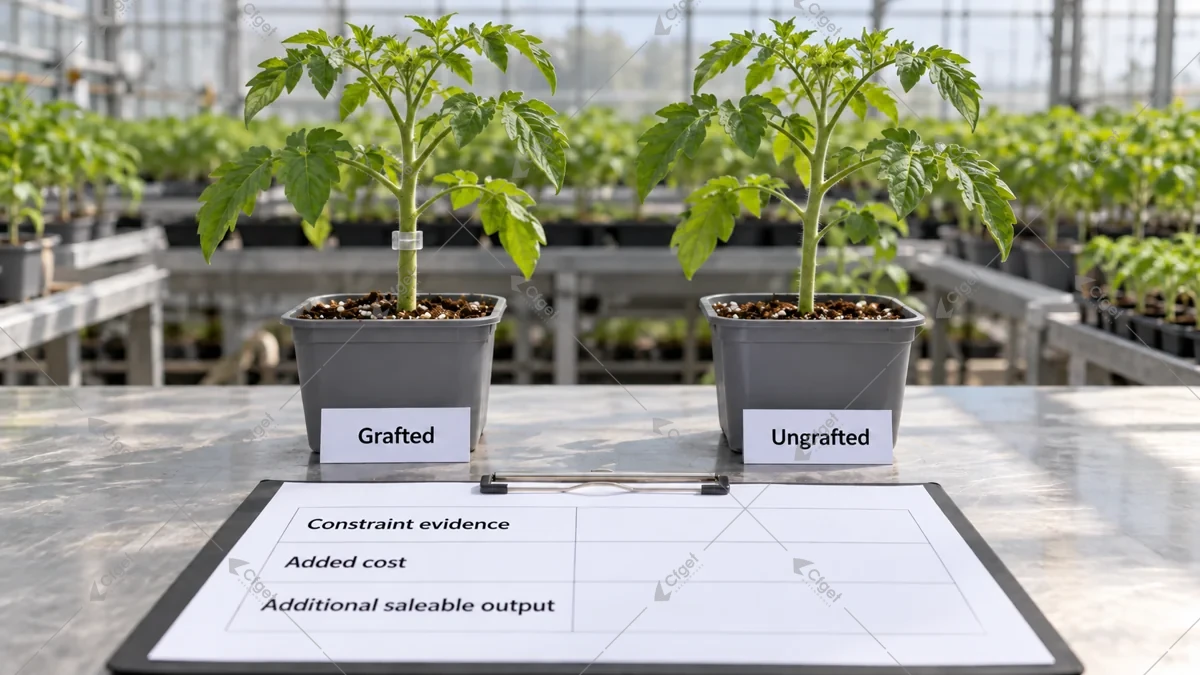
A grafted tomato transplant is worth its extra cost only when the proposed combination addresses a relevant constraint or creates enough additional contribution under the farm’s conditions. A vigorous-looking plant or a higher yield reported elsewhere does not settle that decision.
Start with the crop problem, the compatible scion and rootstock, and evidence from a relevant production system. Then compare the additional costs with a conservative estimate of additional saleable output or documented costs avoided. Keep the assumptions visible, including a case in which the expected benefit does not occur.
Name the constraint before naming a rootstock
Write down what the farm is trying to improve. Is there a diagnosed soilborne disease problem, another root-zone constraint or a production-duration question? Include the diagnostic record or observation that supports it. “We want stronger plants” is too broad to evaluate a specific purchase.
Penn State’s grafting guidance for high-tunnel tomatoes describes combining the scion’s desired crop traits with rootstock characteristics, subject to compatibility. It also emphasizes that suitability depends on the circumstances. A rootstock’s claimed resistance must match the identified problem and its documented scope.
Obtain the nursery’s exact scion/rootstock specification and current supporting information. Do not infer resistance from a general description such as “disease resistant.” Ask the crop adviser to review the relevant organism or condition and the compatibility of the proposed combination.
Read trial results with their operating context
Useful trial evidence identifies the crop combination, growing system, season, crop duration, management and saleable yield. Look for the ungrafted comparison and the costs included. A result from an open field or high tunnel should not be treated as a guaranteed response in a different greenhouse system.
A University of Maryland field trial reported a yield increase that did not cover its additional grafted-plant cost under that trial’s prices and conditions. Penn State describes a different study context in which grafting improved the economic result. These findings illustrate why the local comparison matters; neither is a universal verdict.
Alabama Extension’s trial report also separates rootstock combinations and reports marketable yield and culls. Use such work to frame questions about evidence. Do not copy its transplant prices, resistance table or yield results into a forecast for an untested combination.
Choose one comparison unit
Use a defined crop cycle and growing area, or another basis that keeps the two options comparable. Record plant numbers and production duration for each. If the proposed system changes plant density or training, a simple cost-per-transplant comparison may miss the change in total plants and labor.
Compare the cost of acceptable plants delivered for use, including relevant freight and agreed handling. Keep rejected or unusable plants and supplier credits visible. Do not divide a delivery invoice by the ordered quantity while ignoring a known difference in acceptable quantity.
This is a grafted-versus-ungrafted crop decision. Whether to graft in-house or purchase from a nursery is a separate sourcing question and should not obscure the first decision.
Build the incremental contribution check
For the chosen area and crop cycle, list costs that change between the two options. Include the transplant premium and any additional handling, training or management supported by the proposed plan. Subtract genuine operating costs avoided only where evidence supports them.
Then estimate additional saleable output conservatively. Value it using a relevant net contribution per additional sale unit after the variable harvesting, packing and selling costs associated with that output. Keep the price, grade and period consistent with the intended outlet.
A simple break-even check divides the net additional cost by the positive contribution per additional sale unit. The result is the extra saleable quantity needed to cover that cost. If contribution per additional unit is zero or negative, the calculation cannot justify the premium through extra sales. If the net additional cost is not positive, document why rather than forcing this extra-output formula.
For illustration only: assume the same growing area and crop cycle require $1,200 of additional transplant and management costs, offset by $200 of avoided operating costs. The net additional cost is $1,000. At an assumed contribution of $1.25 per extra saleable kilogram, the grafted option needs 800 additional kg to cover that cost: $1,000 ÷ $1.25/kg. An additional 600 kg would contribute $750, leaving $250 uncovered. These invented figures demonstrate the calculation; they are not actual prices, a farm case or a predicted yield response.
Do not count avoided crop loss twice. If retaining more fruit is already represented as additional saleable output, do not add its sales value again as a separate benefit.
Use an evidence-and-cost decision sheet
| Field | Grafted option | Ungrafted comparison or evidence |
|---|---|---|
| Crop constraint and diagnostic basis | ________ | ________ |
| Scion, rootstock and compatibility evidence | ________ | ________ |
| Documented resistance or tolerance relevant to the constraint | ________ | ________ |
| Area, plant count, system and crop duration | ________ | ________ |
| Relevant trial or farm record and its limitations | ________ | ________ |
| Delivered acceptable-plant cost and quantity | ________ | ________ |
| Additional handling, training and other changed costs | ________ | ________ |
| Documented operating costs avoided | ________ | ________ |
| Net additional cost for the common comparison basis | ________ | ________ |
| Conservative additional saleable quantity and unit | ________ | ________ |
| Contribution per additional sale unit and evidence | ________ | ________ |
| Extra quantity required to cover the net additional cost | ________ | ________ |
| No-benefit case and other supported downside | ________ | ________ |
| Adviser review, decision and remaining conditions | ________ | ________ |
Test the decision without a promised yield increase
Start with a case in which saleable output is unchanged. The transplant premium and other changed costs remain real even if the hoped-for response is absent. Then examine an evidence-based benefit case and any credible downside relevant to the crop.
Keep timing in the comparison. Additional fruit outside the planned crop window or buyer demand should not receive the same assumed contribution automatically. Ask whether the proposed production duration allows the expected benefit to occur and whether the farm can market it.
If the agronomic evidence or economic basis is weak, seek a locally relevant evaluation before committing the full planting. Agree the question with the crop adviser. This article does not prescribe a trial layout or a rootstock pairing.
The decision is strongest when the farm can explain both why the graft is relevant and how much additional contribution it must generate. That makes the nursery quote part of a defined crop decision, rather than a purchase based on an assumed universal yield advantage.
Download the working files
Use these CSV files with the instructions in this article.