A seed-lot report can support a propagation decision, but only if the report can be linked to the supplied seed and its tests answer the questions that matter. A germination result does not automatically establish uniform emergence, freedom from every pathogen or the number of saleable transplants the nursery will produce.
Before reserving the sowing slot, match the lot identity, sampling basis, test dates and requested results. Then identify what still needs clarification from the supplier or laboratory. Keep the original report with the seed’s receiving and storage record.
Make the lot connection first
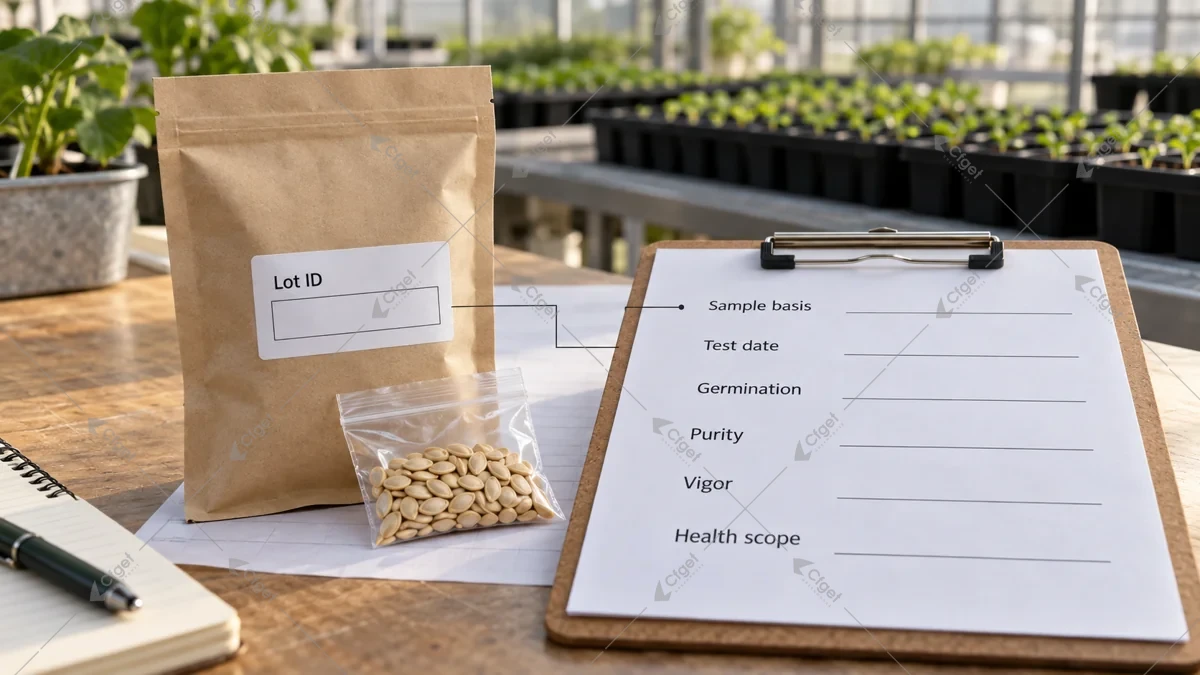
Compare the crop, cultivar and lot identifier on the order, package labels and report. Record any repacking, sublot identifier or supplier reference needed to connect them. A report for the same cultivar is not sufficient if it concerns a different lot.
Ask who sampled the material and what the report says the sample represents. The 2026 ISTA certificate chapter distinguishes an Orange International Seed Lot Certificate, linked to a lot through the specified sampling and testing responsibility, from a Blue International Seed Sample Certificate, which concerns the submitted sample. The latter does not establish the laboratory’s responsibility for the link between that sample and a claimed lot.
Read the actual certificate type and limitations instead of relying on a colored heading or logo. Not every commercial seed lot needs an ISTA certificate. The required evidence depends on the purchase specification and the relevant requirements; a supplier report should be evaluated according to what it actually claims.
Keep the tests in separate columns
ISTA’s International Rules for Seed Testing provide standardized sampling, testing and reporting methods. A report may include several different determinations. Do not collapse them into a single label of “seed quality.”
- Purity: read the reported categories and basis. Do not interpret this as a germination result or as proof of every cultivar-identity claim.
- Germination: retain the stated method, date and result. It describes performance in that test, not the final output of the intended nursery.
- Vigor: check whether it was tested, which method was used and whether its interpretation is appropriate for the crop.
- Seed health: identify the organisms and methods actually included, rather than treating an empty section as a negative result.
The ISTA Vigour Committee explains the value of vigor testing for information about planting performance across environments and storage potential. That is a distinct question from a germination percentage. An unreported vigor result cannot be supplied by inference.
Read a negative health result narrowly
For a seed-health test, retain the target organism, method, sample size and reporting language. ISTA’s seed-health chapter specifies method-related reporting details. These details help explain what was examined and how the result should be read.
A result for named targets does not establish that every possible pathogen was absent. If a disease concern is material to the crop plan, ask the supplier and qualified plant-health adviser whether the supplied test addresses it and what limitations remain.
Do not carry out a home pathogen-culture exercise or choose a seed treatment from this article. Any additional testing belongs with an appropriate laboratory, and treatment decisions need the relevant professional and product guidance.
Use a report-to-lot review sheet
| Field | Evidence supplied | Question or decision owner |
|---|---|---|
| Crop, cultivar and supplier | ________ | ________ |
| Package lot or sublot identifier | ________ | ________ |
| Report identifier, issue date and status | ________ | ________ |
| Link between supplied packages and reported lot or sample | ________ | ________ |
| Sampler, sample date and provenance | ________ | ________ |
| Laboratory and relevant test scope | ________ | Verification reference: ________ |
| Purity result, categories and method | ________ | ________ |
| Germination result, method and test date | ________ | ________ |
| Vigor result and method, if requested | ________ | Not tested / reported / unresolved |
| Health-test targets, methods and results | ________ | Sample size and stated limitations |
| Other requested determinations | ________ | ________ |
| Storage, handling or treatment since sampling | ________ | Supplier and nursery records |
| Intended sowing date and nursery conditions | ________ | ________ |
| Outstanding clarification, owner and needed response date | ________ | ________ |
Keep “not tested,” “not reported” and “tested with the stated result” separate. Those entries lead to different questions. A blank field should not silently become a satisfactory result in the nursery’s planning sheet.
Consider what happened after the sample was taken
Record the interval between sampling, testing, shipment, arrival and planned sowing. Ask about the relevant storage and handling conditions, including any documented treatment or repacking. If information is missing, state the gap rather than assuming the reported condition continued unchanged.
This article sets no universal report expiry period. Ask the supplier or laboratory whether the existing result remains an appropriate basis for the intended decision and whether a further check is justified. Keep any answer linked to the lot.
When comparing reports, check that differences in method, date or sample basis are understood. A newer date alone does not repair a missing link to the seed being supplied.
Turn the review into a clear propagation decision
Give the nursery manager a concise outcome: the lot matches and the required information is available; the lot matches but specific evidence is still missing; or the report-to-lot link remains unresolved. Include the source of any clarification and the conditions attached to the decision.
Do not convert the reported germination percentage directly into a guaranteed count of saleable transplants. Nursery emergence, uniformity and later losses need their own operating evidence. Use the report as one input to the propagation plan rather than a replacement for that evidence.
A well-read report lets the team know what it has purchased, what has actually been tested and where uncertainty remains. That is the foundation for scheduling propagation with realistic expectations.
Download the working files
Use these CSV files with the instructions in this article.