A municipal-water report that says “free chlorine: not detected” has answered a narrower question than “no disinfectant remains.” Before buying greenhouse pretreatment, find out which disinfectant the utility supplies, what the analysis measures and what the crop or equipment actually requires.
Specify the disinfectant form and the point of use before comparing removal claims. This avoids both an unsupported “zero chlorine” assumption and unnecessary treatment. Municipal water is not automatically unsuitable for crops: UMass greenhouse water guidance notes that ordinary municipal additions of chlorine are not a problem for most crops, while still calling for source-specific evaluation.
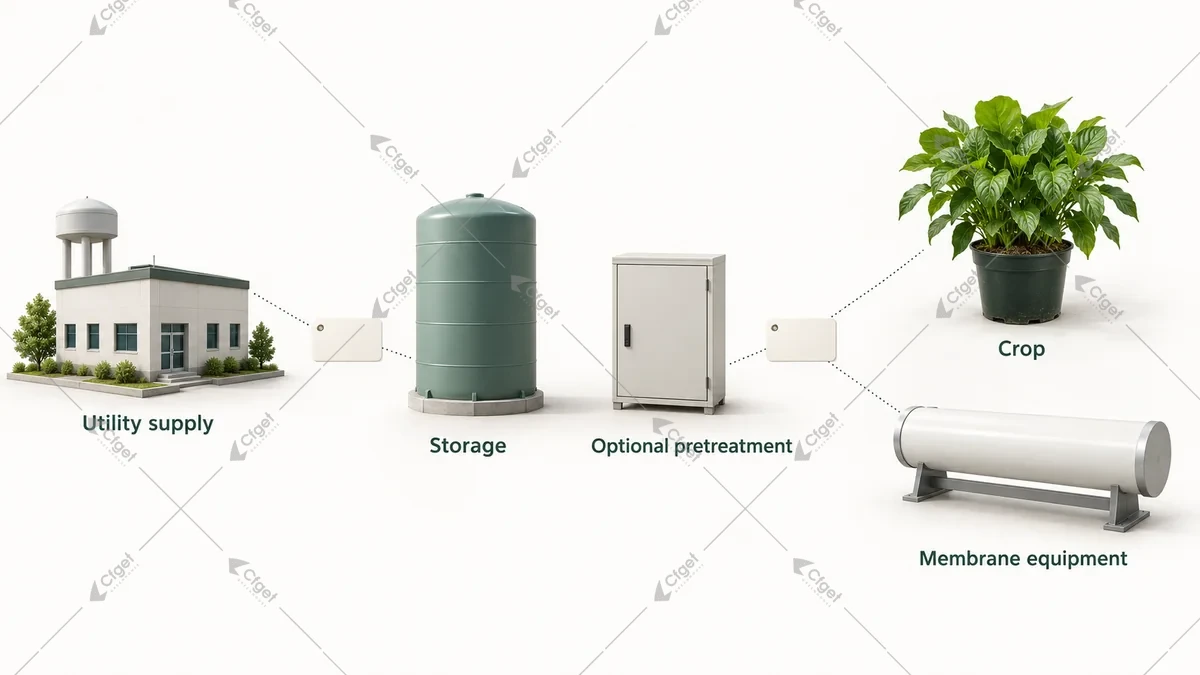
Read what the chlorine result actually measures
Hach’s parameter FAQ distinguishes free chlorine from combined chlorine and total chlorine. Free chlorine includes hypochlorous acid and hypochlorite. Combined chlorine includes chloramines. Total chlorine describes free plus combined chlorine on the applicable reporting basis. These are different scopes, not alternative names for the same test.
| Report entry | Question it addresses | Question still open |
|---|---|---|
| Free chlorine | What does the method report for free chlorine at this sample point? | Whether combined chlorine is present |
| Total chlorine | What does the method report across its total-chlorine scope? | The identity of individual species and relevant interference |
| Monochloramine-specific result | What does the specified method report for monochloramine? | Whether the overall measurement scope matches the intended duty |
At purchasing level, retain the result, units, method, reporting limit and sample location. “Not detected” means not detected within that method’s scope and reporting capability. It should not be rewritten as an unqualified proof that every relevant oxidant is absent.
Although total chlorine is defined as free plus combined chlorine, subtracting two routine results is not automatically a validated monochloramine measurement. Hach specifically warns against using the difference between total and free DPD tests for this purpose because monochloramine can interfere with the free-chlorine result. Ask the laboratory or water-treatment specialist to define the appropriate analysis; do not improvise a reagent procedure.
Work through an incomplete report
Consider a hypothetical greenhouse proposal supported by a single report: “free chlorine: not detected.” There is no current utility-treatment statement and no information on combined chlorine. The supplier concludes that the water needs no disinfectant-related review before a membrane unit.
The report does not support that broad conclusion. The next step is to obtain the utility’s current treatment information and ask the membrane supplier and analytical specialist what evidence is needed at the proposed feed point. The finding is an incomplete measurement scope, not proof that chloramine is present or that a treatment unit must be purchased.
Now suppose the utility confirms chloramination. That answers the source-treatment question but does not tell the team the residual at the greenhouse after storage, blending or other treatment. Keep those locations separate. A utility statement and a point-of-use result are complementary evidence.
Do not treat overnight storage as chloramine verification
A second hypothetical offer says that leaving municipal water in a tank overnight will solve the chlorine issue. The U.S. EPA’s monochloramine question 29, issued in February 2009, states that allowing water to stand at room temperature does not remove monochloramine. Its context is drinking water, not a greenhouse crop limit.
The commercial implication is narrow: elapsed tank time is not evidence of monochloramine removal. Ask what treatment is actually claimed, under which source-water and flow conditions, and how the relevant result will be verified. Do not infer from EPA’s discussion of household filters that no professionally engineered treatment train can address the problem.
Also ask the utility whether temporary disinfectant changes are expected and how customers are informed. The proposal should say how a relevant supply change will trigger review. It need not assume that one particular utility has changed treatment when no such evidence is available.
Separate the crop requirement from the membrane requirement
A crop-water decision and an equipment-protection decision can have different boundaries. DuPont’s FilmTec manual excerpt, revision 11 of February 2026, warns about oxidative exposure and pretreatment for its membranes. Its additional technical information also cautions that combined-chlorine sanitizers may damage membranes. Neither document establishes a universal crop-toxicity threshold or another manufacturer’s warranty conditions.
Ask for the exact membrane model, applicable manufacturer requirements and the feed point where compliance will be assessed. Do not copy a generic oxidant tolerance into a greenhouse specification. A membrane-protection concern also does not establish that every irrigation branch needs identical treatment.
Hach’s June 2024 dechlorination-monitoring note discusses measurement scope and interference at this interface. Use it to ask which method addresses the actual water and duty, not to adopt its numerical examples as membrane-safe or biological-control limits.
The broader greenhouse RO design guide covers recovery, blending and the overall system. This form-specific check belongs upstream of a removal-performance assumption; it is not a recommendation to install RO.
Make the verification point part of the offer
Download the municipal-water disinfectant evidence map. This is a manual record, with no removal, dose or safe-residual calculation. Open it using UTF-8 and comma separation. Link the utility information to the connection, post-storage or blending point, and actual crop or equipment inlet.
For each proposed treatment, record the claimed disinfectant form, applicable flow and water conditions, verification method and responsible specialist. Assign downstream storage and hygiene separately: removing a disinfectant does not establish microbiological safety after treatment. EC is likewise not evidence that oxidants are absent.
End with the specific purchasing result: measurement scope clarified, additional evidence required, or treatment performance still unverified for the stated duty. The next action should close that gap before the team relies on a broad “chlorine-free” claim.