A day-neutral strawberry label is useful cultivar information, but it does not define a greenhouse flowering schedule. Cultivars sharing that commercial class can respond differently under controlled conditions. A claim about flower initiation also does not establish when open flowers or saleable fruit will be available.
Match the actual cultivar to flowering-response evidence, its temperature and photoperiod context, and the developmental endpoint measured. Do that before turning a catalog description into a lighting specification or an off-season sales commitment.
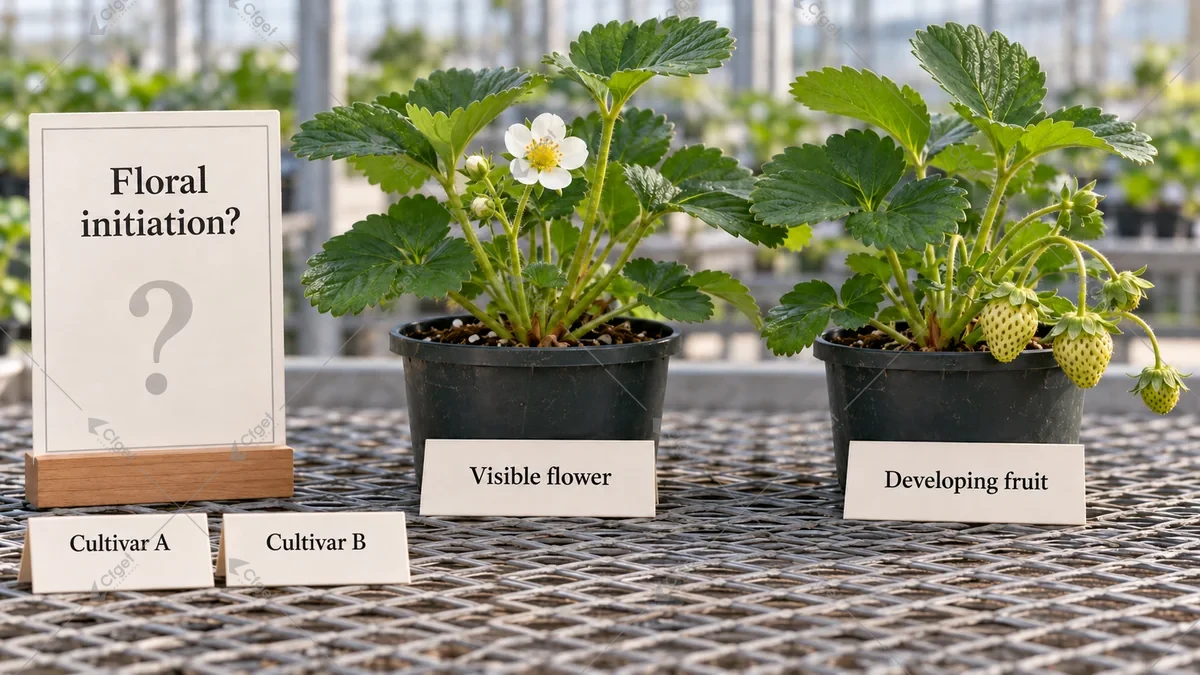
Separate the flowering label from the measured response
The Southern Regional Strawberry Plasticulture Production Guide describes flowering classifications and their environmental context. It also notes overlapping use of day-neutral and everbearing terminology. These terms are useful descriptions, but their commercial use is not a substitute for cultivar-specific evidence.
Ask what the supplier means by June-bearing, short-day, everbearing, repeat-flowering or day-neutral in the actual offer. A calendar-associated name can reflect field production patterns. A flowering-response label concerns how development responds to environmental signals. Neither is a complete specification for a different greenhouse location.
Temperature and photoperiod belong together in the question. Daylength is one environmental signal affecting floral development; it is not the only condition a cultivar experiences. A response observed at one temperature should not silently become an all-temperature rule.
Garcia and Kubota’s 2017 university-repository abstract reports a comparison of North American cultivars. Its day-neutral/everbearing group included Albion, Monterey, San Andreas and Portola. That group was tested across 8-, 11-, 14- and 17-hour photoperiods after reported 8- or 17-hour pretreatments, with a daily average temperature of 17.3 ± 0.4°C.
The researchers assessed developmental stages of shoot apical meristems. Albion, Monterey and San Andreas showed a facultative long-day response, with development tending to advance under longer photoperiods in that experiment; Portola did not show a significant photoperiod influence on flower-primordium development. The abstract calls for further work on cultivar responses and possible temperature interactions.
Those are historical experimental conditions, not recommended greenhouse settings. The reviewed source is the abstract, not the full conference paper. Its bounded lesson is that the shared commercial class did not produce a common response in this study. It does not establish Portola as universally insensitive or rank the cultivars for a grower’s project.
Keep three developmental steps separate
| Step | What the evidence needs to describe | What cannot be assumed from it |
|---|---|---|
| Floral initiation or developmental commitment | The actual cultivar, conditions and developmental endpoint assessed | A shipment-ready fruit date |
| Visible, open flowers | Observed flowering under the relevant crop program | Successful fruit development and buyer acceptance |
| Fruit development and saleable harvest | The crop’s actual fruit and acceptance evidence | A result guaranteed by its flowering-class label |
The sequence matters because evidence can stop at different points. An early developmental observation can be important without demonstrating the later commercial outcome. Record what was measured instead of replacing every endpoint with the word production.
For example, a hypothetical proposal cites a study of floral development and promises a specific off-season harvest window. Ask which evidence connects the studied endpoint to visible flowering and then to accepted fruit under the proposed program. If that connection is absent, the harvest commitment remains unsupported even if the citation is genuine.
Use catalogs and regional guidance for the questions they answer
Lassen Canyon Nursery’s variety catalog groups cultivars under commercial class headings. That helps identify the offered variety and wording. It does not establish a controlled-environment response for every listed cultivar or guarantee local stock, flowering behavior or profitability.
University of Minnesota Extension’s day-neutral guide discusses a regional production context. Keep that context attached to its seasonal guidance rather than transferring field dates to a greenhouse calendar elsewhere. A broad introductory label should not override a more specific controlled-condition result for an identified cultivar.
Now imagine two suppliers both offering plants described as day-neutral. One names the cultivar and supplies relevant response evidence with its conditions. The other supplies only the class name. The second offer has an evidence gap; it is not automatically a worse cultivar. Ask for its identity and applicable response information before treating the two offers as equivalent for the intended flowering program.
Translate the evidence into a design question
Give the crop and lighting designers the actual cultivar, intended season and response evidence. Ask which conclusions are supported under the proposed environmental conditions and which remain provisional. Do not copy experimental daylengths into a control schedule or assume the day-neutral label means no lighting review is needed.
The strawberry temperature and humidity guide addresses the wider climate evidence. The Netherlands strawberry greenhouse discussion is regional project context. Neither substitutes for identifying which developmental response supports this cultivar’s proposed program.
Download the cultivar flowering-response evidence sheet. It is a manual record with no forcing schedule or harvest-date formula. Open it using UTF-8 and comma separation. Keep commercial class, tested cultivar and conditions, measured endpoint, and unresolved control implication in separate columns.
Complete the short initiation-to-flower-to-fruit sequence with the evidence actually available at each step. A useful conclusion might establish a flowering-response assumption while leaving harvest timing unresolved. Keeping that boundary visible is what makes the label useful for a real greenhouse decision.