Short answer: there is no single strawberry greenhouse temperature and humidity schedule that is correct for every cultivar, crop stage, climate and production system. A commercial brief should define crop-level setpoints with the grower or crop adviser, measure conditions at the canopy, control condensation during transitions, and coordinate ventilation, heat, circulation, irrigation, light and alarms. The useful target is a stable crop environment with recorded limits, not one universal number copied into a controller.
This page already earns visibility for strawberry temperature queries, but its earlier version presented fixed ranges as broadly applicable, claimed personal project experience that was not verified, and tied settings to yield and fruit quality without evidence. The revision preserves the temperature, humidity and Botrytis topic while turning it into a commissioning and RFQ guide for commercial buyers.
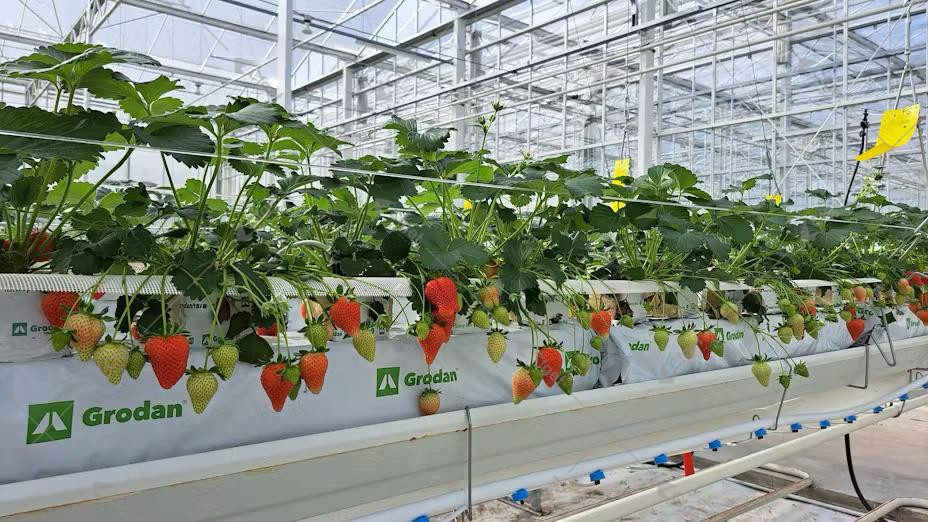
Start with cultivar, stage and production calendar
Ask the crop adviser to define acceptable day and night air temperature, root-zone temperature, relative humidity or vapor pressure deficit, leaf-wetness risk, photoperiod and light target for each crop stage. Propagation, vegetative growth, flowering, fruit development and harvest can require different operating priorities. Cultivar, plant source, substrate, planting density and market calendar also change the brief.
Record the design weeks rather than relying on an annual average. A winter crop may be limited by low light and condensation after sunset. A warm-season crop may be limited by ventilation capacity and fruit temperature. The controller schedule should show who approved each target, when it changes and what range triggers an alarm.
| Decision input | Record in the brief | Why it matters |
|---|---|---|
| Crop | Cultivar, source, stage, density and calendar | Prevents a generic setting from being treated as a crop recommendation |
| Climate target | Day, night, transition and alarm bands | Separates normal control from an emergency response |
| Light | Outdoor basis, greenhouse transmission, DLI or other adviser target | Connects temperature and irrigation decisions to crop energy |
| Root zone | Substrate, volume, drainage, irrigation and nutrient monitoring | Exposes conditions that an air sensor cannot describe |
Measure temperature where the crop experiences it
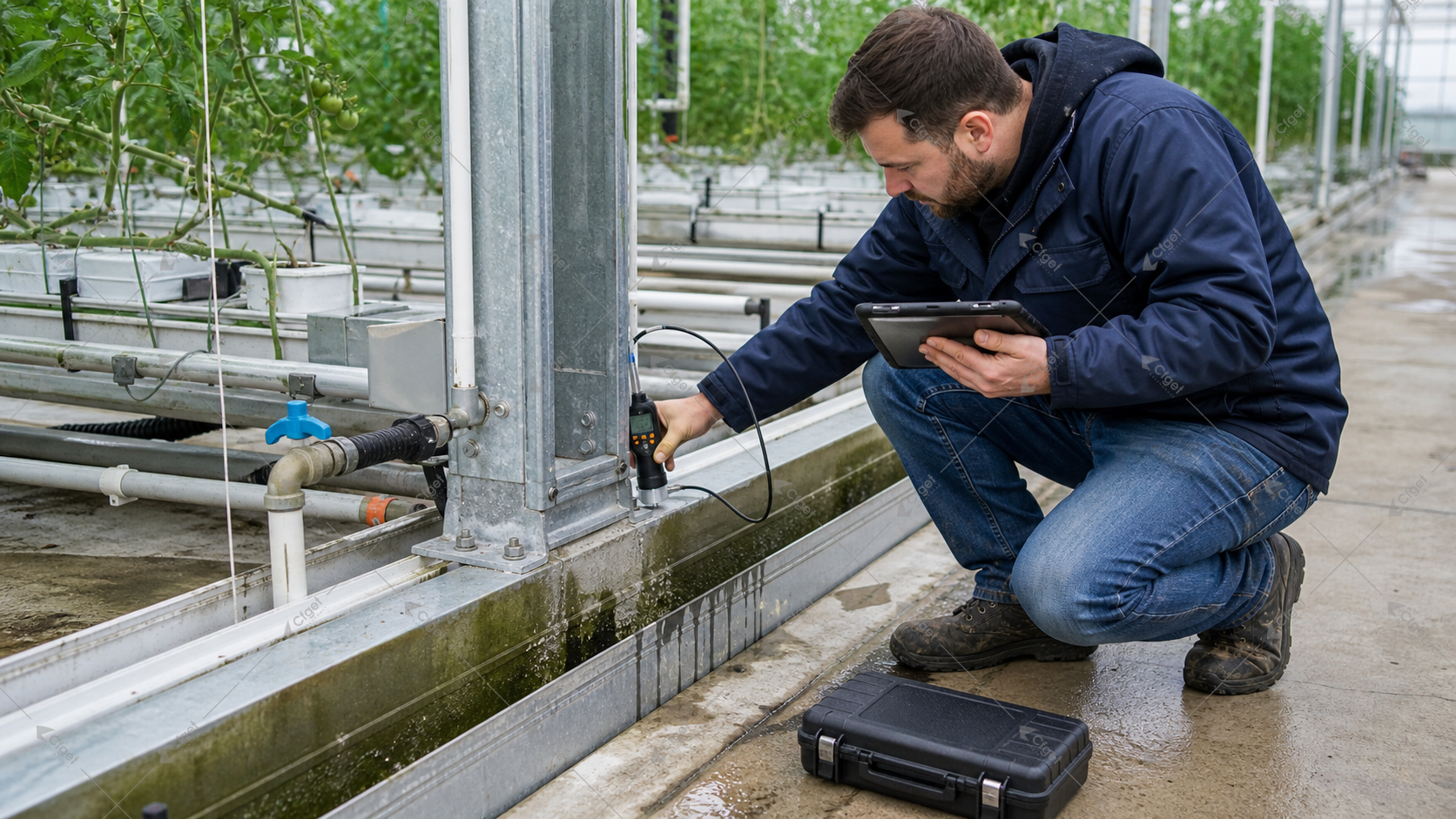
A single wall sensor can miss warm bays, cold edges and dense-canopy pockets. Map air temperature at representative canopy positions, including perimeter zones and the ends of long bays. Shield sensors from direct radiation and check whether irrigation, heaters, fans or doors distort the reading. Keep a portable reference instrument and a documented calibration interval.
Air temperature does not equal leaf, flower, fruit or root-zone temperature. Radiation, airflow, crop density and water status can move those temperatures apart. If crop-surface temperature is important to the control strategy, define the sensor, field of view and validation method. Use trends and spatial checks before changing the whole house based on one location.
Control condensation, not just relative humidity
Relative humidity changes when air temperature changes, even if the amount of water vapor is similar. That is why sunset, heat-up, irrigation and vent transitions deserve their own sequence. Compare canopy or surface temperature with dew point, inspect for wet flowers and fruit, and track how long risky conditions persist. A single daily humidity average can hide the hours that matter.
Moisture removal may require a coordinated sequence of controlled heating, venting, circulation and, where justified, mechanical dehumidification. The correct choice depends on outdoor enthalpy, energy source, greenhouse leakage, crop transpiration and equipment capacity. Avoid aggressive venting that creates a cold wet crop, and avoid heating without an outlet for moisture. The greenhouse humidity-control overview explains available system interfaces; the project sequence still needs design calculations and commissioning.
Separate air exchange from canopy circulation
Roof and side vents exchange indoor air with outdoor air. Horizontal-airflow or other circulation fans redistribute air inside the greenhouse. They solve different problems. Lay out fans around bays, curtains, hanging gutters, crop rows and service aisles, then verify velocity and temperature patterns at canopy height. A fan nameplate does not prove uniform movement through the crop.
Natural ventilation depends on vent area, temperature difference, wind direction and obstructions. Screens and neighboring structures can change resistance. Mechanical systems add their own intake, discharge, power and failure constraints. Define what happens during rain, high wind, cold outdoor air, screen closure and power loss. The climate-control system page provides a broader system map.
Coordinate irrigation with light and moisture removal
Do not specify a fixed daily volume or number of pulses for every strawberry project. Irrigation demand changes with radiation, stage, substrate volume, root health, salinity, drainage strategy and climate. Record source-water analysis, nutrient recipe ownership, sensor locations, drain measurement and the method used to adjust events.
Late irrigation can add moisture when ventilation and crop uptake are falling. Starting too late on a bright morning can create root-zone stress. Define start, stop and override logic with the crop adviser, then test cloudy, bright and fault conditions. The irrigation and fertilization guide owns dosing and water-system scope; this article owns the climate interface.
Use light data before changing temperature strategy
Hours of daylight alone do not describe crop light. Use measured or modeled crop-level light and greenhouse transmission, including structure shadows, screens, dirt and condensation. When supplemental lighting is proposed, coordinate its heat load, distribution, dimming and electrical schedule with the climate controller.
Ohio State University’s controlled-environment strawberry guidance emphasizes that cultivars and production conditions matter and discusses temperature, humidity, light and carbon dioxide as interacting factors. Use such research to frame questions, then have the responsible crop adviser set the project targets. Do not turn a research condition into a guaranteed commercial outcome.
Build Botrytis prevention into operation
Climate control is one part of gray-mold risk management. The plan also needs plant spacing, sanitation, removal of senescent tissue and diseased fruit, clean harvest practices, scouting and an integrated pest and disease program. Record crop wetness observations beside climate trends so the team can test whether a control change worked.
The e-GRO greenhouse strawberry Botrytis guide describes moisture, infected tissue and sanitation as important parts of disease management. Local labels, resistance management and biological or chemical decisions remain with qualified crop-protection professionals. A greenhouse supplier should not promise that equipment alone will prevent disease.
Commission sensors, sequences and failure states
Before handover, verify sensor identity, location, shielding, calibration, units and controller mapping. Test heaters, vents, fans, screens, cooling, humidification or dehumidification, irrigation interfaces and alarms one mode at a time. Then run transition tests for sunrise, sunset, irrigation, rain, high wind and changing outdoor conditions.
Simulate missing sensors, implausible readings, communication loss and power recovery. State the safe state and responsible contact for each fault. Handover should include as-built locations, setpoint authority, sequence descriptions, trend names, alarm delays, calibration records, spare parts, controller backups and training records.
RFQ inputs for a strawberry greenhouse climate system
- Project location, greenhouse plan, bays, covering, screens and production months
- Cultivar, plant source, stage schedule, density, gutter or bed geometry and market brief
- Adviser-approved air, crop-surface and root-zone targets with alarm bands
- Outdoor weather basis, greenhouse transmission and crop-level light target
- Vent, fan, heat, cooling and moisture-removal capacities with operating limits
- Sensor types, locations, shielding, accuracy, calibration and spare strategy
- Substrate, source-water analysis, irrigation, drain monitoring and fertigation boundary
- Control sequences for day, night, transition, rain, wind and screen states
- Failure states, alarms, remote access, trend retention and manual override
- Commissioning tests, acceptance records, training, warranty and service response
Technical references
Coraline Liao is CEO and Greenhouse Technical Director at CFGET. Her review role here is limited to greenhouse interfaces, procurement records and commissioning boundaries. Crop prescriptions and disease-control decisions remain with responsible specialists.
- Ohio State University: controlled-environment strawberry production environment
- e-GRO: Botrytis management in greenhouse strawberry production
Send the site data, crop brief, climate zones, utilities and responsibility matrix through the CFGET contact page. Require each bidder to price and test the same operating cases.