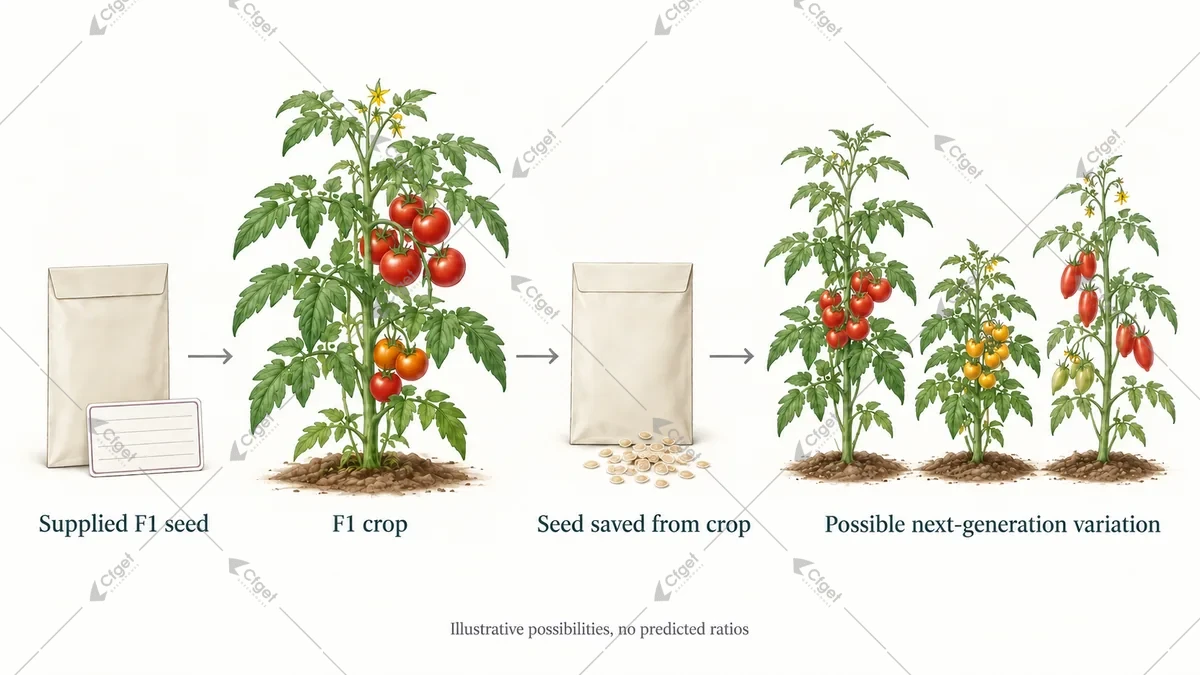
Seed saved from an F1 tomato crop is a different input from a newly supplied lot of the same named F1. Some hybrid tomatoes produce viable seed, so the issue is not automatic sterility. The question is whether the next crop has the same documented genetic starting point and supported expectations for its market traits.
Keep the seed route explicit before calling a plan “repeat last year’s tomato.” Remaining original seed, newly supplied F1 seed and seed collected from the resulting crop belong in separate inventory records.
Follow the seed route into the next generation
F1 means the first generation of a defined parental cross. The crop grown from that supplied seed carries the resulting combination. Seed produced by those plants starts another generation; it is not a replenishment of the original parental cross.
Where the F1 plant self-pollinates, its offspring form a later segregating generation: combinations of inherited traits can separate among the descendants. Where cross-pollination is unknown, the lineage is less certain still. The attractive appearance of the fruit from which seed was taken does not establish an identical next crop.
University of Maryland explains the range of traits that can appear in descendants of F1 hybrids in its discussion of plants not true to type. This biological point is separate from a diagnosis of any particular off-type crop.
Germination cannot settle the generation question
University of Minnesota notes that named hybrid tomatoes can produce viable seed while the plants grown from it differ from the hybrid parent. Its seed-saving guidance also describes conditional trait stability in open-pollinated material.
A successful germination observation answers whether seed can produce seedlings under the assessed conditions. It does not establish that those seedlings reproduce the intended F1’s fruit type, growth pattern or market uniformity. A seed coating, treatment or priming label answers another question again.
| Seed route | What the description establishes | What still needs evidence |
|---|---|---|
| Remaining original purchased F1 lot | Same recorded supply lot if identity is maintained | Current suitability and relevant lot/health checks |
| Newly supplied same named F1 | Intended documented cultivar input | Actual lot identity and supply checks |
| Saved offspring of the F1 crop | A descendant population, with known or unknown lineage | Trait expectations for the next crop |
| Another named open-pollinated cultivar | A deliberate alternative cultivar choice | Fit to the buyer and production requirements |
Compare three plans that sound like repetition
In a fictional nursery discussion, Plan A orders the same named F1 from a documented supplier. It still needs the actual seed-lot and nursery checks, but its purchasing intention is clear.
Plan B saves seed from last year’s F1 fruit and assumes identical plants will follow. Even if that seed germinates well, the assumption about crop traits remains unsupported. Relabel the inventory as saved offspring with the known parent and lineage uncertainties. Do not put it back into the original cultivar-lot balance as though it were unused purchased seed.
Plan C chooses a named open-pollinated tomato. That can be a purposeful crop choice, but it needs its own market and production assessment. It is not proof of superiority over Plan A or a way to guarantee that an untracked saved lot will meet the same buyer specification.
Open-pollinated is a conditional description
Relatively stable traits can be maintained in open-pollinated material under suitable seed-production conditions. The label alone does not document the identity, health or uniformity of a particular saved lot. Uncontrolled crossing and incomplete records can leave those questions open.
Johnny’s seed-type explanation presents both F1 and open-pollinated categories commercially. The categories help describe a supply route; they do not establish that all hybrids outperform all open-pollinated cultivars or that either category is automatically appropriate for this greenhouse.
Generation also does not confer propagation rights, organic status or a GMO/non-GMO certification. Keep those separate questions with their own documents. This comparison supplies no seed-production, collection, isolation or treatment method.
Download the next-crop seed-route record
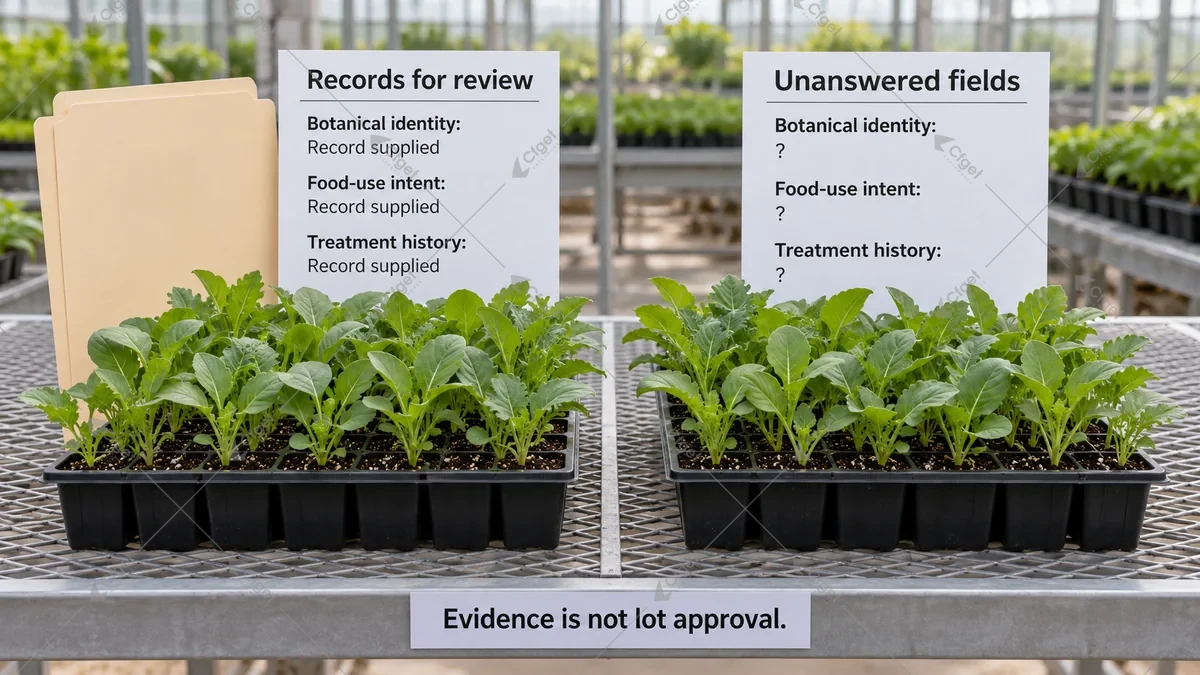
Download the seed-route and inventory worksheet (CSV). It is a manual record with no formulas. Import as UTF-8, comma-separated text and complete each applicable route separately. Record the cultivar or strain, supplier/lot, known lineage and supported market-trait expectations. Keep saved descendants distinct from original purchased inventory and mark uncertain lineage explicitly. Adjust column widths and wrapping and save a native spreadsheet copy.
Before committing the next crop, make the chosen route and its unresolved trait questions visible to the nursery and buyer. Follow it with the separate incoming-transplant inspection when plants are supplied.