For a planned U.S. edible-flower crop, confirm that the offered planting stock has an identifiable route into food production before ordering it. Botanical identity, the intended edible part and production history are separate pieces of evidence. A healthy ornamental plant of the same species does not establish that route.
Make the intended food use explicit to the supplier. If prior treatments or origin remain unknown, resolve the purchasing assumption before building the crop plan around that stock. “No sprays since arrival” cannot describe what happened earlier.
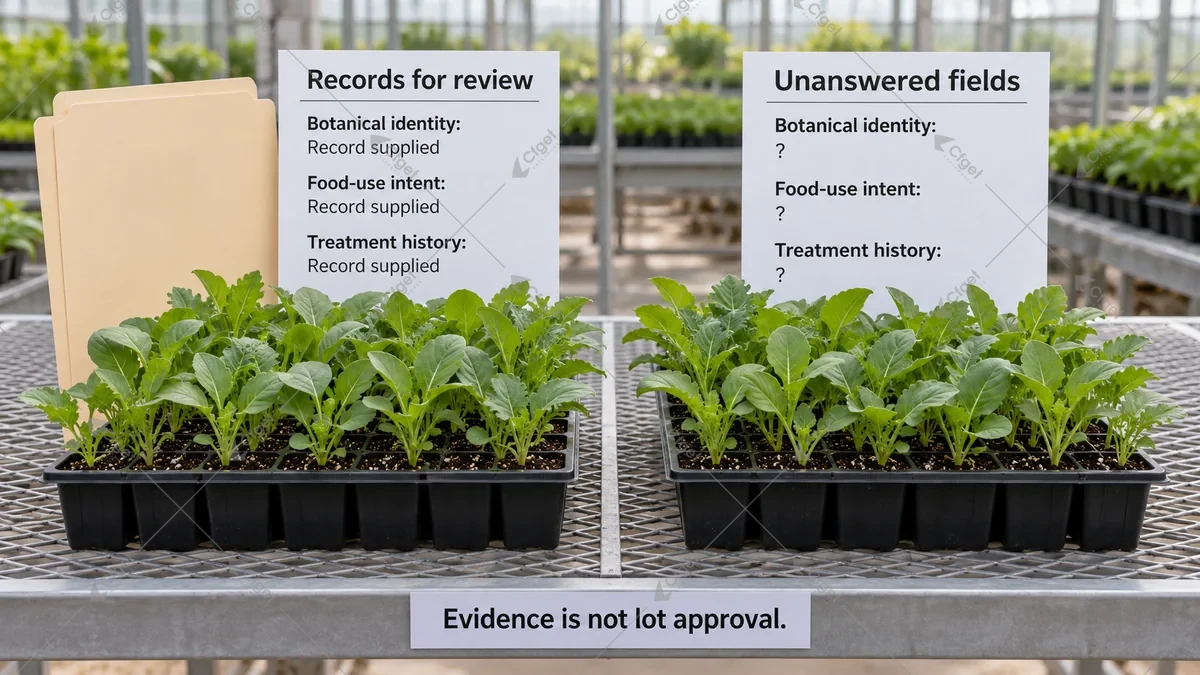
Follow the planting stock into its intended food use
Begin with the exact species and cultivar, then identify the part intended for harvest and sale. A common name or a flower photograph is not sufficient to settle identity and edible-part questions. Have those questions checked using suitable botanical and food-crop expertise rather than offering an unidentified flower for tasting.
NC State’s 2019 Choosing and Using Edible Flowers cautions against assuming ordinary florist, garden-center or nursery flowers are suitable for eating. It distinguishes flowers grown without pesticides from those grown using pesticides labeled for edible crops. That is a reason to establish intended use and history, not to declare every pesticide incompatible with edible-flower production.
| Evidence | Question it answers | Assumption it cannot replace |
|---|---|---|
| Confirmed botanical identity and harvested part | What plant and product are proposed? | That the offered stock’s treatment history is suitable |
| Supplier lot and origin | Which material do the records describe? | That a general supplier statement covers this lot |
| Documented intended food use and prior history | What production assumptions can be reviewed? | Automatic approval of the material or final food crop |
Request records that follow the actual material through its supply stages. If the nursery sourced young plants elsewhere, a statement covering only its own recent holding period may leave an earlier stage unresolved.
Read pesticide scope as a U.S. food-crop question
EPA’s pesticide-labeling answer LC06-0061 distinguishes ornamental-use wording from food-crop labeling. For food crops, the relevant species or applicable crop-group scope and tolerance or exemption context matter. Permission to use a product on ornamentals does not by itself establish permission for the intended food crop.
For an actual proposal, a qualified crop-protection reviewer needs the current relevant labels and applicable state requirements, together with the treatment history. Do not infer an edible-flower use from a familiar active-ingredient name or from another ornamental use of the same species. This discussion concerns U.S. sourcing and label interpretation; it does not approve a particular treatment or lot.
Include growth-regulator history where relevant, as well as pest and disease treatments. An empty treatment field means the history is unknown unless the supplier provides an explicit, supportable account. It should not be silently changed to “untreated.”
Compare two offers for the same botanical identity
Imagine two fictional planting-stock offers. Offer A identifies the species but was produced for ornamental sale and has no usable treatment history. Offer B identifies the same species, states an intended food-production program and supplies traceable records for qualified review.
B is the better-documented starting point. It is not automatically approved. The reviewer still needs to assess the exact material, harvested part, records and intended market. A remains an unresolved sourcing assumption even if its plants look healthier or arrive sooner.
Washing future flowers cannot supply A’s missing history. Neither can an invented waiting period or a promise to avoid spraying after delivery. Seek a documented suitable supply route instead of improvising a method for converting ornamental stock to food production.
Connect the evidence to the purchase, before discussing expansion
Kentucky Extension’s April 2021 edible-flower crop profile describes restaurant and specialty-market opportunities while noting that local niches may be small. Use that as context for asking an actual buyer what product is wanted, not as evidence of a guaranteed price premium or established demand for your greenhouse.
Once the proposed product is clear, ask the supplier to respond to that food-use requirement in the order discussion. If it cannot provide the relevant history, compare another documented source rather than treating the missing information as a paperwork task that can be completed after planting.
Keep this decision distinct from harvest-lot release. An acceptable sourcing review is one part of a food-production program, not a certificate that future flowers are safe to sell. Conversely, this inquiry worksheet should not be used to clear an existing uncertain ornamental lot.
Download the stock-to-food-use inquiry
Download the edible-flower stock-history worksheet (CSV). It is a manual inquiry record with no formulas. Import as UTF-8, comma-separated text and complete the two offer columns from supplier records. Use explicit “unknown” entries for gaps. Keep document references tied to the supplier lot and identify the qualified reviewer and unresolved purchase question. Adjust widths and wrapping, then save a native spreadsheet copy.
Before committing to an order, obtain the review outcome for the specific proposal. For the separate arrival-stage check, see incoming-transplant inspection.