For ornamental cut sunflowers, “pollenless” describes a pollen-production trait. It does not establish that a flower has no nectar, cannot attract insects or cannot form seed after receiving suitable pollen. Those are separate functions, and a buyer’s product description should keep them separate.
Use the named cultivar’s documentation to describe what is being supplied. Extending a pollenless label into “bee-free,” “fully sterile” or a health-safety promise goes beyond the information in that label.
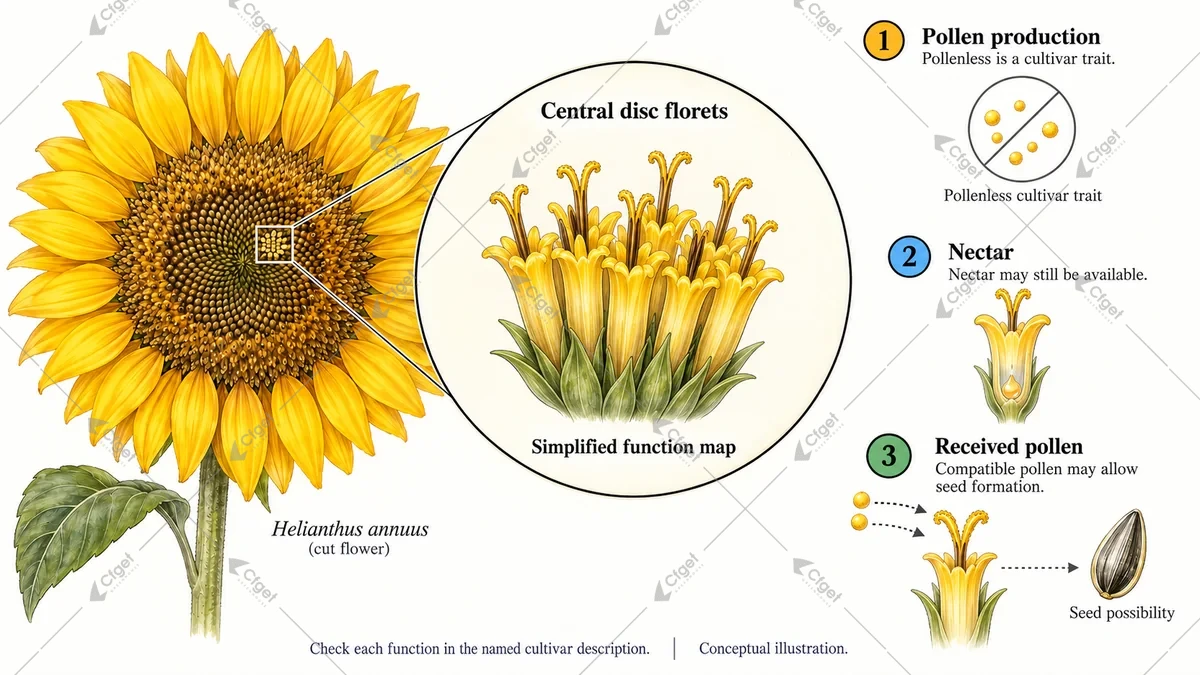
Map the separate functions of the sunflower head
A sunflower head contains many small florets. In a simplified function map, focus on the central disc florets rather than assigning pollen and nectar functions to one large decorative ray petal. Keep three paths visible:
- Pollen supply: whether the cultivar produces and sheds pollen.
- Nectar reward: what the cultivar documentation says about nectar and potential visitors.
- Received pollen and seed: whether a receptive flower can form seed after suitable pollen reaches it.
Johnny’s commercial sunflower guide describes pollenless cut types that still offer nectar and can form seed when pollen is available from other sunflowers. That is enough to show why the three paths cannot be collapsed into one “sterile flower” label. It does not establish identical nectar production or visitor behavior for every cultivar.
Iowa State’s ornamental sunflower overview also links pollenless types to reduced pollen shedding in cut-flower use while acknowledging possible seed formation. The commercial benefit being described is the floral product’s pollen characteristic. It is not proof of a price premium or a guaranteed holding period.
Keep plant architecture on a separate line
A branching habit, a single-stem habit, flower form and hybrid designation answer other questions about the offered seed. Do not fill a missing pollen-trait field from one of those descriptions.
For a concrete catalog example, Johnny’s lists both pollen-producing branching types, including Sonja and Soraya, and pollenless branching types, including Rouge Royale. These examples demonstrate independent descriptors. They are not a recommendation to substitute one cultivar for another, and they do not supply a stem-yield or planting schedule.
When a buyer requests “branching pollenless sunflowers,” both traits need confirmation for the named offer. When an offer says only “F1 hybrid,” ask for the missing pollen description rather than assuming all hybrids share it. Keep the subject here to ornamental Helianthus annuus, not rules borrowed from a seedless-fruit crop.
Correct a fictional product description
Suppose a seed supplier documents a named cut-sunflower cultivar as pollenless. A sales draft expands the description to “bee-free, sterile and allergy-safe.” The documented trait supports none of those three added promises.
| Draft wording | What the evidence establishes | Editing decision |
|---|---|---|
| Pollenless cut-sunflower cultivar | The supplied cultivar’s documented pollen trait | Retain with the correct cultivar identity |
| Bee-free | Pollenless does not establish absence of nectar or visitors | Remove the promise |
| Sterile | Seed formation can remain possible after receipt of compatible pollen | Do not infer complete sterility |
| Allergy-safe | A pollen description does not establish individual health safety | Remove the health claim |
A bounded replacement would be: “Named pollenless cut-sunflower cultivar, supplied according to the producer’s current description.” If branching habit or flower form matters to the order, add that separately when documented. If nectar information is missing, say it has not been supplied rather than changing the omission into “no nectar.”
The next step is an evidence question to the seed supplier: which exact cultivar description supports each requested trait? An unsupported promise in a sales draft does not become supported because the buyer would prefer it. Keep the description tied to what the producer has actually specified.
Download the flower-function offer exercise
Download the sunflower function-description CSV. This is a manual worksheet with no formulas or acceptance score. Import as UTF-8 with comma separators, widen the columns and wrap text, then save an editable spreadsheet copy.
Enter the offer wording, supporting cultivar evidence and proposed public wording in separate columns. Work through pollen, nectar, received-pollen/seed possibility and architecture individually. The fictional corrections are examples, not claims about your lot. Finish with a description limited to supported traits and a short list of unresolved questions. The exercise does not provide a pollination program or a health-safety conclusion.