A nursery can own the young plants it bought without having established permission for every activity it later plans. Finishing that order, retaining mother stock, taking cuttings and transferring young plants are distinct questions. Check the intended activity before allocating propagation benches or promising a later supply.
Match the exact variety, order, premises and destination to documented permission. This is a procurement planning process, using U.S. intellectual-property examples and a named supplier’s U.S./Canada licensing summary. It is not a legal determination about your plants, a patent or a contract.
Identify two separate sources of restrictions
First, identify the relevant intellectual-property rights. The USDA Plant Variety Protection overview lists U.S. plant variety protection, plant patents and utility patents as distinct forms of protection for plant-related subject matter. A commercial variety name alone does not tell a grower which, if any, applies.
Second, examine the terms governing the actual supply and any separate license. A purchase invoice may identify the variety and quantity while another document defines permitted production activities. Keep both. Do not assume that checking a patent record also resolves contractual obligations, or that receiving a healthy tray supplies an unrestricted propagation license.
The USPTO’s patent overview explains that a U.S. patent provides exclusion rights within the U.S. and its territories and possessions. It does not establish automatic worldwide protection. For a cross-border program, write down where production, transfer and sale would occur and obtain advice for those territories.
A missing tag is not evidence that propagation is unrestricted. A trademark is not interchangeable with a patent. An apparently expired record also does not, by itself, clear every other right or agreement. Where the status or effect is uncertain, ask qualified local counsel or the relevant licensing administrator to identify what evidence is needed.
A supplier example shows why the activity matters
Ball Seed’s published Plant Protection and Licensing summary, checked October 2, 2026, separates flowering-only supply terms from licensed propagation for listed Ball FloraPlant material. The flowering-only summary permits defined finished-plant production, includes label/tag requirements and prohibits propagation and specified cutting sales. Its separate propagation section has premises, destination-market and transfer restrictions.
The page also limits the varieties for which its described propagation license is available. Do not infer that every listed plant can be licensed in the same way. This is a named commercial example, not a rule for all suppliers or countries. The linked full agreement was not available for this review; obtain the current agreement that actually applies to an order.
The practical lesson is to ask for the permission that fits the intended activity, not simply to ask whether the plants are “licensed.” That short answer may hide restrictions on where the activity occurs or what can leave the nursery.
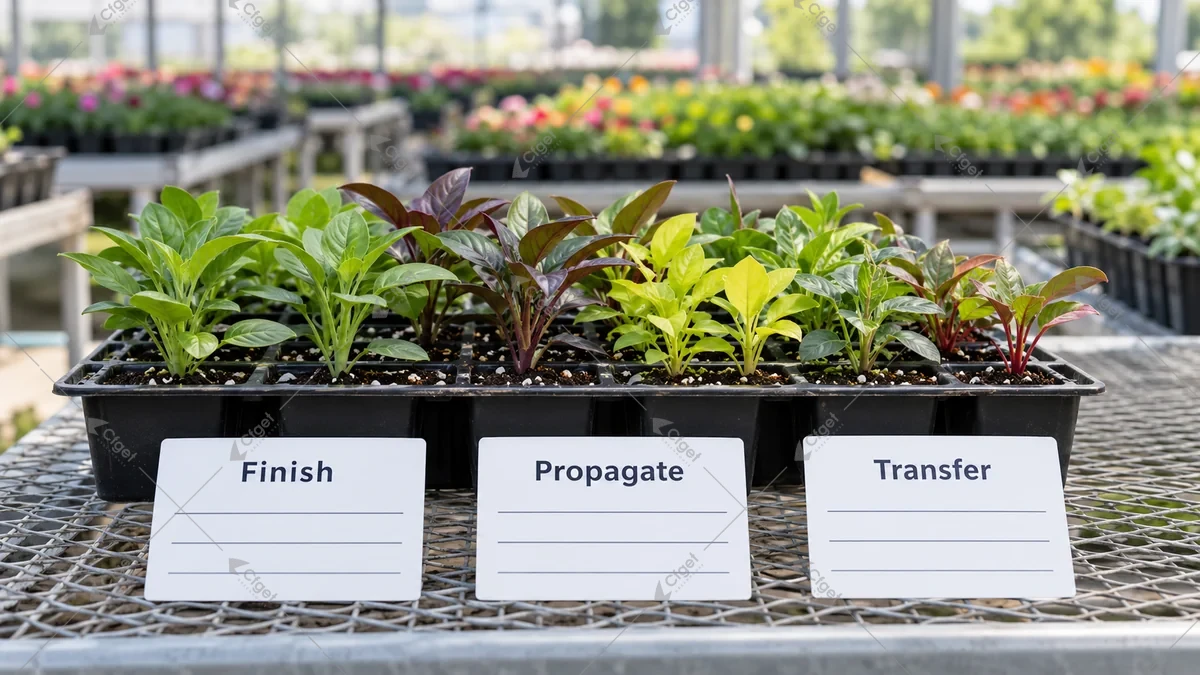
Map each planned activity to written permission
| Planned activity | Question to resolve | Evidence to retain |
|---|---|---|
| Finish the purchased plants | Does this order allow the intended finished product and market? | Applicable supply terms and product definition |
| Retain mother stock | May supplied plants be kept for this purpose? | Relevant license or rights-holder confirmation |
| Take and root cuttings | Which varieties, premises and production uses are authorized? | Current activity-specific permission and conditions |
| Sell young plants | Does permission extend to that product and recipient? | Written scope addressing young-plant supply |
| Transfer between sites or companies | Does the authorization cover the actual sender, receiver and premises? | Transfer terms and any required written approval |
| Use labels and sell into a destination | What labeling obligations and territorial limits apply? | Approved terms, destination and responsible person |
Use a separate row for each activity even when the same people manage both sites. One company name on a purchase order should not silently stand in for every growing location or related business. Equally, an unanswered row does not establish infringement; it identifies a permission question that has not been resolved.
Work through the bench-plan consequence
Consider a hypothetical order of 1,000 young plants. The production plan assigns 800 to finishing and 200 to mother stock. The documents in the file address finishing, but the team has no activity-specific answer for mother stock or cuttings.
The planning result is straightforward: the proposed 200 mother plants cannot yet support a confirmed cutting-supply assumption. They are 20% of the purchased count, but that arithmetic says nothing about royalties or legal rights. Keep the mother-stock area and later cutting output provisional until the exact permission is confirmed. Do not count a predicted cutting quantity as available planting stock merely because the plants have arrived.
Suppose a later response permits a defined propagation activity at Site A. A proposed transfer to Site B remains a separate question if the response does not address it. Attach the answer to the exact row it resolves. Avoid turning one satisfactory response into a blanket green light for the whole plan.
If the intended pathway is not available under the offered terms, ask the supplier about an authorized supply route or consider a different documented plant program. The point is to resolve that commercial choice while the facility plan can still change.
Keep the permission record usable
Download the activity-permission map. Record the exact botanical/cultivar identity, order and supplier, planned activity, production premises, destination markets, relevant right or agreement, document version, conditions and unresolved question. Store the actual agreement or written confirmation beside the reference; a shorthand spreadsheet entry should not replace it.
Use clear outcomes such as “documented for this activity and site,” “conditions still to resolve,” or “permission not established.” Identify who reviewed the response and when a changed variety, location or sales destination needs another review. These are working records, not automated legal verdicts.
Once the pathway is documented, connect the permitted quantities and activities to the nursery bench-space plan. Space calculations can then describe a production route the business has actually established permission to pursue. Uncertain rights, contract interpretation or territorial questions belong with qualified counsel or the licensing administrator before propagation starts.