Keeping a pepper on the plant for color is a commercial commitment. Harvesting it mature-green ends that particular on-plant route. Before choosing, identify the buyer-accepted state, the evidence for reaching it and what happens if the fruit misses the intended window.
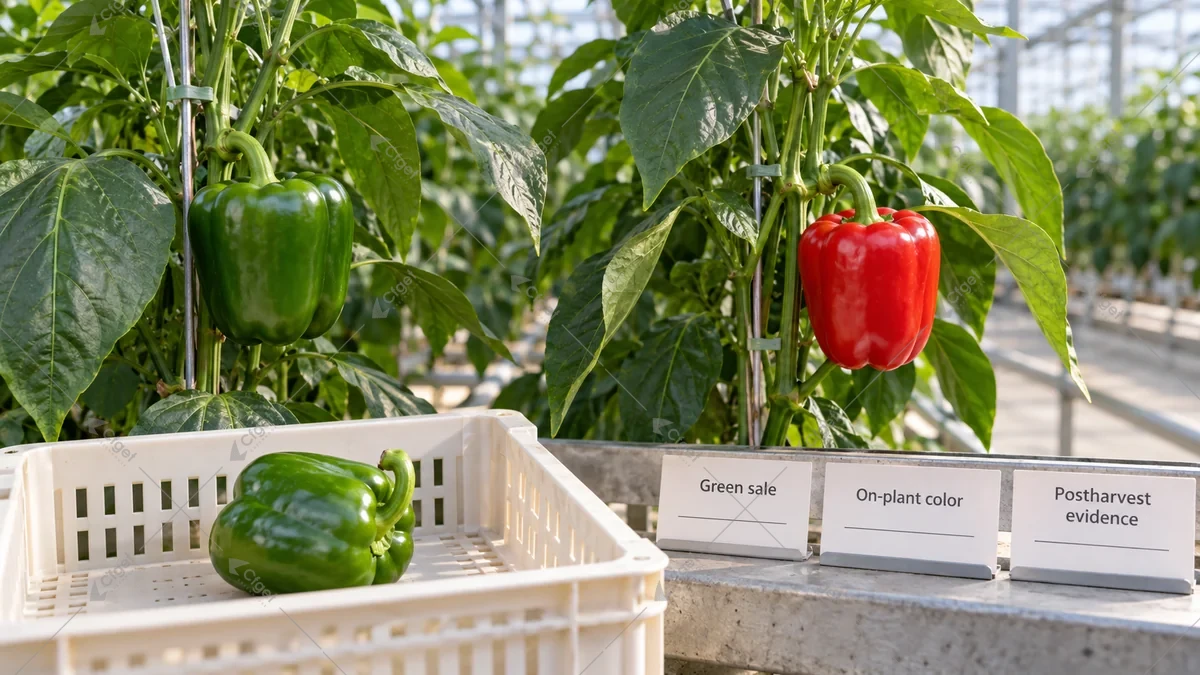
Choose a documented route for each fruit cohort. Mature-green sale, retention for on-plant color and an independently supported postharvest-color route are different plans. The same fruit cannot be counted as both a completed green sale and a later colored sale.
Separate final cultivar color from commercial acceptance
A cultivar’s final color tells you something about its development. It does not, on its own, say whether today’s fruit is commercially mature or whether a buyer will accept it. A green-fruit order still needs a maturity and quality specification. A colored-fruit order needs the named color and the point at which acceptance will be checked.
The Alberta greenhouse pepper guide describes colored-pepper production in its regional system. Its economic statements about green production should stay in that context. They do not establish that selling green fruit is unprofitable everywhere.
There is also published protected-crop work with mature-green harvest. A UF/IFAS observational trial conducted in Florida in 2006 harvested and graded mature-green bell peppers under an open shade structure. This establishes a particular production example. It was not a controlled comparison proving that green or colored harvest is the better commercial choice for another greenhouse.
Use these sources to define the question, then use your own comparable buyer and crop evidence to answer it. A regional guide, a trial harvest total and a current buyer’s acceptance specification have different jobs.
Choose a route for one identified fruit cohort
Start with a defined block, cultivar and observation date. Record whether the fruit is still attached or already harvested. For a cohort with mixed states, separate the groups rather than hiding the difference in an average color description.
| Route | Commitment being made | Evidence needed before relying on it |
|---|---|---|
| Mature-green sale | Harvest for a buyer who accepts that state | Current maturity/quality acceptance and an actual delivery opportunity |
| On-plant color | Keep the identified fruit attached for the intended colored market | Comparable transition observations, added on-plant exposure and a decision deadline |
| Postharvest color | Rely on a change after detachment | Independent evidence for the actual starting state, cultivar, handling route and buyer acceptance |
These are alternatives, not three revenues to add together. A fallback route becomes credible only when someone can identify its buyer and acceptance requirements. “Sell green if necessary” is still an assumption if no buyer has agreed to take that product at the relevant time.
Do not assume a tomato-like off-plant fallback
The UC Davis bell-pepper factsheet, with physiology information dated April 1996, describes bell peppers as nonclimacteric and only weakly responsive to ethylene. It also discusses color change in partially colored fruit. These distinctions prevent two opposite shortcuts: that every picked green pepper will reliably reach a colored specification, or that peppers can never change color after harvest.
For purchasing and crop planning, the question is narrower: what evidence supports the proposed transition from this starting state to this buyer’s accepted state through this actual delivery chain? A picture of a red pepper or a general ripening claim does not answer it. Do not prescribe a gas treatment or storage regime from this comparison.
Where the postharvest route lacks evidence, mark it unknown. That does not force immediate harvest or continued retention. It removes an unsupported fallback from the decision so the grower can compare the routes that are actually available.
A hypothetical allocation shows what can be counted
Assume a planning exercise identifies 100 attached fruit of one cultivar at the mature-green decision stage. A buyer has accepted 40 for a green order. The grower provisionally retains the other 60 for a named colored order. These quantities are invented to illustrate recordkeeping; they are not yield or acceptance forecasts.
Once the 40 are harvested and accepted, record 40 completed green sales and 60 fruit remaining on the colored route. Do not report 100 green sales plus 60 expected colored sales. The original cohort contains only 100 fruit, and the remaining 60 have not yet completed a sale.
At the next observation, suppose 45 of those 60 meet the colored buyer’s specification and are accepted, 10 remain attached and 5 are rejected. The cohort reconciles as 40 green accepted, 45 colored accepted, 10 still pending and 5 rejected: 100 total. Accepted sales are 85 fruit so far. The pending 10 are not accepted colored stock, and the rejected five are not automatically a secondary sale.
The decision now concerns the remaining 10 and the latest useful decision date. Record their actual state and whether a real fallback buyer exists. This small reconciliation keeps the commercial choice tied to physical fruit rather than optimistic totals.
Use comparable observations, then record the commitment
Download the pepper harvest-state commitment map and fruit-cohort reconciliation worksheet. The harvest-state map is a manual record; the reconciliation CSV contains formulas, so open it in a spreadsheet with formulas enabled, keep the row order unchanged and enter the counts, including explicit zeros, in “Your cohort”. The map records cultivar, current and accepted states, attached/harvested status, transition evidence, additional on-plant exposure, loss/rejection observations and the next decision date. Label quantities as observed, provisional or unknown.
The worksheet illustrates the 100-fruit example and keeps final accepted sales separate from pending fruit. It is a count reconciliation, not a yield forecast, price comparison or contribution calculation. If observations come from different cultivars, seasons or acceptance points, retain those differences instead of presenting them as a like-for-like comparison.
A crop adviser should help interpret whether the proposed retention route fits the actual crop. The buyer must define acceptance. Regional project context, such as the sweet-pepper greenhouse discussion for Spain, can frame facility questions, but it does not settle another market’s harvest choice. Commit the cohort only after the physical route and the commercial destination are both clear.