Compare predatory-mite bottles and breeding sachets by the delivery pattern needed for the crop program, not by the largest printed organism count. The exact formulation, its support environment and its documented release behavior matter. A sachet is not automatically a breeding system.
Start with the target and biological agent already identified by the crop adviser. Then compare named products against the same crop window and conditions. This is a formulation-purchase decision, not a recommendation of a species, application rate or placement pattern.
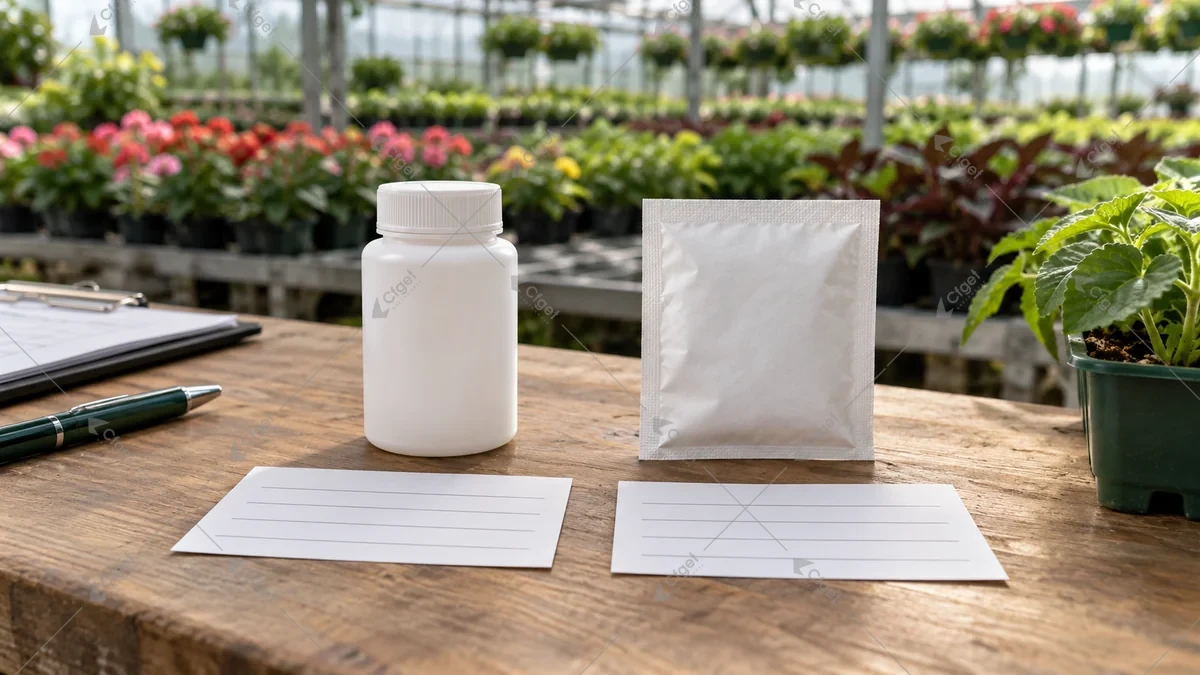
A sachet describes packaging, not the whole mechanism
Loose products deliver organisms in their supplied formulation, commonly with a carrier. A breeding sachet provides a product-specific environment intended to support reproduction and subsequent release. Other sachets can deliver a different pattern without operating as a breeding system.
Koppert’s buyer FAQ distinguishes loose products, breeder sachets and its non-breeding Boost sachets. That distinction is more useful than assuming that every packet provides the same prolonged release. Its product-specific performance and cost claims should not be generalized to another formulation or crop.
Biobest’s Andersoni-Breeding-System is a named commercial example describing predatory mites multiplying inside sachets with a bran carrier and food support. This explains a breeding-system mechanism. It does not select that agent for your target or prove an effective control period in your greenhouse.
| Offer detail | What to establish |
|---|---|
| Exact product and organism | Which named formulation and species does the adviser intend to use? |
| Loose, breeding sachet or other sachet | What mechanism does the supplier actually claim for this product? |
| Carrier and support environment | Which product-specific conditions sustain the intended delivery pattern? |
| Printed count | What is counted, at what stage, and for which package quantity? |
| Subsequent release evidence | What is documented about emergence over time and under which conditions? |
| Crop program | Does that pattern fit the required window, canopy and adviser-defined observations? |
Keep three kinds of evidence separate
The supplied count describes the stated contents of the product. Subsequent emergence describes organisms leaving the formulation over time under the relevant conditions. Observed establishment concerns what is found in the crop. These are different records.
Do not treat a sachet’s printed starting count as its guaranteed future total emergence. Equally, do not treat a quoted emergence profile as proof that all released organisms establish in the crop. Ask the supplier which quantity its document reports and retain the basis beside the claim.
UMass Extension’s predatory-mite update explains that biology, food, temperature and humidity affect performance, and that movement between plants can be limited where foliage is separated. This is a reason to identify the actual crop and canopy conditions. It is not a universal humidity setting or duration for every product.
Two similar counts can buy different delivery patterns
Consider a hypothetical comparison for the same adviser-confirmed agent and program. Offer A supplies loose material with a declared count basis. Offer B is described as a breeding sachet with its own starting count and a supplier release profile. The buyer cannot rank them by dividing package price by the printed count without first deciding which delivery pattern the program needs.
Ask the supplier to relate each exact formulation to the required window and conditions. Keep any projected later emergence separate from the supplied quantity. If a release claim lacks its conditions or evidence, mark it unresolved rather than treating the claim as delivered organisms.
Now consider an offer labeled only “sachets.” Before assuming sustained breeding, obtain the exact product name and mechanism. If the product is a non-breeding formulation, return that information to the adviser to assess whether it fits the intended role. A different mechanism is not automatically unsuitable; it changes what the crop is buying.
These comparisons use no invented price, dose or control result. They show why packaging and count alone are incomplete purchasing criteria.
Match the formulation to the real crop window
Record when the program needs the agent, how the canopy changes during that window, and the product’s stated storage and handling conditions. Retain the current instructions for the actual formulation. Do not carry a duration from another sachet type or assume all bottles are curative and all sachets preventive.
Ask the adviser what observations are appropriate for confirming delivery and establishment. The separate sticky-card pest-record method may support the wider pest-monitoring program where suitable. Sticky-card counts do not themselves verify predatory-mite establishment; that needs the agent-appropriate observation method.
If conditions or crop continuity differ from those supporting the supplier’s claim, make that difference a specific question. This is more useful than adding a generic “works for several weeks” statement to the order.
Buy the documented formulation
The formulation-to-release-window comparison is a manual worksheet. It contains no application rate, species selection, placement instructions or automatic recommendation. Enter the common adviser-defined program first, then compare the two named offers.
Keep supplier wording, supporting evidence and unanswered questions in separate cells. Finish with a conclusion for the required delivery pattern and the specific confirmation needed from the supplier or adviser.
Before ordering, make sure the purchase names the exact formulation and current instructions that were assessed. The useful outcome is a product matched to its intended role, with supplied contents, later emergence and crop observations clearly distinguished.