A commercial raspberry project can require much more than a greenhouse for fruiting. Someone must produce the canes, manage the appropriate plant state before fruiting, move or hold them where the program requires, and decide what happens after harvest.
Choose the whole cane-production and fruiting pathway before specifying the structure. Identify which phases the plant supplier delivers and which phases the grower must provide. The words “long cane” do not settle the plant’s genetics, conditioning history or next crop cycle.
Separate cane biology from the supplied format
Raspberry plants have perennial root systems, while individual canes develop through their own cycle. Floricane-fruiting types bear on second-year canes. Primocane-fruiting types can bear on first-year growth, with the subsequent use of the cane depending on the chosen program.
The Cornell Greenhouse Raspberry Production Guide explains these biological distinctions and several production pathways. It is a 2003 guide. Its historical prices, dates, growing conditions and cultivar advice should not become current project assumptions.
Long cane describes a supplied production format. It is not a synonym for floricane genetics. The current Genson raspberry catalogue lists both floricane and primocane long canes as well as plugs. That establishes real commercial categories, not a performance guarantee for an unspecified order.
Ask the supplier and crop adviser to name the genotype or cultivar, the stock format and the actual management pathway. Record whether the material is container-grown or another specified format. Do not assume that every long-cane order is bare-root or that every primocane program has the same conditioning needs.
Map the whole cane pathway and its handovers
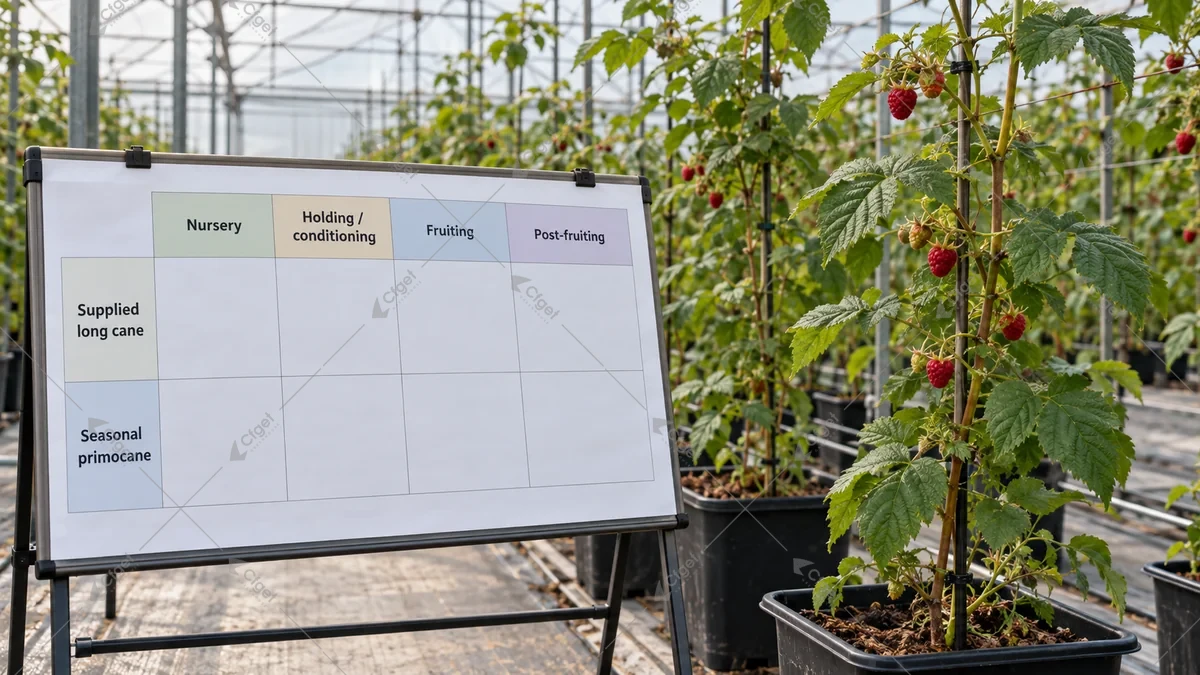
Use the whole-cycle facility and responsibility map. Compare two named programs: a supplied-long-cane pathway and a seasonal primocane-fruiting pathway. They are planning alternatives to be specified, not fixed universal recipes.
| Biological or operating phase | Question the project must answer |
|---|---|
| Plant and cane production | Who supplies the material, and which development phase has already occurred before delivery? |
| Holding or conditioning | What state is required, who verifies it, and where does the named program achieve it? |
| Movement into fruiting | Which release condition and date allow the plants to move, and who accepts the handover? |
| Fruiting occupancy | Which facility is occupied, for what approved period, and with which crop and access requirements? |
| After fruiting | Are plants carried over, moved, replaced or assigned another confirmed disposition? |
| Next cycle | Who produces the next suitable canes, and which facilities and commitments overlap? |
For each phase, record its owner, facility, planned dates, incoming condition, outgoing condition and evidence reference. Where the supplier performs a phase, retain the actual contractual scope and plant-state evidence. “Supplied by nursery” should not conceal an unassigned period after delivery.
The handover register keeps one row per transfer between parties or facilities. It makes an unresolved interface visible before the greenhouse brief is priced.
Conditioning is a program-specific facility question
AHDB’s dormancy and chilling overview, last updated in 2019, emphasizes understanding the requirements of particular varieties in programmed production. Its landing-page summary does not provide a universal chilling requirement for every raspberry offer.
If a supplier says the relevant conditioning is complete before delivery, ask for the state, timing and conditions that its statement covers. If the grower must finish or maintain a specified state, the project needs an identified facility and responsible operator for that phase.
Do not assume an ordinary produce room is suitable for holding or conditioning live cane material. Have the supplier and competent crop or storage adviser specify the actual requirement and have the facility provider confirm its capability. This article supplies no temperature, duration or forcing schedule.
A seasonal primocane pathway also needs its own confirmed sequence. The name alone does not establish that chilling or holding can be omitted. Genotype, starting material, region and intended fruiting period still need to be reconciled.
Two pathways can produce very different building briefs
Hypothetical Program A: the grower buys a specifically identified long-cane product. The agreed supplier scope includes cane production and a defined conditioning stage. The grower provides receiving and any permitted interim holding, the fruiting facility, and the agreed post-fruiting disposition.
Hypothetical Program B: the grower begins with a specified younger plant format for a seasonal primocane-fruiting crop. Its approved program assigns more cane development and seasonal holding to the grower before or during the fruiting period. The project must therefore identify where those plants occupy space and which facilities serve each phase.
These examples do not predict yield or prescribe a crop calendar. They show why identical fruiting-greenhouse areas can represent different projects. If Program A’s delivery moves earlier while the fruiting bay is still occupied, the buyer must resolve the intervening plant-state and holding requirement. If Program B has no defined place for cane development, its fruiting-house quotation is incomplete.
A third decision comes after harvest. Do not assume that carrying plants into another cycle is always acceptable or always economical. Record the chosen, adviser-supported disposition and the facilities it requires. An unpriced carryover phase is still part of the project.
Use historical whole-cycle examples carefully
The UMass greenhouse raspberry account describes a historical program linking outdoor cane development, a dormancy period, greenhouse fruiting and later outdoor phases. Its value here is the connected sequence and movement of living plants.
Do not copy that account’s New England dates, treatment recipes, lighting assumptions or repeat-cycle claims into another project’s specification. The new program needs current supplier and adviser confirmation for each handover.
Issue a facility brief that covers the whole cycle
Carry the completed map into the commercial greenhouse feasibility review. The structure can then be scoped against the actual fruiting occupancy, while nursery, holding, conditioning and post-fruiting responsibilities remain visible.
Before committing, identify every phase without a facility, every facility without an operator and every handover without an acceptance condition. Close those specific gaps with the plant supplier and relevant specialists. A raspberry greenhouse becomes a reviewable investment when the business can explain where its canes come from, what happens to them and who owns the next step.