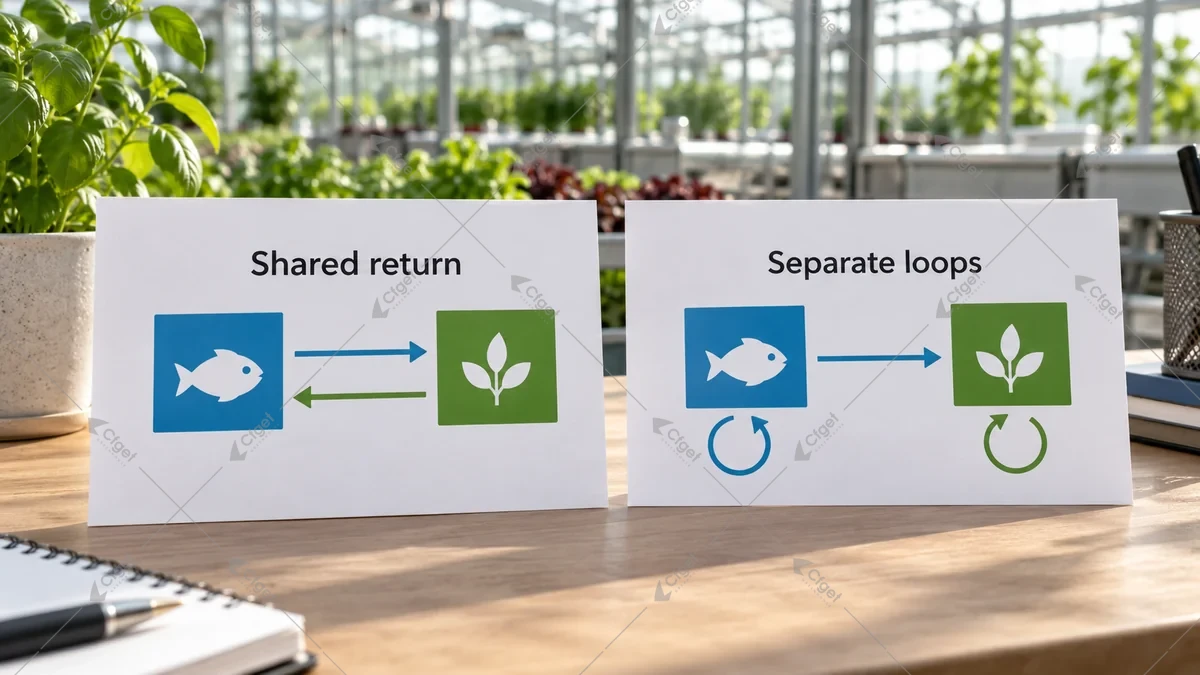
Choose a coupled or decoupled aquaponics layout by identifying which water movements and operating decisions must remain linked. A shared-return arrangement sends crop-side water back toward the fish system. Separate recirculating loops with managed fish-to-crop transfer can change that dependency, but they still need a workable transfer balance and shared-service plan.
“Decoupled” does not automatically mean independent air climate, power, staffing or production schedules. Ask the supplier to draw the actual flows and explain what changes when crops are absent, fish production changes or one subsystem is unavailable.
Draw the return path before naming the system
In the shared-return arrangement considered here, water passes from the fish-side system to crop production and returns. In the separate-loop arrangement, fish and crop water recirculate within their respective systems, while a defined transfer moves water from fish to crop without a routine crop-to-fish return.
A 2017 pilot study by Monsees, Kloas and Wuertz compared those architectures in a tilapia-and-tomato setting. Its methods describe a coupled setup and a decoupled setup with an additional crop-side reservoir and one-way transfer. It was a limited pilot with its own nutrient inputs and operating conditions, not a guarantee of commercial output or economic superiority.
Use the flow distinction to interrogate an offer. Where does water recirculate? Which volume can be managed separately? What initiates transfer, and what happens to water or residual material that does not enter the crop loop? A label on a drawing cannot answer those questions.
| Path or dependency | Shared-return proposal | Separate-loop proposal |
|---|---|---|
| Fish to crop | Identify the normal circulating path and its operating dependency. | Identify the managed transfer and the conditions that permit it. |
| Crop to fish | Show the return path and its boundary. | Confirm whether a return exists; do not assume from the system name. |
| Makeup water | Show where it enters the combined arrangement. | Show makeup requirements for each independent volume. |
| Purge and residual flows | Identify the actual destinations and responsible systems. | Identify them for each loop and any additional process. |
| Air, utilities and staff | Declare shared services and responsibilities. | Declare which services remain shared despite separate water loops. |
Check the transfer through the production calendar
Separate water loops still interact through the amount and timing of transfer. The repository abstract for Goddek and colleagues’ 2016 system-dynamics study reports a modeled relationship between fish-side water quality and crop evapotranspiration. It is model evidence, not a field validation of a proposed installation.
The 2019 chapter on decoupled aquaponics further discusses two-loop arrangements, seasonal transfer constraints and possible additional recovery or mineralization loops. Those extra loops should be shown if offered; they are not inherent components of every system called decoupled.
Ask the design team to assess the actual crop calendar and fish-production plan together. A low crop-water-demand period or a crop changeover can alter the receiving side of the proposed transfer. Record how the supplier’s approved design addresses that case, including any extra storage, controls or residual-water route. Do not fill the gap with an assumed zero-waste claim.
A changeover reveals the real dependency
Consider a hypothetical operation that plans to remove a crop batch while fish production continues. The shared-return offer must show what happens to its normal water path during that period. The separate-loop offer must show what happens to the expected fish-to-crop transfer when the crop side is not receiving it as planned.
Neither drawing is complete if its answer is simply “the systems are independent.” Ask for a supported operating case and the unresolved conditions. The purpose is to discover whether the proposed architecture fits the schedule before equipment is selected, not to perform a live isolation test.
Now suppose both proposals have separate water paths but share one electrical supply, greenhouse air volume and operator. The water architecture alone does not remove those dependencies. Put the common services on the comparison so their consequences and responsibilities can be reviewed.
These are hypothetical operating questions, not instructions for handling fish, treating water or stopping a live system.
Compare what each option adds
For the separate-loop offer, identify the reservoirs, transfer controls, monitoring points and operator work actually included. For the shared-return offer, identify the common operating requirements and any specialist-approved means of accommodating the crop schedule. Keep exclusions alongside the relevant flow or operating case.
If a proposal adds mineralization, nutrient recovery or another process, give that process its own boundary and evidence. Ask what enters it, what leaves it and which part of the operation depends on it. Avoid treating a research multi-loop diagram as a ready-made scope for your project.
The comparison should lead to a supported architecture choice or a defined hold. It does not need a universal winner. Costs and practical responsibilities may differ with the actual design, crop, fish system and market.
Take two drawings and one scenario list to the supplier
Use the water-loop direction sheet to record the two proposed architectures, and the operating-dependency sheet to compare them under the same changes. Both are manual records with no sizing or dosing formulas. Attach the supplier’s flow drawings and repeat the same option IDs in both files.
Complete the normal paths first. Then work through crop absence or changeover, fish-production changes, low seasonal transfer and a subsystem-unavailable case. For each, record the supplier’s supported response, required additional scope and question still awaiting specialist confirmation.
Use the existing aquaponics design and RFQ guide for the wider project brief and the cost and scope guide to capture the accepted equipment responsibilities. Send back the unresolved flow or operating rows before choosing an architecture by its name.