A greenhouse cooling pad needs an even supply of water and an open path for air. If the house becomes hotter while the fans and pump are running, inspect the pad face, distributor, sump and fan shutters before deciding that the media needs replacing. Dry streaks, hard deposits, slime and damaged sections suggest different faults. Cleaning one part will have little lasting benefit if the water or airflow problem remains.
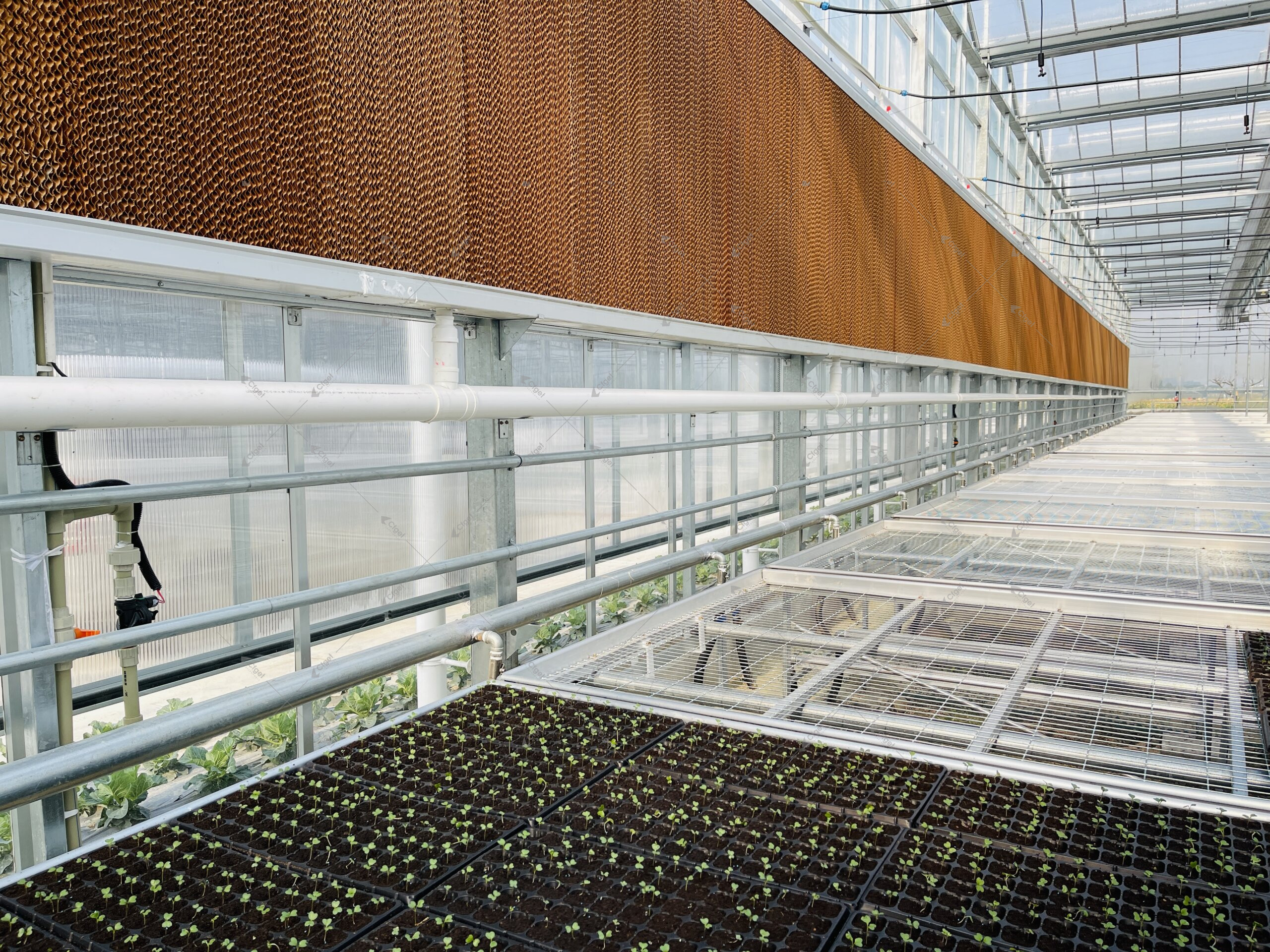
This guide covers routine diagnosis of recirculating fan-and-pad systems. Water-flow settings, cleaning products and replacement limits must come from the manual for the installed pad and distribution system. Check the model and media type before applying advice written for a different product.
Check the cooling conditions before blaming the pad
Evaporative cooling depends on the gap between outdoor dry-bulb and wet-bulb temperature. When that gap is small, a clean pad has less cooling potential. Also, air warms as it travels from the pad toward the exhaust fans. A thermometer at the fan end therefore cannot, by itself, establish whether the pad is working properly. These distinctions are explained in the University of Florida fan-and-pad guide.
Measure outdoor conditions and air temperature immediately downstream of the pad at the same time. Record the fan stage and whether the pad is fully wetted. Then check representative crop locations. This separates a problem at the inlet from heat gained farther through the greenhouse.
The Florida guide expresses pad-exit temperature as:
T_exit = T_outdoor − efficiency × (T_outdoor − T_wet-bulb)
For an illustrative calculation, assume 35°C outdoor dry bulb, 29°C wet bulb and 80% efficiency. The result is 35 − 0.80 × (35 − 29) = 30.2°C. This is a calculated pad-exit condition, not a CFGET field measurement or a prediction for the whole crop area. The assumed efficiency must not be used as proof of the installed system’s performance.
Read the pattern on the pad face
Use the following observations to decide what to investigate. They are starting points for inspection, not a diagnosis from appearance alone.
| Observation | What to check next | Why it matters |
|---|---|---|
| Vertical dry streaks | Distributor outlets, filter condition and water delivery along the full wall | A wet pad at one end can conceal poor distribution elsewhere. |
| Hard crust or restricted passages | Deposit identity, source-water condition and the bleed-off route | Repeated cleaning will not correct continuing mineral concentration. |
| Green or slimy deposits | Sunlight reaching the sump, accumulated debris and the permitted drying cycle | Algae control involves the whole water circuit. |
| Soft, sagging or torn media | Material deterioration, supporting frame and the pad maker’s replacement criteria | Water flow cannot restore the shape of damaged media. |
| Even wetting but weak cooling | Outdoor wet bulb, fan operation and air bypass | The limiting factor may be outside the water-distribution system. |
The dry-streak and sump checks follow the Illinois Extension maintenance guidance. That publication discusses evaporative pads in agricultural buildings, including greenhouse applications; its example dimensions and settings should not be treated as universal specifications.
Photograph the same pad sections before and after work. Keep the photographs with the operating readings so the next inspection can distinguish a recurring fault from a new one.
Separate recirculation, make-up water and bleed-off
These flows serve different purposes. Recirculation delivers sump water to the top of the pad. Make-up water replaces water lost from the system. Bleed-off removes part of the circulating water so dissolved material does not keep concentrating as water evaporates.
Trace each pipe rather than relying on its label. The Munters MPG assembly manual, section 6.4 specifically warns against returning bleed-off to the gutter: doing so defeats its purpose. The same manual explains that the required bleed rate depends on water quality, operation and maintenance.
Keep a simple circuit record: source supply, float valve, sump, pump, filter, distributor, return gutter and discharge destination. Mark which valve adjusts each flow. This makes a maintenance handover useful to someone who did not install the system.
Ask for water results from both the incoming supply and the circulating sump. Compare them with the installed product’s limits. A pH reading alone cannot answer every water-quality question, and a generic instruction to “treat hard water” does not establish a treatment method.
Why one pH range is not a specification for every pad
Published guidance differs. Illinois Extension gives a general starting pH range of 6–8, while the Munters CELdek inspection record lists 7–9 for sump water and 6–9 for make-up water. Those ranges have different scopes; they should not be combined into a new universal target.
Identify the installed media, obtain its current care instructions and give the supplier the actual water analysis. If treatment is needed, have the supplier or water-treatment specialist state the compatible product, control method and verification procedure. Do not infer an acid dose from the pH difference alone.
Deal with algae and deposits without damaging the media
Illinois Extension recommends keeping debris out of the sump and limiting sunlight reaching the pads and reservoir. It also discusses allowing pads to dry during a suitable operating period. Plan that period around the crop’s cooling needs and the installed controller; copying a night-time schedule from another climate can leave a greenhouse unprotected when cooling is still required.
Before opening equipment or handling media, follow the site’s isolation procedure and the equipment manual. Keep a temporary cooling plan in place for the affected crop block. Routine inspection can reveal a problem; servicing a powered fan, pump or controller needs the appropriate competent person.
The Munters MPG manual cautions that some chemicals can damage cellulose and metal components. Use its product-specific cleaning instructions or the equivalent instructions for your own equipment. Do not assume that a disinfectant used elsewhere in the greenhouse is compatible with the pad, and do not mix cleaning chemicals.
Work out where loosened material will go. Cleaning the pad while leaving solids in the gutter, sump or distributor can return contamination to the same circuit. Record the cleaning product and method used, the sections treated and any damage found. Keep maintenance records separate from claims about product lifespan.
Check fans and shutters as part of the same job
A water-circuit inspection is incomplete if the fans cannot move the intended air volume. The University of Florida maintenance guide covers dirty fan blades and shutters, belt condition and other equipment faults that can impair ventilation. It recommends keeping records of checks and corrective work.
After maintenance, confirm the intended fan stage operates and shutters move as designed. Compare pad wetting across the full wall. Repeat temperature observations under recorded conditions, and note differences in weather, shade position or crop canopy before interpreting a change as an improvement.
Decide whether to repair the circuit or replace the pad
Serviceable media with uneven water delivery calls for attention to the distribution system. Media that has deteriorated or developed bypass openings needs assessment against the manufacturer’s replacement criteria. UF/IFAS distinguishes clogging from decay and explains how openings allow air to pass with insufficient contact with water. Its older guidance for aspen pads should not be applied automatically to corrugated cellulose products.
Before ordering replacements, record the installed product, dimensions, thickness, orientation and supporting frame. Ask the supplier to confirm the replacement is compatible with the distribution and airflow design. Replacing pads without correcting the original water or mechanical fault can leave the same operating problem in place.
For each service visit, retain the date, observed fault, operating conditions, readings, action taken and follow-up result. Set the next inspection from the equipment manual and the rate at which problems recur at your site. A useful maintenance record explains what changed and whether the fault returned.