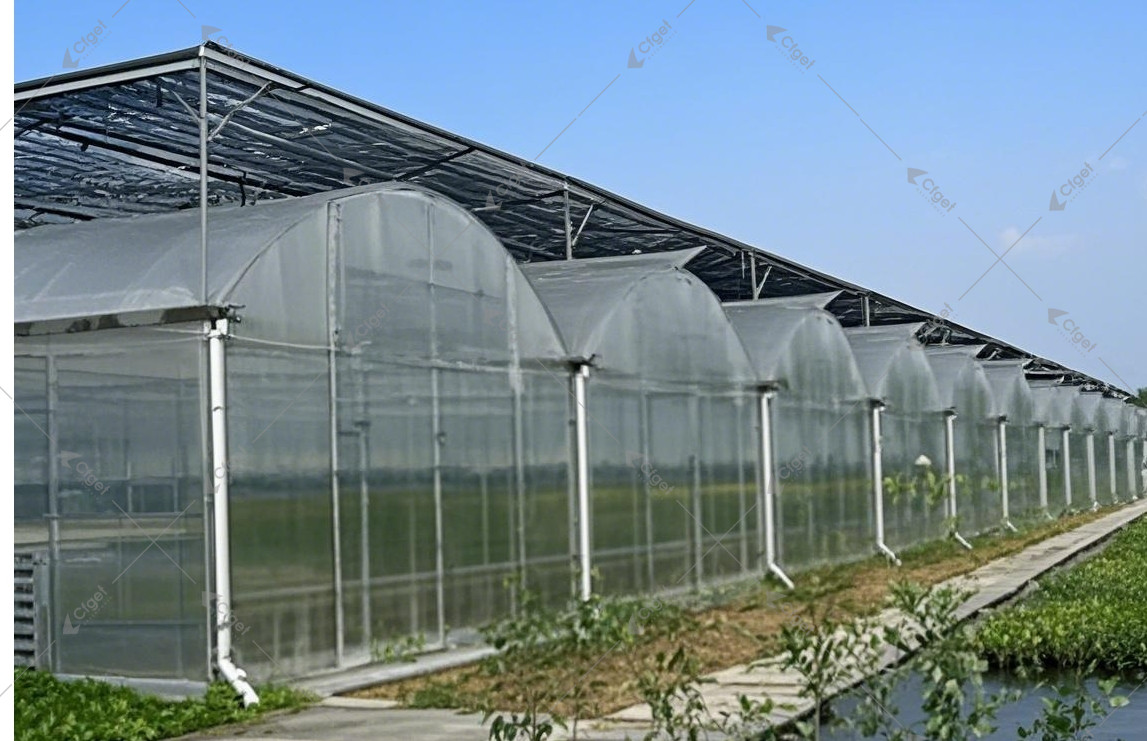
A commercial greenhouse has no single price per square meter. Two quotations for the same area can include different structures, climate equipment and installation work. A lower price may suit your project, or it may leave more work for you to arrange locally. The equipment list and exclusions tell you which.
One hectare of greenhouse footprint is 10,000 m². Once a supplier has priced a design for that area, multiply its rate by 10,000 to get the amount covered by the quotation. Every US$1/m² difference is US$10,000 across the hectare. Land, utilities, foundations, installation and the first crop still need their own allowances wherever they are excluded.
Before choosing between two offers, work through what each supplier will deliver and what you will still have to buy.
Contents
- Read what sits behind the quoted rate
- Work through the 1-hectare calculation
- Price the greenhouse for the season you intend to grow
- Two published projects show what a material label leaves out
- Obtain local prices before committing the budget
- Questions about a first greenhouse project
- What to prepare for a preliminary greenhouse budget
Read what sits behind the quoted rate
Start with the equipment schedule. A total at the bottom of a page gives you little to compare if the pages above it do not identify the covering product, steel specification or size of the cooling system. Ask the supplier to mark each required item as included, excluded or awaiting design, with quantities beside it.
| Budget line | Details to establish | Work that may sit outside the quotation |
|---|---|---|
| Structure and covering | Footprint, span, height, loads, steel specification, covering product and fixings | Foundations and local structural documentation |
| Climate equipment | Ventilation, shading, cooling, heating and controls required for the production season | Power supply, fuel connection and backup arrangements |
| Water and growing systems | Water treatment, tanks, irrigation, fertigation, drainage and crop supports | Benches, gutters, substrate and crop-specific equipment |
| Freight and site delivery | Named delivery point, packing, transport and unloading responsibilities | Port handling, inland haulage, taxes and lifting equipment |
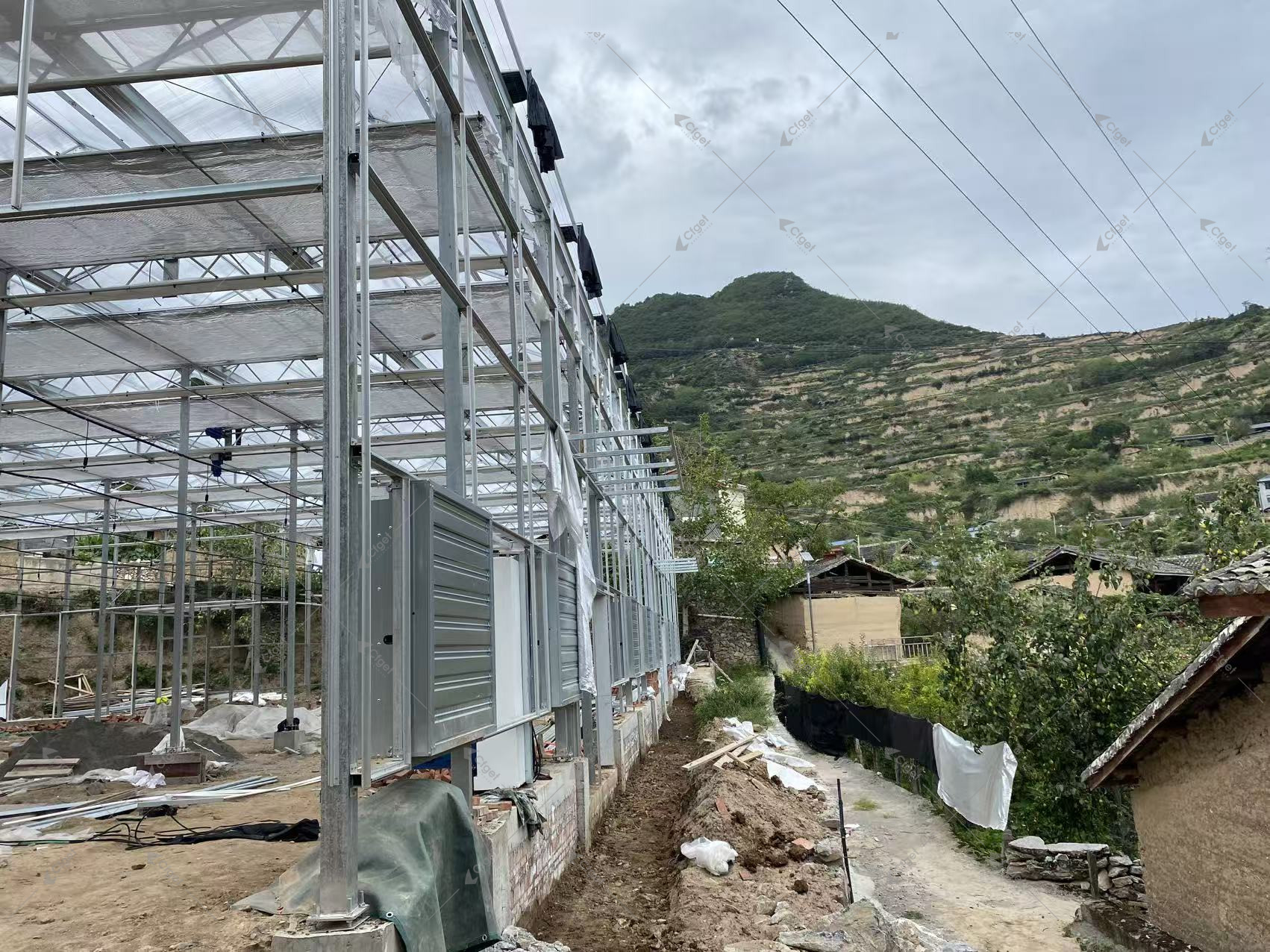
| Site work and installation | Earthworks, drainage, foundations, erection, electrical work and plumbing | Installation supervision versus a complete installation crew |
| Commissioning and handover | Checks, operator instruction, drawings and agreed spare parts | Who tests the combined systems and pays for corrections |
| Cash needed before crop sales | Planting material, inputs, payroll and utilities until receipts arrive | Working capital alongside the construction budget |
Read short descriptions carefully. “Installation support” could mean a supervisor or remote guidance; you may still need to pay for the crew, tools and lifting equipment. “Irrigation included” needs more detail too. Water treatment, storage, dosing and delivery to the crop may come from different suppliers. Establish who supplies and installs each part before treating either phrase as a complete service.
The commercial greenhouse construction guide explains these construction packages in more detail. For the price comparison, put the missing work beside each offer so you can see what remains to be paid.
Work through the 1-hectare calculation
Begin with the supplier’s rate multiplied by the covered footprint, then add any packages that supplier has priced separately. Next, add the construction and equipment you must obtain elsewhere to make the facility operable. Your funding plan will also need an allowance for identified uncertainties and enough cash to establish and run the crop before sales cover expenditure.
If electrical installation inside the greenhouse is already in the supplier’s price, adding it again under local work would count it twice. The incoming utility connection may still need a separate quotation.
The figures below are an arithmetic illustration, not a CFGET quotation or a market price benchmark. They assume a 10,000 m² covered footprint, prices in US dollars and no change in quantities.
| Calculation | Result | What the number means |
|---|---|---|
| Illustrative quoted scope: US$15/m² × 10,000 m² | US$150,000 | The amount for that scope only |
| A separately quoted package: US$40,000 ÷ 10,000 m² | US$4/m² | Its contribution on the same area basis |
| Those two non-overlapping scopes together | US$190,000, or US$19/m² | Still excludes every unresolved budget line |
| A US$5/m² difference between comparable offers × 10,000 m² | US$50,000 | Check which specifications explain the difference |
Use written quotations in place of these assumed figures. Leave an unpriced installation or freight item visibly open. A zero is appropriate only when the item is unnecessary or its cost is already included elsewhere.
The design must also fit the area you are pricing. Multiplying the rate from a small greenhouse quotation by 10,000 will not account for changes in layout, equipment quantities or local work. Have the supplier confirm a design and price for the proposed hectare.
Check what a square meter measures
Covered floor area includes space that may be occupied by aisles, equipment or services. Productive crop area is smaller in that layout. The roof and wall area used to order covering material is another measurement again.
Suppose a 10,000 m² greenhouse has 8,000 m² allocated to crops. In this second arithmetic illustration, a US$200,000 scope costs US$20 per covered square meter or US$25 per crop square meter. The 80% crop allocation is an assumption, not a recommended layout. Both rates describe the same expenditure, but only the second uses the area available for crops.
Use matching covered areas to compare suppliers and the actual crop layout to assess production capacity. Also check what the project brief means by “one hectare.” A hectare of land must accommodate any roads, drainage and service buildings as well as the greenhouse.
Price the greenhouse for the season you intend to grow
A seasonal vegetable shelter and a greenhouse expected to produce through winter need different budgets. Before asking which is cheaper, decide the crop, growing months and indoor conditions the building must support.
For seasonal production with limited initial funds, a film structure is worth pricing, provided its ventilation and structural design meet the site’s needs. Include the labor and access needed to replace the film. Oklahoma State University’s covering guide describes polyethylene as a relatively low-investment option with more frequent replacement; it also explains how the covering affects the supporting structure.
If you plan to heat through winter, compare inflated double film with a specified multiwall polycarbonate assembly, using their actual heat transfer and light specifications. Glass can also belong in the comparison for a permanent facility where winter light is a priority. Its supporting structure, heating provision and maintenance costs need to fit the business. UMass’s planning guidance discusses the trade-off between glazing expense, insulation and winter light. Neither university guide is a current price list.
Heat, humidity, wind exposure and snow loads can narrow the choice further. Request the local design basis before ranking prices. A basic film package cannot stand in for a year-round production budget until its operating limits have been checked. Equally, a high crop selling price is insufficient reason to buy glass or extensive automation if the farm cannot fund the required controls and maintain them.
For the options that remain, the greenhouse lifecycle cost guide helps you compare replacement work and operating expenditure over a common period. Use estimates for the site and production schedule you actually intend to run.
Two published projects show what a material label leaves out
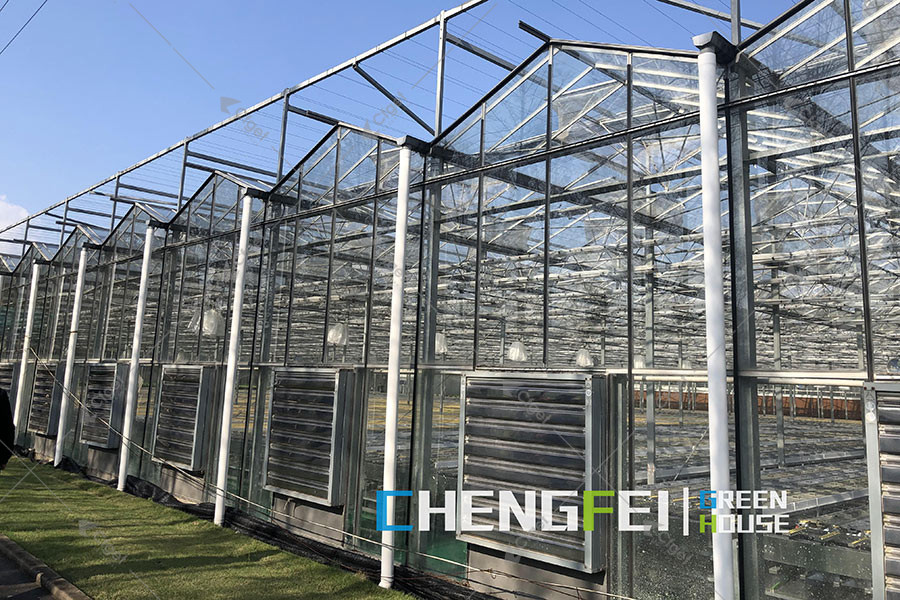
CFGET’s project records list a film greenhouse in Tajikistan and a polycarbonate greenhouse in Uzbekistan. Both include environmental systems alongside the structure and covering:
| Published project | Listed dimensions | Listed systems relevant to the budget |
|---|---|---|
| Film greenhouse in Tajikistan for fruit production | 48 × 48 m; calculated footprint 2,304 m² | Galvanized steel structure, cooling, ventilation and internal shading |
| Polycarbonate greenhouse in Uzbekistan for flowers | 48 × 36 m; calculated footprint 1,728 m² | Galvanized steel structure, cooling, ventilation, internal and external shading |
The dimensions and equipment lists are from CFGET’s published records. The floor areas are calculated from those dimensions and do not measure productive crop space. Neither record gives project prices, energy consumption, yields or financial returns.
These examples give you specific items to look for in an offer headed “film greenhouse” or “PC greenhouse”: cooling, ventilation and shading all belong in the price discussion. The two projects have different locations and crop uses, so their specifications cannot establish a cost ranking or a price for a new hectare.
Obtain local prices before committing the budget
A proposal may include pumps and climate equipment while the site still needs an electrical connection, fuel supply or water treatment. That work needs local prices. UMass’s site-planning guidance includes water quality and peak supply, utilities, drainage, access and room for expansion among the factors to establish before building.
Hold off choosing a supplier if the offer still lacks design loads, an installation boundary or an identified covering product. Those gaps can change what you receive. Before signing, check the currency, delivery basis and quotation validity, along with who commissions the equipment and completes the local work. You should be able to trace the difference between two totals to particular materials, equipment or responsibilities.
Questions about a first greenhouse project
Can I build part of a hectare first and expand later?
A phased layout is worth assessing before the first order. Reserve access and drainage routes, and establish the utility capacity and connection points needed for the later phase. Ask for separate prices for the initial build and these provisions. The second phase may have a different unit cost, and connecting it may interrupt production; both need to be considered in the plan.
Does a more expensive greenhouse pay back faster?
Price alone cannot tell you. Payback depends on marketable output and sales prices as well as operating costs, downtime and when the farm receives payment. Check the production plan against the operator’s skills, available maintenance support and expected expenditure. The CFGET downloads page lists a Commercial Greenhouse Project Feasibility Workbook to help organize that work. Any yield assumption still needs a crop and market basis beyond the supplier’s promise.
What to prepare for a preliminary greenhouse budget
Send the country and city, greenhouse footprint, crop and growing method, production months, available water and power, and your budget range. Attach a site survey, water test or local design requirements if you have them. Describe the help you need with construction: equipment supply, installation supervision or a wider service.
CFGET can use those details to discuss suitable configurations and identify work that will remain with you. Ask for a dated list of inclusions and exclusions with the preliminary price, then use it to obtain the outstanding local quotations.