Used coir can be physically present in the greenhouse and still be unavailable for the next crop. Its condition may be unresolved, its format may not suit the new plan, or the required assessment and preparation may finish after planting.
Count only suitable, released material that can be available by the required date as firm supply. Keep conditional used cohorts separate, then calculate the replacement quantity and the latest feasible order decision. A reuse decision has to work in both the root zone and the calendar.
Start with the next crop’s requirement
Write down the approved substrate specification, crop, intended growing period, usable quantity and planting date. Use one comparable unit. “One bag” cannot reconcile two formats with different usable volumes, dimensions or planting arrangements.
Use the crop adviser’s assessment of substrate suitability for the planned container and irrigation system as an input. This supply record should consume that decision, rather than replace it with a visual judgement or a new universal acceptance threshold.
Identify fresh stock already accepted for that use and confirmed suitable incoming deliveries. Record any separate contingency quantity explicitly, with its purpose. If the crop requirement already includes that reserve, do not add it again.
Keep used cohorts traceable
A cohort is a quantity whose history and review can be kept together. Record its greenhouse or block, original product and batch where known, crop and cycle history, quantity and reason for any segregation. Preserve different or uncertain histories as separate entries.
Retain the current physical, chemical and plant-health evidence and the professional decision about the named next use. An original unused-product certificate does not establish the condition after a crop. Neither normal appearance nor a low EC reading is enough to close the plant-health question.
UF/IFAS guidance on solid media identifies variability in water conductance and aeration as a concern in reuse. Its Florida context and historical design material do not establish a universal number of coir cycles. The useful distinction is that retained physical function and plant-health suitability both need attention.
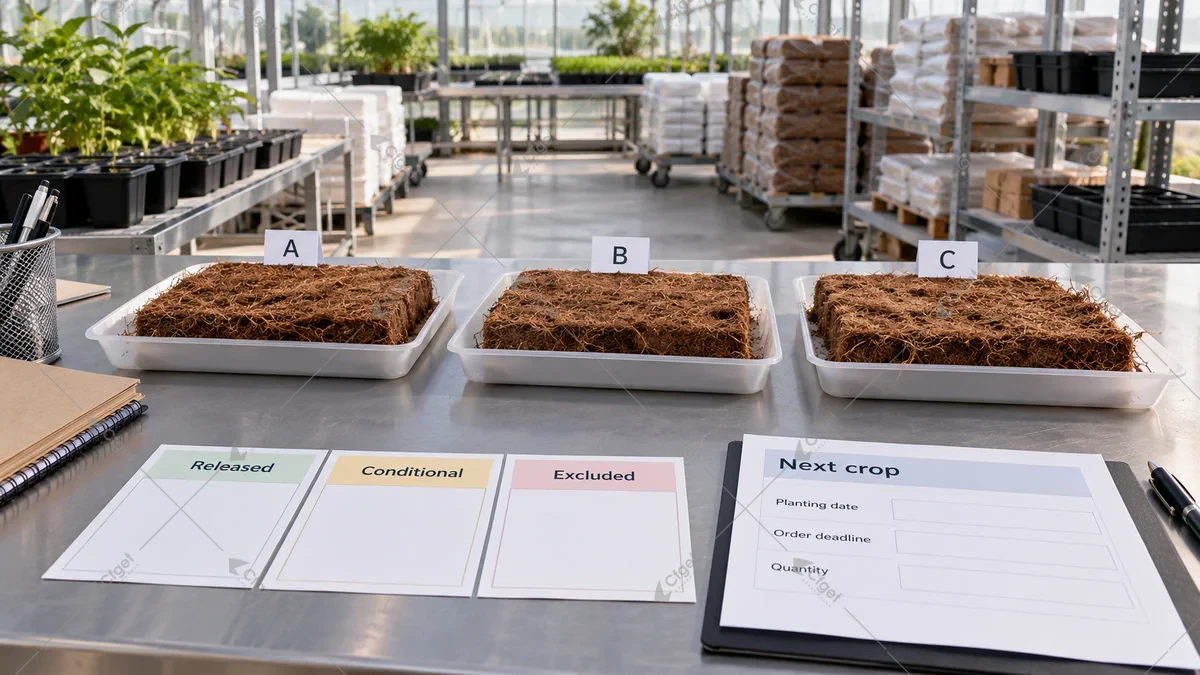
Keep one row per cohort in the cohort allocation ledger, linked by its identifier to a detailed cohort evidence card. The ledger connects the separate histories to quantity and timing. Keep these states distinct:
- Excluded: unavailable for the named use under the recorded decision.
- Unresolved: evidence or an acceptance decision is still missing.
- Undergoing an approved process: a defined assessment or preparation is in progress, with capacity and timing recorded.
- Released for the named use: the responsible reviewer has accepted the stated quantity and conditions.
A release still needs an availability date and allocation. Do not promise the same cohort to two blocks. Record the released quantity rather than assuming every bag originally in the cohort remains usable.
Reconcile firm supply before the order deadline
The next-crop supply and deadline calculator separates accepted available stock, confirmed timely new deliveries and conditional used material. Transfer quantities from the cohort register only after checking that they match the crop specification, allocation and date.
Its firm purchase gap is the requirement, plus any separately approved contingency, less accepted fresh stock, released timely used stock and confirmed timely incoming new stock. Conditional material does not reduce that gap. A separate scenario shows what could change if a specified conditional quantity is actually released in time.
Obtain the supplier’s real order-to-delivery lead time and the time needed for receiving and release before planting. State whether the lead time uses calendar days, working days or a confirmed fixed date. Do not subtract a working-day promise as calendar days. The calculator’s optional date calculation applies only to a verified calendar-day basis.
Record the latest decision date, responsible buyer and supplier confirmation. Review unresolved reuse quantities before that date. If the answer is still uncertain, the business must choose between securing replacement supply and revising the planting plan with the grower.
A worked example keeps conditional stock visible
Hypothetical example: a crop needs 1,000 identical approved slabs. A separate, explicitly approved contingency adds 50, so the requirement is 1,050. There are 150 accepted fresh slabs, 200 released used slabs allocated to this crop and 100 suitable new slabs with confirmed timely delivery.
Firm supply is 150 + 200 + 100 = 450 slabs. The replacement gap is therefore 1,050 − 450 = 600 slabs. Another 300 used slabs are still conditional. They may reduce the gap to 300 if released and available in time, but they do not reduce today’s firm gap.
Suppose planting is 30 November 2026, the supplier confirms a 21-calendar-day lead time, and the plan requires five further calendar days for receiving and release. The latest calculated order date is 4 November 2026. These are invented planning inputs, not a supplier promise or recommended allowance. The actual order date must be confirmed against the real supply arrangements.
If the conditional cohort will not be resolved by 4 November, waiting for a favorable result leaves the 600-slab gap exposed. The buyer needs a documented supply or planting decision by that date. The potential reuse quantity should remain visible without being treated as a completed saving.
Similar-looking slabs can require different actions
Intact appearance, unresolved history: a cohort looks physically serviceable, but its crop-health history is incomplete. Keep it segregated and unresolved while the plant-health adviser determines the next step. Do not count it as firm stock because its replacement price is inconvenient.
Acceptable direction, late completion: the adviser considers reuse feasible under a defined approved process, but its earliest credible release is after planting. That quantity cannot supply this planting date. It may be considered for another compatible use or date under a separate allocation; the current crop still needs timely supply.
Research does not erase these distinctions. A 2015 cherry-tomato study abstract reports no significant production or quality difference between fresh and reused coconut-fiber treatments in its particular unheated, gutter-subirrigated experiment. That result does not release another farm’s used slabs.
A 2026 eggplant study used previously cropped coir after grinding and blending it with perlite. That is a different material-processing and crop context from reusing intact tomato slabs. It should not be presented as evidence that those slabs can stay in place unchanged.
Keep the release decision and the buying decision connected
Qualified local advisers should control the necessary assessment, any permitted treatment, release and disposal decisions for the actual material. This stock calculation provides no treatment method and cannot bypass the crop-changeover release process.
Update the allocation whenever a cohort quantity, decision, completion date or supplier commitment changes. The grower should be able to see exactly which material supports the next crop, and the buyer should be able to see exactly which unresolved quantity still requires a timely decision.