A greenhouse crop changeover should separate removal, cleaning, disinfection, repair, verification, and restart. Disinfectants cannot compensate for plant debris, biofilm, blocked drains, hidden pests, or equipment that was never opened and cleaned.
*By Coraline Liao, CEO, CFGET | Updated: September 6, 2026*
*Reviewed by CFGET Project Planning Team*
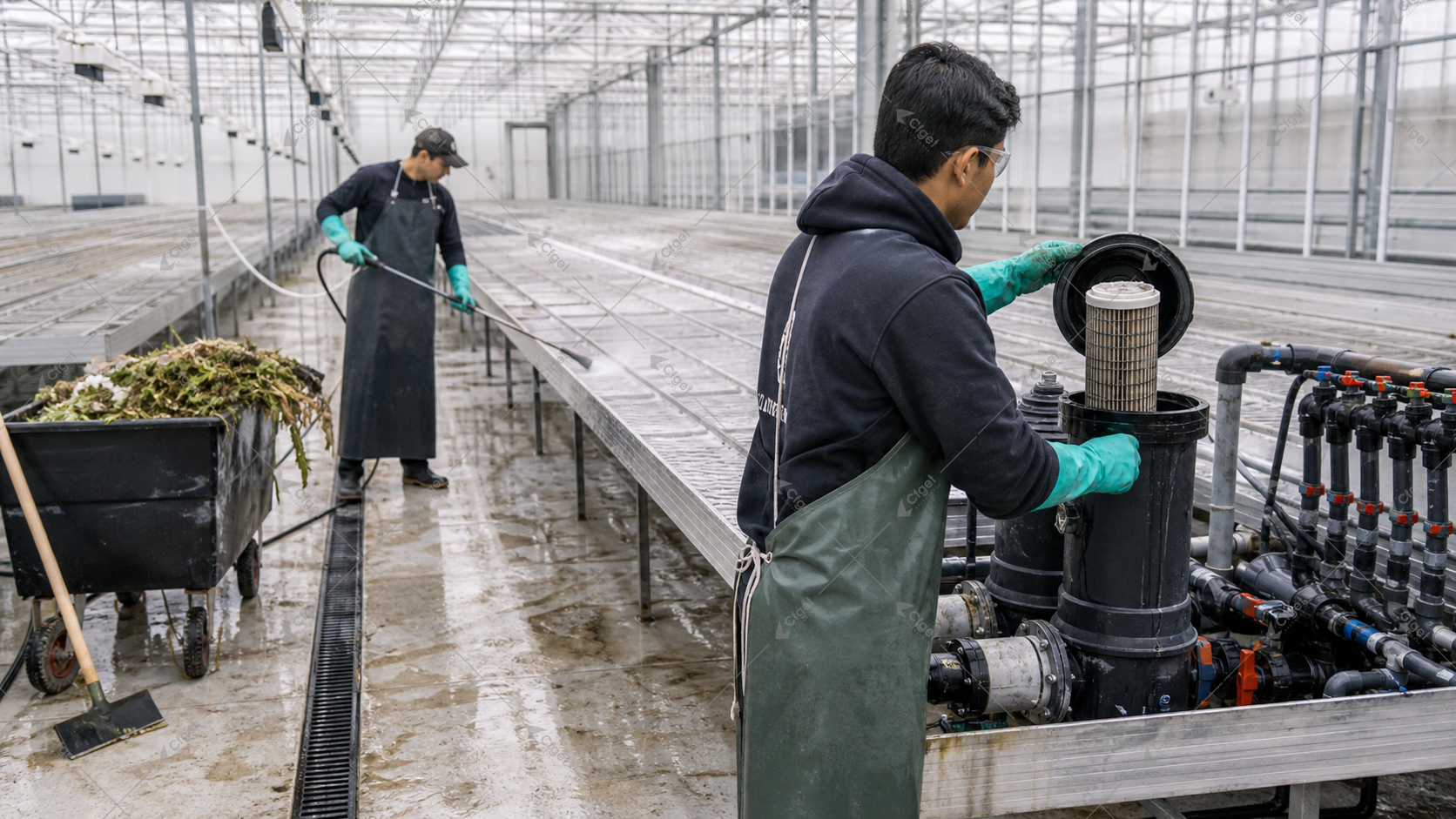
The clean-looking greenhouse is not necessarily ready for the next crop. Biofilm inside irrigation lines, roots beneath gutters, dirty wheels, blocked drains, and tools moving between zones can carry the previous crop’s problems straight into new planting material.
Use this with our Commercial Greenhouse Buying Guide topic cluster. For a full project, keep it beside Commercial Greenhouse Solutions so the structure, systems, and crop plan do not drift apart.
What should the buyer know first?
- Define clean and dirty traffic, waste routes, tool ownership, and zone release before crop removal starts.
- Remove organic matter and biofilm before applying a compatible disinfectant at the validated concentration, contact time, temperature, and surface condition.
- Include tanks, filters, emitters, drains, gutters, screens, trolleys, tools, sensors, cold rooms, and service spaces in the scope.
- Verify through inspection, process records, targeted testing where appropriate, and a signed release rather than smell or appearance alone.
Key facts worth checking
| Changeover stage | Main work | Release evidence |
| Removal | Crop, substrate, strings, clips, waste, and pest reservoirs | Zone-clear inspection |
| Clean and disinfect | Surfaces, water system, drains, tools, and equipment | Method, concentration, time, and completion records |
| Restart | Repairs, flushing, calibration, sampling, and clean entry | Signed pre-plant checklist |
How I would test this before pricing
I would follow people, crop waste, water, tools, and equipment through the complete changeover, checking where dirty and clean routes cross and whether every claimed disinfection step was preceded by cleaning and followed by evidence.
Notes from an early project review
- I would work from the dirtiest crop zone toward a controlled clean boundary and prevent waste carts from crossing finished areas.
- The irrigation system needs its own hydraulic cleaning and disinfection method; spraying the greenhouse does not remove internal biofilm.
- Changeover is also the safest time to repair leaks, replace failed emitters, calibrate sensors, and close pest-entry gaps before access becomes difficult.
Questions to settle before the RFQ
| Buyer question | What to decide before requesting a price | Why it protects the project |
| Design basis | Removal: Crop, substrate, strings, clips, waste, and pest reservoirs | Zone-clear inspection |
| Difficult operating case | Clean and disinfect: Surfaces, water system, drains, tools, and equipment | Method, concentration, time, and completion records |
| Acceptance evidence | Restart: Repairs, flushing, calibration, sampling, and clean entry | Signed pre-plant checklist |
Evidence pack
Use the following evidence to challenge the design basis. A checklist item is useful only when the supplier attaches a value, drawing, calculation, test, or named responsibility.
Climate and project assumptions to confirm
- Confirm the project-specific risk history: Previous crop pests, pathogens, and root disease. State who verifies it and when.
- Confirm the project-specific water system: Tank, filter, mainline, laterals, emitters, and drains. State who verifies it and when.
- Confirm the project-specific traffic: Waste exit and clean re-entry route. State who verifies it and when.
Sources worth checking
- Greenhouse Sanitation: Seed Treatments & Transplant…
- Cleaning and Disinfecting the Greenhouse
- UConn commercial greenhouse design resource
Neutral source to keep beside the quote
CFGET project planning note
CFGET’s review would begin by reconciling crop, substrate, strings, clips, waste, and pest reservoirs with zone-clear inspection, then marking every unresolved interface on the drawings and responsibility matrix.
Buyer risk signal
Pause the comparison when all crews clean wherever space is available; one disinfectant spray covers the whole project; or the next crop enters when surfaces look clean.
Ask the supplier for these exact specs
Require a completed response for Risk history, Water system, Traffic, Release, supported by the relevant drawings, calculations, settings, or test records. Do not accept “standard” or “as required” where a project value can be stated.
Project video: greenhouse project reference
This field video gives a quick project visual to read beside the specifications and RFQ checklist.
What must leave the greenhouse before cleaning begins?
Plan crop removal as a biosecurity operation. Decide the sequence, bagging or containment, waste destination, vehicle route, worker clothing, and how tools return. Leaving roots, strings, weeds, algae, or spilled substrate gives pests and pathogens a bridge into the next crop.
Dry clean and physically remove debris before wet work where practical. High-pressure washing can spread contamination if direction, drainage, splash, and neighboring clean zones are not controlled.
Technical reference for this decision: Greenhouse sanitation is the first step in managing pests and….
How should structures, irrigation, drains, tools, and work zones be sanitized?
Write separate methods for structural surfaces, benches or gutters, irrigation tanks and pipes, filters, drains, tools, harvest equipment, and rooms. Materials differ in chemical compatibility and in whether they can be safely wetted.
For the water system, define cleaning velocity or flushing, acid or detergent steps where justified, disinfectant dose, contact time, endpoint, neutralization or rinsing, waste handling, and protection of sensors and membranes. Follow product labels and local safety requirements.
Technical reference for this decision: Greenhouse Sanitation: Seed Treatments & Transplant….
| Check | Good sign | Risk sign |
| Sequence | Dirty and clean zones have controlled routes | All crews clean wherever space is available |
| Method | Surface and water-system procedures are separate | One disinfectant spray covers the whole project |
| Release | Records and risk-based verification are signed | The next crop enters when surfaces look clean |
What to request from a supplier
Ask for the zone sequence, waste plan, cleaning methods, chemical labels and compatibility, irrigation sanitation procedure, drain and equipment scope, worker safety controls, verification plan, repair list, pre-plant release, responsibilities, consumables, and contingency time.
What evidence allows the next crop to enter?
Release should include visual inspection under good light, drain and emitter checks, repair completion, chemical records, sensor calibration, and targeted microbiological or pest verification when the risk plan calls for it.
Restart with clean water, verified dosing, controlled staff entry, clean tools, and documented source material. Keep deviations and missed areas visible so the production team can monitor them instead of assuming the reset was perfect.
Technical reference for this decision: Cleaning and Disinfecting the Greenhouse.
| Plan field | Example | Why it matters |
| Risk history | Previous crop pests, pathogens, and root disease | Sets sanitation depth |
| Water system | Tank, filter, mainline, laterals, emitters, and drains | Prevents hidden biofilm |
| Traffic | Waste exit and clean re-entry route | Prevents recontamination |
| Release | Inspection, process records, and targeted tests | Defines readiness to plant |
Practical next step
Prepare one page covering Risk history, Water system, Traffic, Release. Add the project city, crop, greenhouse area, available utilities, relevant drawings, and the party responsible for local work. Send that evidence to [email protected] for a first technical-scope review.
Before you use this recommendation
- Treat the article as a decision and RFQ guide, not a final engineering design.
- Replace every example with project-specific climate, crop, utility, code, and operating data.
- Require calculations, drawings, test records, or named assumptions for every important supplier claim.
How I researched this guide
This guide combines the current search evidence listed above with a greenhouse project planning checklist: define the failure case, trace the interfaces, identify measurements, and turn unresolved assumptions into RFQ fields. CFGET observations are labeled as project-review judgment; local engineering and operating data remain the final authority.
Coraline Liao is CEO of CFGET. Her public LinkedIn profile describes her as a Greenhouse Technical Director with more than 15 years in the greenhouse industry, focused on customized climate-control and greenhouse solutions. Her published technical topics include greenhouse structures, climate control, light management, hydroponics, and fertigation. Her article reviews begin with the crop, climate, site, project scope, installation boundaries, and operating constraints. Technical recommendations should be adapted to local climate data, crop plans, budgets, and professional engineering review before implementation.
Professional profile: Coraline Liao on LinkedIn
Company details
CFGET: Founded in 1996, CFGET designs, manufactures, and delivers greenhouse systems and smart farming solutions from its own factory in Sichuan, China.
Address: NO 108, South Area Chengdu Modern Industrial Park, Sichuan, China
Email: [email protected]
About the company: https://cfgreenway.com/about/
Company profile: GreenWay on LinkedIn
Technical videos: Greenhouse project channel on YouTube
Where this fits in the greenhouse buying cluster
Start with the hub, then open the system or crop pages that match your decision.
- Commercial Greenhouse Buying Guide
- Commercial Greenhouse Solutions
- Greenhouse Growing Systems
- Vegetable Greenhouses
- Greenhouse Project Cases