By Coraline Liao, CEO, CFGET | Reviewed by CFGET Project Planning Team | Updated: July 24, 2026
Greenhouse case studies often jump from a photograph to a performance claim. A row of healthy-looking plants becomes proof of yield. A tank becomes a closed-loop water system. A control screen becomes “full automation.”
The CFGET Chengdu footage deserves a narrower and more useful reading. It shows how a protected container crop, greenhouse openings, irrigation hardware and a utility area sit together. It does not provide the operating data needed to claim a result.
This review separates three things:
1. what the supplied video directly shows or says;
2. what a greenhouse or crop specialist may reasonably investigate from those observations;
3. what remains unknown.
That distinction makes the case useful for buyers. It also protects the evidence from becoming sales copy.
For a wider project sequence, open the blueberry greenhouse planning guide.
The material reviewed
CFGET supplied one vertical site video recorded at the Chengdu blueberry base:
- duration: 52.756 seconds;
- visible content: fruiting blueberry plants, harvest activity, arched film houses and a utility area;
- spoken content: English narration about the greenhouse shell, filtration, fertilizer mixing, return water, pH and EC;
- review method: local frame extraction and local faster-whisper transcription.
The user also identified three public CFGET YouTube videos:
- CFGET Farm, an aerial view of several protected structures;
- greenhouse, a large block of individually irrigated container plants;
- Ventilation Greenhouse, a longer view of container rows, openings and local control hardware.
The YouTube tracks contain music rather than technical narration. Crop identity in those three public clips comes from the user’s first-hand provenance. The images do not identify cultivar or performance.
What the Chengdu video directly verifies
A protected container crop
At 00:04.60, fruiting blueberry bushes appear in individual black containers or grow bags inside an arched film structure. This confirms a managed container layout. The frame does not reveal container volume, substrate recipe, planting density or emitter flow.
Recommended image caption: `Container-grown blueberry rows inside a protected CFGET production house in Chengdu.`
Recommended alt text: `Blueberry bushes growing in black containers inside an arched film greenhouse in Chengdu`
The container system separates the crop’s managed root zone from native soil. How well it performs still depends on the container, substrate, water and drainage described in the blueberry root-zone guide.
Fruit at several ripening stages and active harvest
At 00:24.20, green, pink and ripe berries are visible on a plant. A worker carries a ventilated plastic harvest basket. At 00:26.20, the basket contains harvested blueberries.
These frames verify fruit presence and harvest activity. They cannot establish:
- yield per plant or area;
- saleable pack-out;
- berry size or firmness;
- soluble solids;
- harvest duration;
- market destination.
Recommended image caption: `Blueberries at different ripening stages on a container-grown plant during harvest.`
Recommended alt text: `Green, pink and ripe blueberries on a fruiting bush beside a harvest basket`
Repeated arched film houses with side openings
At 00:18.60 and 00:45.80, the footage shows parallel arched structures, roll-up film and screened side openings. At 00:51.60, an aerial frame shows service lanes between repeated houses.
These are useful physical observations. The clip does not state:
- effective vent area;
- screen mesh or pressure drop;
- film specification;
- wind or snow design load;
- internal air speed;
- temperature or humidity performance.
The longer Ventilation Greenhouse video adds views of a wide side opening and overhead opening components. It still cannot support an air-exchange claim. The climate-based design guide explains which calculations a buyer should request.
A separate water and fertigation utility area
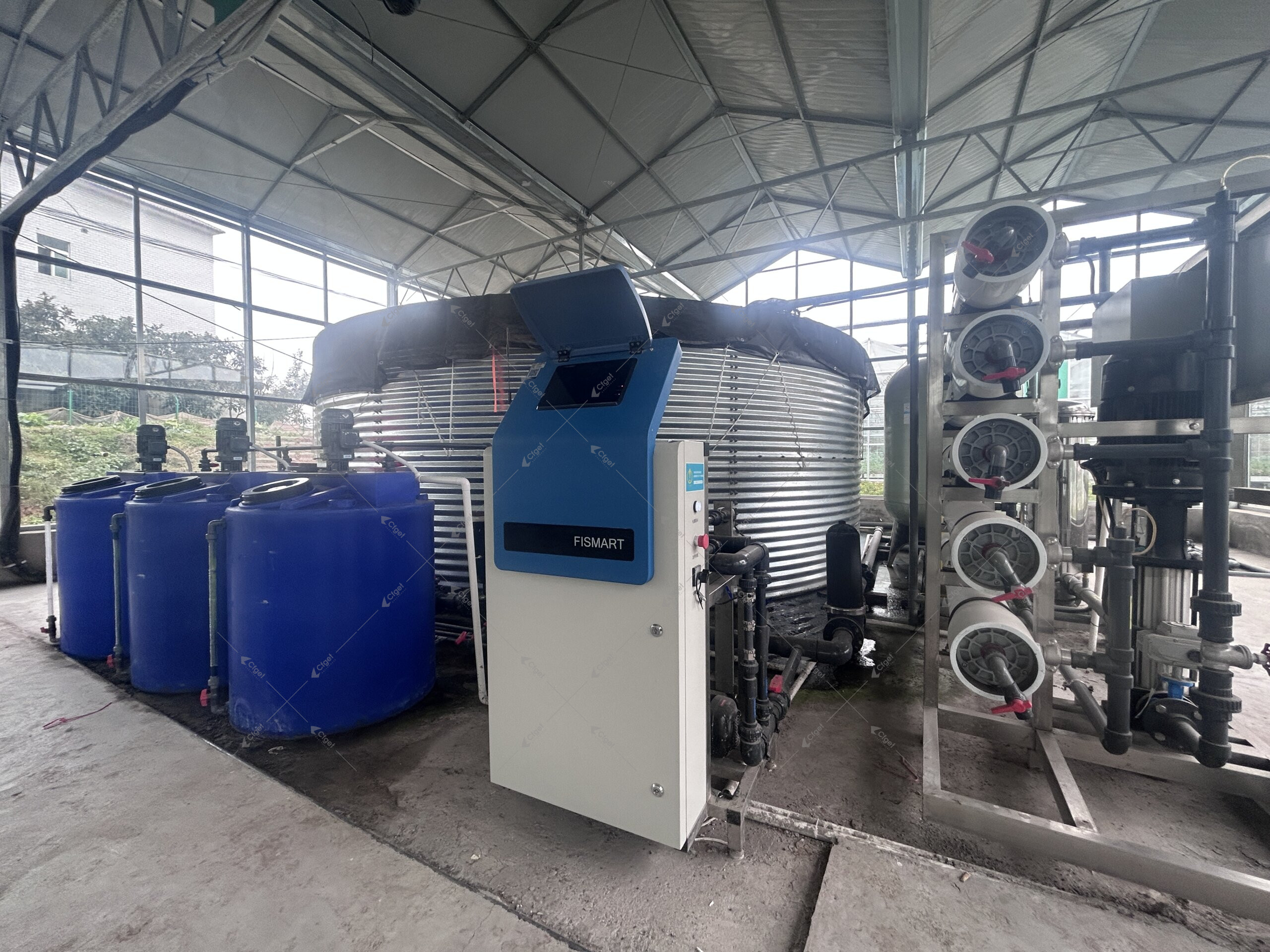
At 00:14.40, the video shows a utility space containing pressure vessels, pumps, pipework and an electrical or control enclosure. At 00:28.60, flow meters and pressure gauges are visible. At 00:40.40, the view includes several fertilizer or mixing tanks and a larger corrugated storage tank.
The narration mentions:
- filtration and fertilization;
- return-water disinfection or treatment;
- pH and EC control;
- mixing ratios for different fertilizers.
Those are direct spoken statements. The images support the presence of water and dosing hardware.
The footage does not identify the filter media, disinfection technology, tank capacities, dosing accuracy, recirculation proportion or control sequence. Calling it a closed-loop or fully automated system would go beyond the evidence.
Recommended image caption: `The site’s water and fertigation utility room, with pressure vessels, pipework and control equipment.`
Recommended alt text: `Irrigation filtration vessels, pipes and control equipment at the CFGET Chengdu blueberry site`
One spoken cost should stay out of the project budget
At the beginning, the speaker says the small utility house behind her is “worth $300,000.” The video does not define the currency date, included equipment, installation scope or whether the statement covers systems outside the building.
For that reason, this article does not use the number as a project cost. A buyer should only compare it after CFGET confirms:
- bill of equipment;
- civil and electrical work;
- treatment and dosing capacity;
- installation and commissioning;
- freight, duties and local work;
- date and currency basis.
This is the same scope discipline recommended in the blueberry greenhouse investment checklist.
What the footage suggests to investigate
The following points are professional interpretations. They are questions for project records, not established facts.
| Visible or spoken observation | Reasonable technical question | Evidence still needed |
| Several dosing channels are visible | Are stock solutions injected separately? | Piping diagram, injector count and dosing logic |
| Green pressure vessels appear in the utility room | What filtration or treatment stage do they serve? | Equipment data sheet and process schematic |
| Containers receive individual tubes or stakes | How uniform is delivery across the block? | Catch test, pressure map and emitter specification |
| Side openings and mesh are visible | How much passive ventilation remains with screens installed? | Net free area, pressure drop and climate results |
| Dark overhead material appears in some views | Is it a shade system? | Product specification, position and control sequence |
| Return-water treatment is mentioned | How is drainage collected, treated and reused? | Drainage map, treatment validation and water balance |
This distinction matters. An image can reveal what to ask, even when it cannot answer the question.
Professional grower note
During a site visit, take the same camera route while logging current sensor readings, valve states and irrigation zones. The footage then becomes an operating record rather than a visual tour.
The system-integration lesson
The speaker says the greenhouse is a protective shell and emphasizes filtration, fertilization, return water, pH and EC. The statement should not be read as “the structure is unimportant.” The footage itself shows why the parts depend on each other.
- Openings affect heat and humidity around the crop.
- Climate affects irrigation demand.
- Containers limit the root volume available to buffer mistakes.
- Water treatment and dosing influence emitter reliability and root chemistry.
- Drainage design determines whether water leaves, accumulates or can be considered for reuse.
- Controls matter only when sensors and operating responses represent the crop.
This is the useful CFGET project planning insight: scope the structure, root zone, water path and control logic as one operating system. Do not claim performance until the records show it.
What the video cannot answer
The supplied material does not confirm:
| Missing information | Why a project reader needs it |
| Total growing area and house count | Scale, zoning and capital boundary |
| Cultivar and plant age | Chill, bloom, crop stage and expected growth |
| Yield and pack-out | Biological and commercial performance |
| Container and substrate specification | Root-zone design |
| Source-water analysis | Treatment and fertigation basis |
| Irrigation frequency and drainage | Water balance and oxygen risk |
| Actual pH and EC data | Operating result |
| Temperature, RH, VPD and light | Climate performance |
| Design loads and code | Structural suitability |
| Equipment capacities | System performance boundary |
| Degree of automation | Labour, alarms and failure response |
These are not flaws in a short video. They are the data needed before the video can become a full agronomic or financial case study.
How a buyer can use this site example
Use the time-coded frames to prepare questions in four workstreams.
Crop and root zone
- cultivar, plant age and crop calendar;
- container geometry and substrate tests;
- emitter layout and uniformity;
- drainage and root-zone sampling.
Greenhouse environment
- local loads and covering;
- vent and screen calculations;
- shade and cooling sequence;
- sensor locations and climate maps.
Water and fertilizer
- source-water report;
- process and piping diagram;
- filter and treatment design;
- dosing range, pH and EC verification;
- return-water collection and validation.
Operation and evidence
- staff roles and training;
- alarm and failure logs;
- harvest and pack-out records;
- maintenance and calibration;
- changes made after crop observations.
The blueberry irrigation and fertigation guide provides the monitoring method. The RFQ checklist turns these questions into supplier documents.
About this review
Coraline Liao, CEO of CFGET, reviewed this page with attention to the boundary between direct site evidence and professional interpretation. Her public LinkedIn profile describes her as a Greenhouse Technical Director with more than 15 years in the greenhouse industry.
The CFGET Project Planning Team completed the technical review. Cited research, direct observations from CFGET’s Chengdu footage and professional interpretation are kept separate. Local crop advisers, laboratories, engineers and authorities must confirm decisions that depend on cultivar, site or regulation.
Project video: greenhouse project reference
This field video gives a quick project visual to read beside the specifications and RFQ checklist.
Frequently asked questions
Does the video prove that the Chengdu system increases yield?
No. It shows fruiting plants, harvest activity and installed systems. A yield comparison needs area, plant count, cultivar, crop age, harvest records, pack-out and a valid baseline.
Is the crop grown hydroponically?
The footage shows plants in containers with individual irrigation lines. It does not show the substrate recipe or justify a more specific label.
Is the return water fully recycled?
The narration mentions return-water treatment. The collection system, treatment validation, reuse proportion and discharge route are not visible.
Is the greenhouse fully automated?
Control hardware and a suspended display are visible, but the footage does not define controlled functions, sensor coverage, algorithms or operator interventions.
Your next action
Use this case as an evidence checklist:
1. mark each feature you can see in the time-coded footage;
2. write the technical question that feature raises for your site;
3. request the calculation, data sheet or operating record that answers it;
4. label any remaining statement as an assumption;
5. keep cost, yield and performance out of the comparison until the scope matches.
For a CFGET review, send the site climate, water analysis, cultivar plan, target harvest period and expected growing system through the project contact form. The discussion can then move from visible equipment to the evidence your project actually needs.