Size greenhouse dehumidification from an hourly moisture balance at the required air condition. Include crop transpiration, irrigation and surfaces, ventilation or infiltration, screens, equipment capacity curves, sensible heat, airflow distribution, condensate, controls, and energy use.
*By Coraline Liao, CEO, CFGET | Updated: September 16, 2026*
*Reviewed by CFGET Project Planning Team*
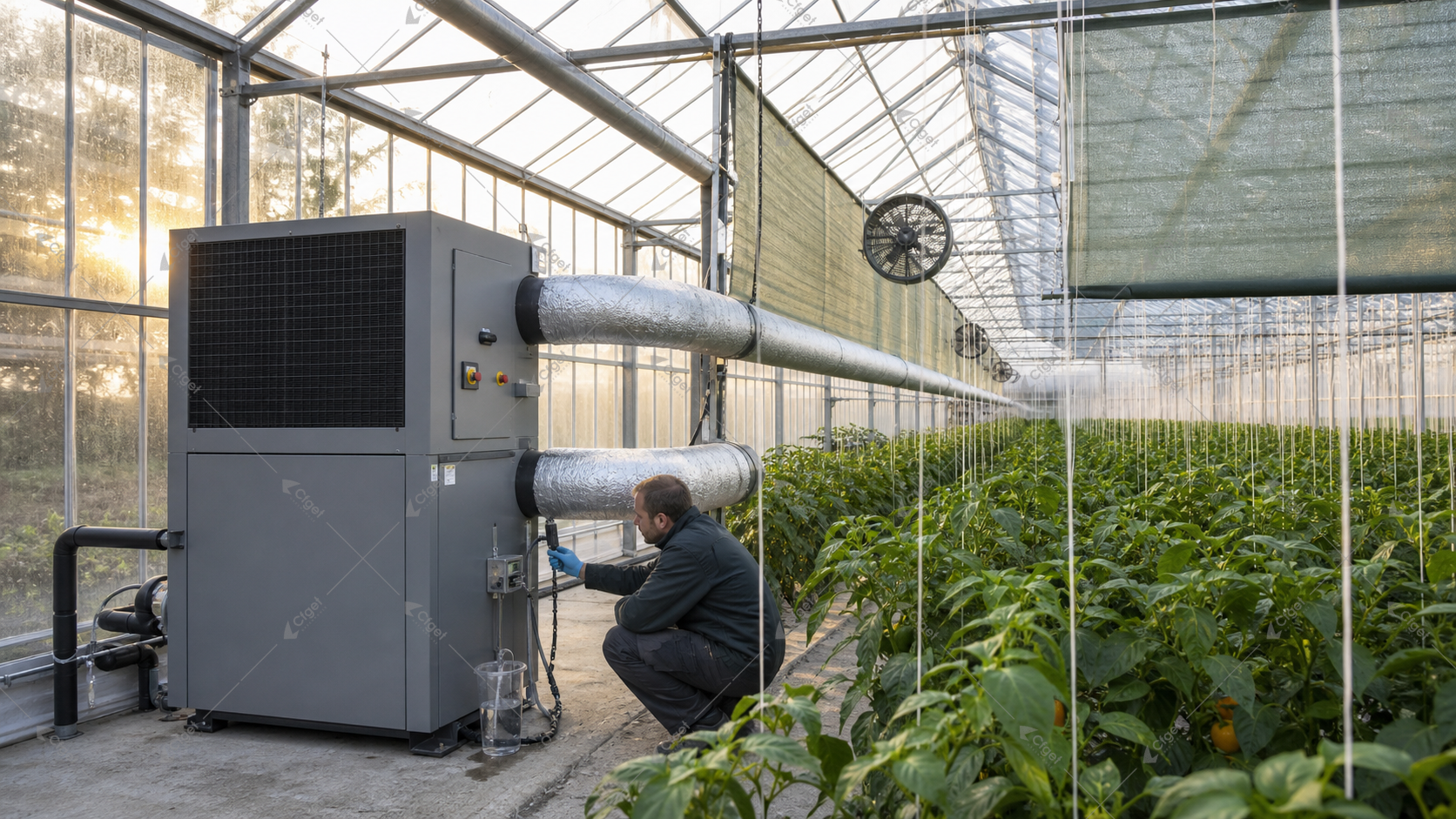
A dehumidifier cannot be selected from greenhouse floor area alone. Moisture production changes with canopy size, irrigation, light, screens, temperature, infiltration, and the hours when vents are deliberately closed, while equipment capacity changes with entering-air conditions.
Use this with our Commercial Greenhouse Buying Guide topic cluster. For a full project, keep it beside Commercial Greenhouse Solutions so the structure, systems, and crop plan do not drift apart.
Quick answer
- Define the hours and weather cases when passive venting cannot meet the humidity target without unacceptable heat or CO2 loss.
- Use crop-stage and lighting assumptions to estimate moisture generation; floor area is not a moisture load.
- Read capacity and power at the expected entering temperature and humidity, not only the catalogue maximum.
- Coordinate supply air, screens, heating, vents, condensate drainage, defrost, alarms, and fallback operation as one sequence.
Key facts worth checking
| Sizing input | What to establish | Evidence |
| Moisture | Crop stage, transpiration, irrigation, wet surfaces, and infiltration | Hourly mass-balance cases |
| Equipment | Capacity and power at entering conditions, defrost, and turndown | Manufacturer performance map |
| Distribution | Zone airflow, screen position, crop density, condensate, and controls | Layout and integrated sequence |
How I would make this decision on a real project
I would reconstruct the worst closed-house moisture period, compare it with the unit performance map, then trace air and condensate through every zone while checking heat release, controls, service access, fallback modes, and the measured crop-zone result.
Field notes to check before the quote
- I would start with the closed-screen pre-dawn case and a wet outside-air case because both can expose a system selected from favourable nominal data.
- A unit may remove the rated water yet leave flowers or dense canopy wet if dry air short-circuits above the crop.
- Recovered sensible heat can reduce heating demand in one season and create a cooling penalty in another, so the heat has to stay in the hourly balance.
Buyer checkpoint
| Buyer question | What to decide before requesting a price | Why it protects the project |
| Design basis | Moisture: Crop stage, transpiration, irrigation, wet surfaces, and infiltration | Hourly mass-balance cases |
| Difficult operating case | Equipment: Capacity and power at entering conditions, defrost, and turndown | Manufacturer performance map |
| Acceptance evidence | Distribution: Zone airflow, screen position, crop density, condensate, and controls | Layout and integrated sequence |
Evidence pack
Use the following evidence to challenge the design basis. A checklist item is useful only when the supplier attaches a value, drawing, calculation, test, or named responsibility.
Climate and project assumptions to confirm
- Confirm the project-specific control case: Closed screen before dawn at full canopy. State who verifies it and when.
- Confirm the project-specific moisture load: Sources and kilograms of water per hour. State who verifies it and when.
- Confirm the project-specific entering air: Temperature and humidity at unit inlet. State who verifies it and when.
Sources worth checking
- Rutgers environmental control of greenhouses guide
- UConn commercial greenhouse design resource
- UMass greenhouse selection and building resource
Neutral source to keep beside the quote
CFGET project planning note
CFGET’s review would begin by reconciling crop stage, transpiration, irrigation, wet surfaces, and infiltration with hourly mass-balance cases, then marking every unresolved interface on the drawings and responsibility matrix.
Buyer risk signal
Pause the comparison when capacity is selected per square metre; only a maximum litres-per-day value is shown; or dry air returns directly to the unit.
Ask the supplier for these exact specs
Require a completed response for Control case, Moisture load, Entering air, Acceptance, supported by the relevant drawings, calculations, settings, or test records. Do not accept “standard” or “as required” where a project value can be stated.
Project video: greenhouse climate control in practice
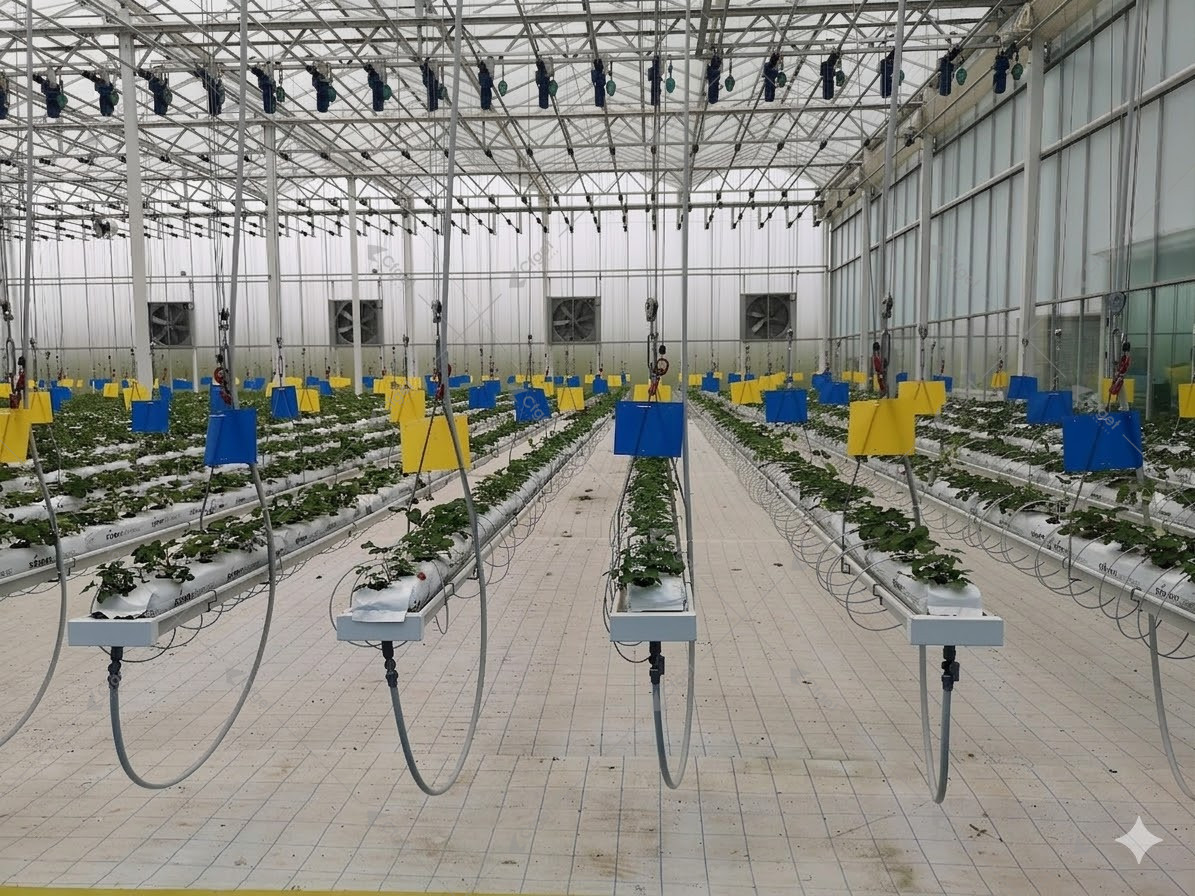
This field video shows a greenhouse climate system in use, which helps buyers check whether the quoted equipment matches the site conditions.
What moisture load must the dehumidifier remove?
Define the control problem before choosing equipment. State indoor temperature and humidity or dew-point limit, outside conditions, screen and vent position, crop area and stage, lighting, irrigation timing, and the duration of the event.
Build a water-vapour balance for each controlling period. Include crop release, wet floors or pads, open tanks, combustion where applicable, leakage, deliberate outdoor-air exchange, and moisture removed by the proposed system. Keep assumptions visible because crop transpiration is not constant.
Technical reference for this decision: University of Arizona sustainable greenhouse systems guide.
How do capacity, heat release, and air distribution affect selection?
Compare units at the entering dry-bulb temperature and humidity they will actually see. Capacity, electrical input, defrost behaviour, condensate temperature, and useful heat release can differ significantly from headline values.
Place air so it crosses the occupied crop zone without creating damaging jets or bypassing below a closed screen. Duct pressure, fan energy, filtration, service clearance, noise, drain traps, freeze protection, and safe cleaning all belong in the installed selection.
Technical reference for this decision: Rutgers environmental control of greenhouses guide.
| Check | Good sign | Risk sign |
| Load | Hourly moisture sources and control cases are stated | Capacity is selected per square metre |
| Performance | Capacity and power match entering conditions | Only a maximum litres-per-day value is shown |
| Distribution | Crop-zone airflow and screens are coordinated | Dry air returns directly to the unit |
What to request from a supplier
Ask for the moisture-balance cases, crop and lighting assumptions, indoor and outdoor design conditions, equipment capacity and power curves, heat release, airflow and duct layout, screen interaction, condensate route, filtration, defrost, controls, alarms, redundancy, service access, and witnessed trend test.
Which operating tests prove dehumidification in the crop zone?
Commission under at least two representative loads. Trend indoor and outdoor temperature, humidity or dew point, unit inlet and outlet, condensate volume, power, fan state, screen and vent position, heating, irrigation, and crop-zone variation.
Test sensor failure, high condensate level, blocked filter, defrost, communication loss, power restoration, and manual operation. Acceptance should use a stated starting moisture condition and load period rather than an empty-house demonstration.
Technical reference for this decision: UConn commercial greenhouse design resource.
| RFQ field | Example | Why it matters |
| Control case | Closed screen before dawn at full canopy | Defines the difficult hour |
| Moisture load | Sources and kilograms of water per hour | Sets required removal |
| Entering air | Temperature and humidity at unit inlet | Sets real capacity and power |
| Acceptance | Crop-zone dew-point trend and condensate measurement | Proves installed performance |
Practical next step
Prepare one page covering Control case, Moisture load, Entering air, Acceptance. Add the project city, crop, greenhouse area, available utilities, relevant drawings, and the party responsible for local work. Send that evidence to [email protected] for a first technical-scope review.
Before you use this recommendation
- Treat the article as a decision and RFQ guide, not a final engineering design.
- Replace every example with project-specific climate, crop, utility, code, and operating data.
- Require calculations, drawings, test records, or named assumptions for every important supplier claim.
How this guide was prepared
This guide combines the current search evidence listed above with a greenhouse project planning checklist: define the failure case, trace the interfaces, identify measurements, and turn unresolved assumptions into RFQ fields. CFGET observations are labeled as project-review judgment; local engineering and operating data remain the final authority.
Coraline Liao is CEO of CFGET. Her public LinkedIn profile describes her as a Greenhouse Technical Director with more than 15 years in the greenhouse industry, focused on customized climate-control and greenhouse solutions. Her published technical topics include greenhouse structures, climate control, light management, hydroponics, and fertigation. Her article reviews begin with the crop, climate, site, project scope, installation boundaries, and operating constraints. Technical recommendations should be adapted to local climate data, crop plans, budgets, and professional engineering review before implementation.
Professional profile: Coraline Liao on LinkedIn
Company details
CFGET: Founded in 1996, CFGET designs, manufactures, and delivers greenhouse systems and smart farming solutions from its own factory in Sichuan, China.
Address: NO 108, South Area Chengdu Modern Industrial Park, Sichuan, China
Email: [email protected]
About the company: https://cfgreenway.com/about/
Company profile: GreenWay on LinkedIn
Technical videos: Greenhouse project channel on YouTube
Where this fits in the greenhouse buying cluster
Start with the hub, then open the system or crop pages that match your decision.
- Commercial Greenhouse Buying Guide
- Commercial Greenhouse Solutions
- Greenhouse Climate Control
- Greenhouse Humidity Control
- Smart Greenhouse Control
- Greenhouse Project Cases