Skip to content
A greenhouse maintenance schedule should be risk based. Link the asset register to crop consequence, failure modes, inspection and service tasks, condition limits, safe isolation, frequency, season, skills, tools, spares, records, alarms, and planned shutdown windows.
*By Coraline Liao, CEO, CFGET | Updated: September 13, 2026*
*Reviewed by CFGET Project Planning Team*
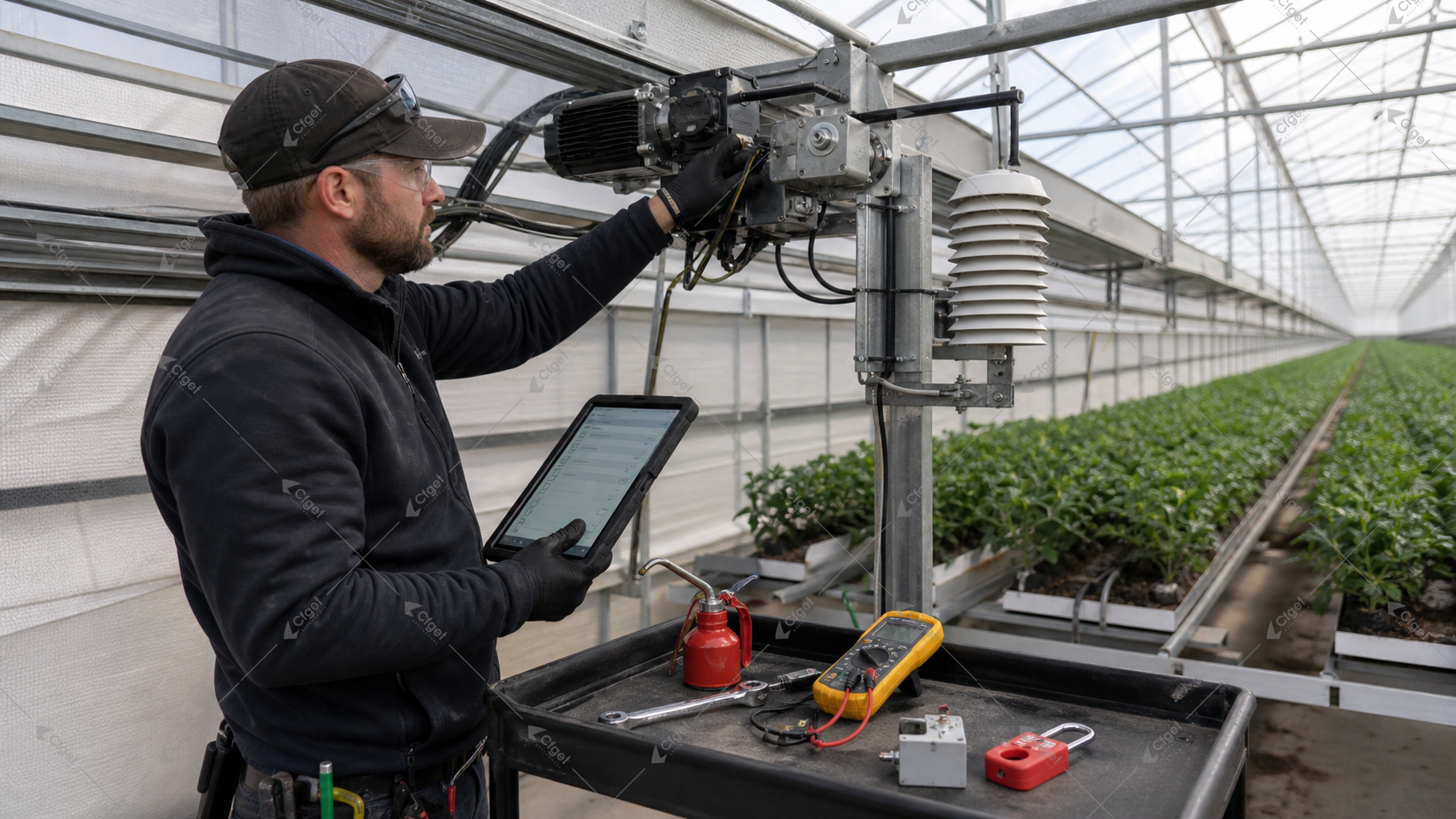
A calendar full of weekly and monthly tasks is not yet a maintenance plan. The schedule must connect each asset to crop consequence, failure mode, safe isolation, task method, skill, spare part, acceptable condition, record, and a production window when the work can actually be done.
Use this with our Commercial Greenhouse Buying Guide topic cluster. For a full project, keep it beside Commercial Greenhouse Solutions so the structure, systems, and crop plan do not drift apart.
What matters before a supplier quotes?
- Tag structures, covers, vents, screens, fans, heating, cooling, irrigation, dosing, water treatment, electrical, controls, sensors, alarms, drainage, and safety equipment.
- Rank each failure by crop consequence, safety, environmental impact, repair lead time, and whether a manual fallback exists.
- Write tasks with a method, safe isolation, acceptance limit, skill, tool, consumable, spare, estimated time, and required record.
- Schedule high-risk work before critical weather and crop stages, then use inspection trends and failures to adjust intervals.
Key facts worth checking
| Planning input | What to establish | Evidence |
| Asset and duty | Tag, function, operating hours, environment, and critical zones | Asset register and drawings |
| Failure and task | Failure mode, consequence, method, limit, frequency, and fallback | Maintenance job plan |
| Resources | Skill, isolation, tools, spares, access, time, and record | Annual plan and work history |
The order I would check the project
I would trace each critical crop function to its assets, rank credible failures, convert vague maintenance verbs into measurable job plans, place them around weather and production windows, then use readings, alarms, backlog, and failures to revise the schedule.
Details I would challenge in the offer
- I would align roof, vent, cooling, and drainage work with the local storm and hot-season calendar rather than giving every site the same month number.
- A task such as check pump is unusable; the technician needs to know which pressure, current, vibration, seal condition, alarm, and acceptable change to record.
- The backlog deserves a crop-risk review every week because a small deferred alarm, sensor, valve, or drain fault can combine with the next failure.
Buyer checks before price comparison
| Buyer question | What to decide before requesting a price | Why it protects the project |
| Design basis | Asset and duty: Tag, function, operating hours, environment, and critical zones | Asset register and drawings |
| Difficult operating case | Failure and task: Failure mode, consequence, method, limit, frequency, and fallback | Maintenance job plan |
| Acceptance evidence | Resources: Skill, isolation, tools, spares, access, time, and record | Annual plan and work history |
Evidence pack
Use the following evidence to challenge the design basis. A checklist item is useful only when the supplier attaches a value, drawing, calculation, test, or named responsibility.
Climate and project assumptions to confirm
- Confirm the project-specific critical function: Ventilation available through the hottest period. State who verifies it and when.
- Confirm the project-specific job plan: Method, measurement, limit, skill, tool, and spare. State who verifies it and when.
- Confirm the project-specific timing: Hours, cycles, condition, and pre-season window. State who verifies it and when.
Sources worth checking
- University of Florida greenhouse equipment maintenance guide
- UConn commercial greenhouse design resource
- UMass greenhouse selection and building resource
Neutral source to keep beside the quote
CFGET project planning note
CFGET’s review would begin by reconciling tag, function, operating hours, environment, and critical zones with asset register and drawings, then marking every unresolved interface on the drawings and responsibility matrix.
Buyer risk signal
Pause the comparison when only major equipment appears in the schedule; the task says inspect or service as needed; or completed checkboxes are the only metric.
Ask the supplier for these exact specs
Require a completed response for Critical function, Job plan, Timing, Closeout, supported by the relevant drawings, calculations, settings, or test records. Do not accept “standard” or “as required” where a project value can be stated.
Project video: greenhouse project reference
This field video gives a quick project visual to read beside the specifications and RFQ checklist.
Which greenhouse assets need preventive or condition-based maintenance?
Begin with an asset register that matches installed drawings and control tags. Include structural and envelope items as well as mechanical and electrical equipment, instruments, software, communications, drainage, water storage, and safety systems.
For each asset, identify loss of function, hidden deterioration, likely causes, crop and safety consequence, detectability, repair lead time, redundancy, and manual fallback. Use that ranking to decide preventive, condition-based, functional-test, run-to-failure, or redesign action.
Technical reference for this decision: Checklist for Greenhouse, Garden Center, and Nursery….
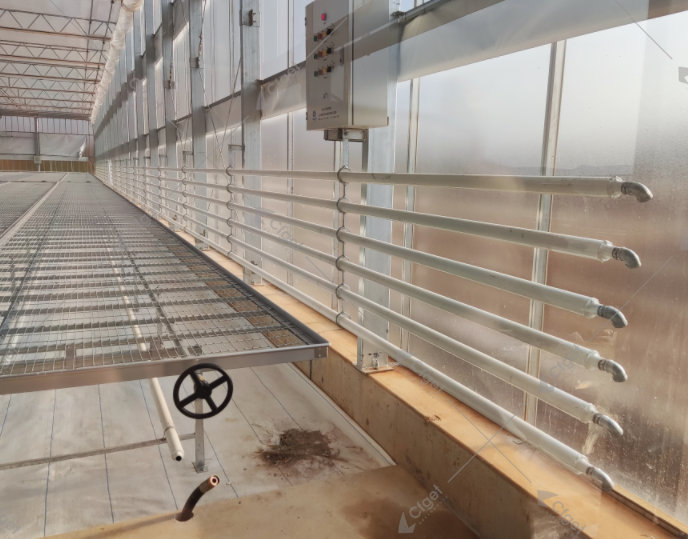
How should task frequency follow season, duty, and crop risk?
Set frequency from operating hours, starts, movement cycles, water and chemical exposure, dust, weather, manufacturer limits, inspection history, and the crop calendar. Pre-season checks should precede heat, cold, storm, or planting risk rather than follow an arbitrary anniversary.
Coordinate work windows with irrigation, spraying, harvest, blackout, biosecurity, and occupied areas. The job plan should include lockout or isolation, access equipment, task steps, measurements, acceptance limits, reset, functional test, housekeeping, and release to operations.
Technical reference for this decision: University of Florida greenhouse equipment maintenance guide.
| Check | Good sign | Risk sign |
| Scope | The asset register matches installed tags and drawings | Only major equipment appears in the schedule |
| Task | Method, limit, skill, spare, and functional test are stated | The task says inspect or service as needed |
| Improvement | Condition and failure trends change the plan | Completed checkboxes are the only metric |
What to request from a supplier
Ask for the asset register, criticality and failure-mode review, manufacturer requirements, annual seasonal plan, detailed job plans, isolation methods, access and safety needs, tools, calibration standards, consumables, critical spares, acceptance limits, functional tests, software and settings backup, work-order records, backlog review, and reliability indicators.
What records turn maintenance into a reliability system?
Record readings and condition, not only a completed checkbox. Pressure, current, movement time, differential pressure, calibration error, corrosion area, leak rate, alarm delay, and photographs can show deterioration before failure.
Review overdue tasks, repeat faults, emergency work, spares use, alarm history, downtime, and seasonal findings. Update intervals and job plans when evidence changes; maintain controlled copies of manuals, settings, drawings, software backups, and supplier contacts.
Technical reference for this decision: UConn commercial greenhouse design resource.

| Plan field | Example | Why it matters |
| Critical function | Ventilation available through the hottest period | Connects work to crop risk |
| Job plan | Method, measurement, limit, skill, tool, and spare | Makes the task executable |
| Timing | Hours, cycles, condition, and pre-season window | Sets a defensible interval |
| Closeout | Reading, defect action, test, and release | Creates usable history |
Practical next step
Prepare one page covering Critical function, Job plan, Timing, Closeout. Add the project city, crop, greenhouse area, available utilities, relevant drawings, and the party responsible for local work. Send that evidence to [email protected] for a first technical-scope review.
Before you use this recommendation
- Treat the article as a decision and RFQ guide, not a final engineering design.
- Replace every example with project-specific climate, crop, utility, code, and operating data.
- Require calculations, drawings, test records, or named assumptions for every important supplier claim.
How these recommendations were assembled
This guide combines the current search evidence listed above with a greenhouse project planning checklist: define the failure case, trace the interfaces, identify measurements, and turn unresolved assumptions into RFQ fields. CFGET observations are labeled as project-review judgment; local engineering and operating data remain the final authority.
Coraline Liao is CEO of CFGET. Her public LinkedIn profile describes her as a Greenhouse Technical Director with more than 15 years in the greenhouse industry, focused on customized climate-control and greenhouse solutions. Her published technical topics include greenhouse structures, climate control, light management, hydroponics, and fertigation. Her article reviews begin with the crop, climate, site, project scope, installation boundaries, and operating constraints. Technical recommendations should be adapted to local climate data, crop plans, budgets, and professional engineering review before implementation.
Professional profile: Coraline Liao on LinkedIn
Company details
CFGET: Founded in 1996, CFGET designs, manufactures, and delivers greenhouse systems and smart farming solutions from its own factory in Sichuan, China.
Address: NO 108, South Area Chengdu Modern Industrial Park, Sichuan, China
Email: [email protected]
About the company: https://cfgreenway.com/about/
Company profile: GreenWay on LinkedIn
Technical videos: Greenhouse project channel on YouTube
Where this fits in the greenhouse buying cluster
Start with the hub, then open the system or crop pages that match your decision.
- Commercial Greenhouse Buying Guide
- Commercial Greenhouse Solutions
- Choose Greenhouse Supplier
- Project Enquiry
- Technical Downloads
- Greenhouse Project Cases