A dark patch on the bottom of a tomato can send a grower straight to the fertilizer store. But blossom-end rot can develop even when the root zone contains calcium. The useful question is not only how much calcium is present; it is whether enough reached the expanding fruit when it was needed.
Blossom-end rot is a physiological disorder, not a contagious disease by itself. Confirm the symptom and investigate water delivery and root function before raising fertilizer concentration. Secondary decay can complicate the appearance, so uncertain or spreading lesions deserve professional diagnosis.
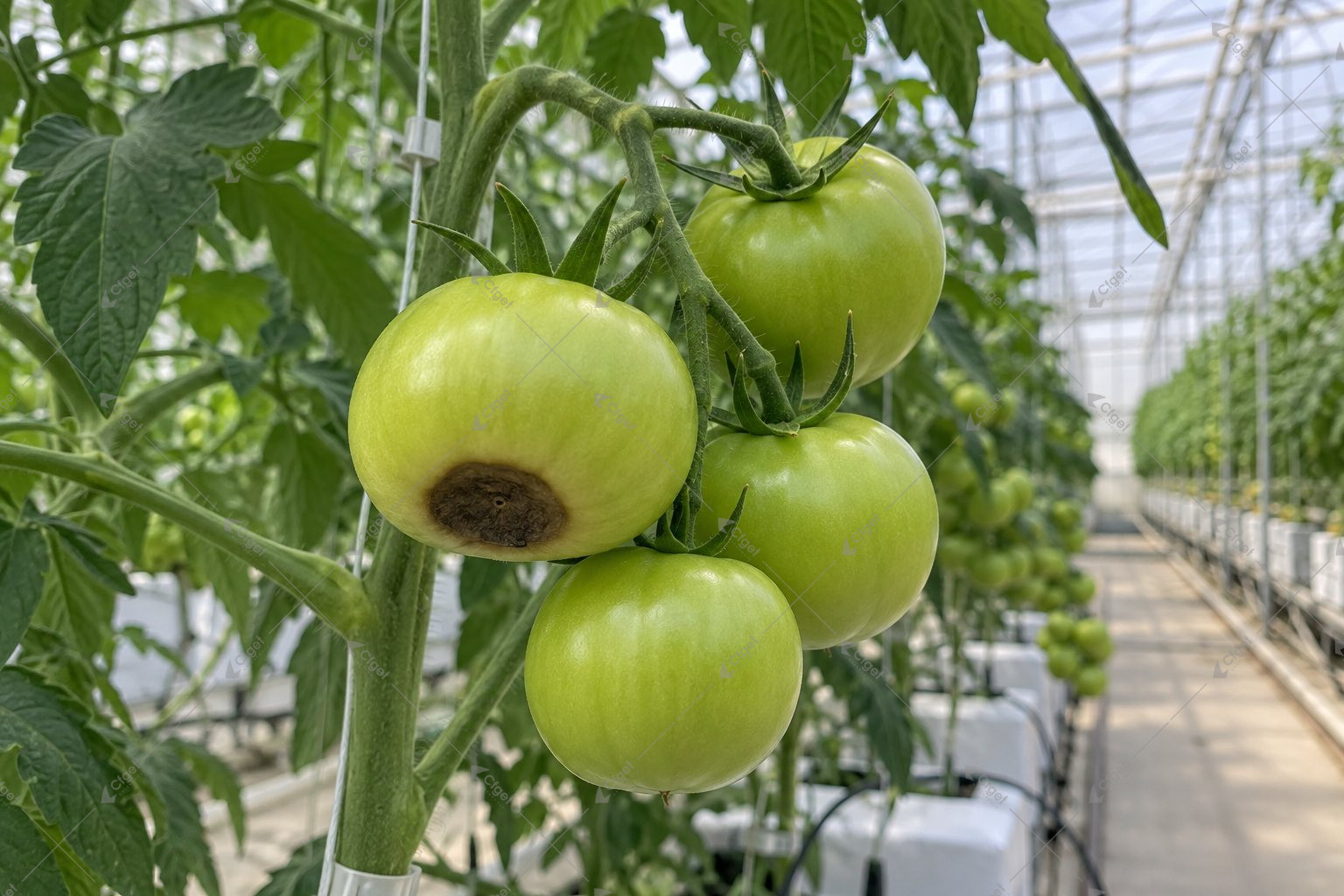
Check the location and the history
The blossom end is opposite the fruit’s stem attachment. Record the position and texture of the lesion, the truss affected and the number of affected fruits relative to those inspected. Compare the same variety and similar fruit stages in another row. The University of Minnesota tomato fruit diagnostic guide shows why lesion location matters when separating blossom-end rot from other fruit problems.
The damage visible today may reflect conditions earlier in fruit development. Review the period before symptoms became obvious, not only this morning’s climate screen. Include a stopped pump, blocked emitter, unusual drying cycle or change in nutrient stock preparation in the timeline.
Follow water from the tank to the fruit
Minnesota Extension’s irrigation guidance links blossom-end rot with moisture fluctuations and notes that it is not necessarily caused by low soil calcium. That principle is a starting point for investigation; its field-soil irrigation schedules should not be transferred directly to a greenhouse substrate slab.
| Checkpoint | Measure or observe | A misleading shortcut |
|---|---|---|
| Feed preparation | Stock recipe, injector ratio, source and delivered solution | Assuming the programmed EC proves the correct ion balance |
| Distribution | Timed output at representative emitters and pressure by zone | Using the pump runtime as proof every plant was irrigated |
| Root zone | Moisture trend, drainage behavior and root condition | Calling a wet surface evidence that roots are adequately supplied |
| Crop response | Variety, fruit stage, load and location of affected plants | Treating a greenhouse average as the experience of every plant |
More water and more calcium are not equivalent corrections
A dry pocket caused by an underperforming emitter needs a delivery correction. Extending every irrigation event may leave other plants unnecessarily wet. A root zone that is already poorly aerated requires a different response from a genuinely dry one. Check the roots and the distribution pattern before changing the whole house.
Likewise, EC measures total conductivity, not calcium concentration. A normal EC cannot confirm the correct formulation, while adding a calcium fertilizer changes more than one property of the solution. Have a crop adviser interpret water, feed and root-zone analyses together when a nutritional imbalance is suspected. Do not mix incompatible concentrated products to improvise a rapid correction.
Track the next fruit, not the scar
Established lesions do not heal into marketable fruit. After an intervention, label the date and track subsequently developing fruit by truss or cohort. Record the affected fraction, marketable yield and any new root or foliage symptoms. A later improvement supports a farm decision but does not prove a single cause if several settings changed together.
A practical comparison is to inspect the same defined number of fruit in marked areas on each visit. Keep the sampling rule stable. Reporting five damaged fruit without the number examined cannot show whether the problem is improving as harvest volume changes.
The next useful action
Before adjusting the recipe, run a timed emitter-delivery check and confirm that your substrate EC results use comparable methods. Bring the findings, crop map and symptom timeline to your agronomist. If distribution or drainage is the constraint, that same evidence gives CFGET a concrete basis for reviewing irrigation zoning or growing-system layout without promising that a new structure alone will prevent the disorder.