Choose greenhouse shade percentage from measured or modelled crop light and heat limits, not a universal crop table. Use outside radiation, roof transmission, screen spectral data, DLI, crop stage, ventilation, cooling, screen geometry, control stages, and crop-zone measurements.
*By Coraline Liao, CEO, CFGET | Updated: September 12, 2026*
*Reviewed by CFGET Project Planning Team*
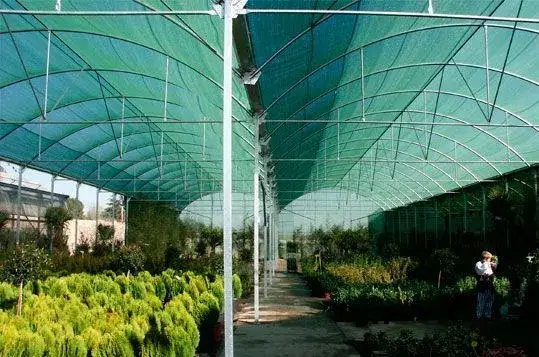
A shade percentage is not a crop recipe. The same nominal number can represent different solar, PAR, diffusion, ventilation, and energy behaviour, while the acceptable light reduction changes with crop stage, season, latitude, roof transmission, and cooling capacity.
Use this with our Commercial Greenhouse Buying Guide topic cluster. For a full project, keep it beside Commercial Greenhouse Solutions so the structure, systems, and crop plan do not drift apart.
Quick answer
- Ask whether the quoted value refers to solar energy, PAR, visible light, or a test method; these numbers are not interchangeable.
- Calculate the crop-plane light and DLI with the installed roof, structure, dirt, screen, and expected deployment hours.
- Check the heat and ventilation consequence of closing the screen, including hot-air escape and interaction with roof vents or evaporative cooling.
- Use staged control from radiation, temperature, crop stress, wind, and time limits, then tune it with crop-plane sensors and observations.
Key facts worth checking
| Shade input | What to establish | Evidence |
| Crop light | PAR, DLI, photoperiod, stage, and stress limits | Crop plan and crop-plane measurements |
| Envelope | Roof and structure transmission, dirt, screen spectral properties | Installed optical calculation |
| Climate | Solar heat, vents, cooling, wind, humidity, and control hours | Hourly operating cases |
How I would make this decision on a real project
I would reconstruct the crop’s difficult light-and-heat hours, calculate installed transmission through every layer, compare staged screen strategies, then verify crop-plane light, leaf temperature, ventilation, and humidity before fixing the final control thresholds.
Field notes to check before the quote
- I would compare the screen in both fully deployed and partially staged positions because growers rarely operate one static percentage for an entire season.
- A stronger shade may lower peak leaf temperature but also remove useful morning or shoulder-season light, so annual operating hours matter more than the label alone.
- Screen gaps, overlap, roof dirt, structural shadow, and sensor location can make the installed crop light differ from a fabric sample.
Buyer checkpoint
| Buyer question | What to decide before requesting a price | Why it protects the project |
| Design basis | Crop light: PAR, DLI, photoperiod, stage, and stress limits | Crop plan and crop-plane measurements |
| Difficult operating case | Envelope: Roof and structure transmission, dirt, screen spectral properties | Installed optical calculation |
| Acceptance evidence | Climate: Solar heat, vents, cooling, wind, humidity, and control hours | Hourly operating cases |
Evidence pack
Use the following evidence to challenge the design basis. A checklist item is useful only when the supplier attaches a value, drawing, calculation, test, or named responsibility.
Climate and project assumptions to confirm
- Confirm the project-specific optical basis: PAR and total-solar transmission with test method. State who verifies it and when.
- Confirm the project-specific crop target: DLI and leaf-temperature limit by stage. State who verifies it and when.
- Confirm the project-specific operating case: Hot clear afternoon with stated vents and cooling. State who verifies it and when.
Sources worth checking
- Purdue Extension greenhouse temperature-control guide
- UConn commercial greenhouse design resource
- UMass greenhouse selection and building resource
Neutral source to keep beside the quote
CFGET project planning note
CFGET’s review would begin by reconciling par, dli, photoperiod, stage, and stress limits with crop plan and crop-plane measurements, then marking every unresolved interface on the drawings and responsibility matrix.
Buyer risk signal
Pause the comparison when one shade percentage is shown without definition; a crop name determines one fixed percentage; or the screen is simply open or closed at one setpoint.
Ask the supplier for these exact specs
Require a completed response for Optical basis, Crop target, Operating case, Acceptance, supported by the relevant drawings, calculations, settings, or test records. Do not accept “standard” or “as required” where a project value can be stated.
Project video: greenhouse climate control in practice
This field video shows a greenhouse climate system in use, which helps buyers check whether the quoted equipment matches the site conditions.
What does a greenhouse shade percentage actually describe?
Shade percentage may describe reduction in total solar radiation, photosynthetically active radiation, or visible light under a particular test. Request the property, wavelength range, test basis, color, openness, diffusion, and wet or aged condition where relevant.
The installed result includes roof covering, frame shadow, dirt, screen layers, gaps, overlaps, and angle of the sun. Do not subtract percentages casually; model or measure the combined transmission at crop height.
Technical reference for this decision: University of Missouri greenhouse and high-tunnel shading guide.
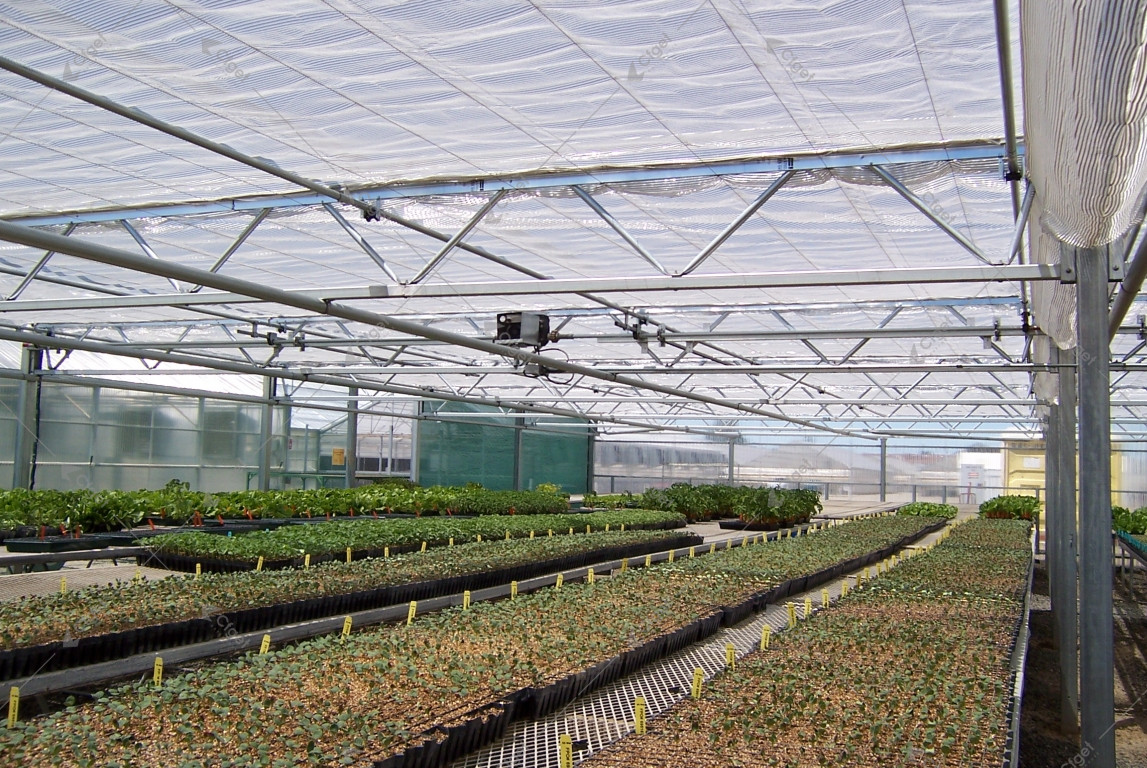
How should crop light targets and cooling limits set the screen choice?
Start with the crop’s useful light window and allowable heat stress by stage. Compare hourly outside radiation with roof and screen transmission, natural or mechanical ventilation, evaporative cooling, leaf temperature, humidity, and water availability.
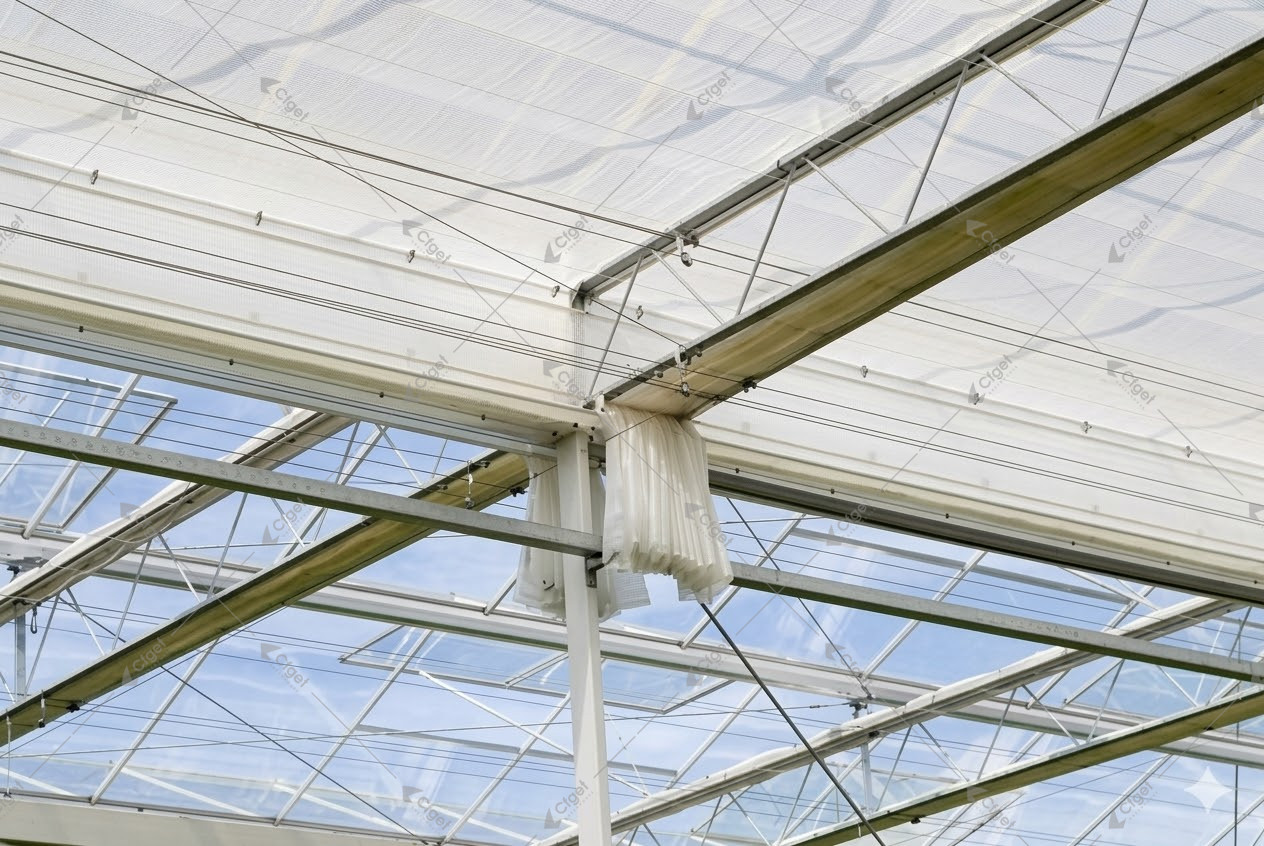
Test several control strategies across the season. A movable screen may deploy only above a radiation threshold, close in stages, retract for useful morning light, or stay partly open for ventilation. The best fabric depends on those operating hours and the consequences of a drive failure.
Technical reference for this decision: Purdue Extension greenhouse temperature-control guide.
| Check | Good sign | Risk sign |
| Property | Spectral property and test basis are named | One shade percentage is shown without definition |
| Crop fit | DLI and heat limits are checked by stage and season | A crop name determines one fixed percentage |
| Control | Staging and climate interactions are commissioned | The screen is simply open or closed at one setpoint |
What to request from a supplier
Ask for screen spectral and thermal data, test methods, roof and structure transmission, crop light and DLI basis, hourly solar and heat cases, vent and cooling interaction, deployment stages, sensor type and location, drive and emergency operation, cleaning, repair, spare parts, and crop-zone acceptance measurements.
Which measurements should tune shade control after installation?
Commission PAR or suitable radiation sensors outside and at representative crop locations. Compare fully open, staged, and closed positions while recording leaf and air temperature, humidity, vent position, cooling, wind, and crop response.
Tune thresholds gradually and keep crop stage visible in the control recipe. Inspect fabric cleanliness, travel, overlap, edge gaps, sensor calibration, and seasonal roof transmission before blaming the nominal shade rating.
Technical reference for this decision: UConn commercial greenhouse design resource.
| RFQ field | Example | Why it matters |
| Optical basis | PAR and total-solar transmission with test method | Defines the quoted percentage |
| Crop target | DLI and leaf-temperature limit by stage | Connects shade to production |
| Operating case | Hot clear afternoon with stated vents and cooling | Tests climate interaction |
| Acceptance | Crop-plane light and temperature in screen stages | Verifies installed performance |
Practical next step
Prepare one page covering Optical basis, Crop target, Operating case, Acceptance. Add the project city, crop, greenhouse area, available utilities, relevant drawings, and the party responsible for local work. Send that evidence to [email protected] for a first technical-scope review.
Before you use this recommendation
- Treat the article as a decision and RFQ guide, not a final engineering design.
- Replace every example with project-specific climate, crop, utility, code, and operating data.
- Require calculations, drawings, test records, or named assumptions for every important supplier claim.
How this guide was prepared
This guide combines the current search evidence listed above with a greenhouse project planning checklist: define the failure case, trace the interfaces, identify measurements, and turn unresolved assumptions into RFQ fields. CFGET observations are labeled as project-review judgment; local engineering and operating data remain the final authority.
Coraline Liao is CEO of CFGET. Her public LinkedIn profile describes her as a Greenhouse Technical Director with more than 15 years in the greenhouse industry, focused on customized climate-control and greenhouse solutions. Her published technical topics include greenhouse structures, climate control, light management, hydroponics, and fertigation. Her article reviews begin with the crop, climate, site, project scope, installation boundaries, and operating constraints. Technical recommendations should be adapted to local climate data, crop plans, budgets, and professional engineering review before implementation.
Professional profile: Coraline Liao on LinkedIn
Company details
CFGET: Founded in 1996, CFGET designs, manufactures, and delivers greenhouse systems and smart farming solutions from its own factory in Sichuan, China.
Address: NO 108, South Area Chengdu Modern Industrial Park, Sichuan, China
Email: [email protected]
About the company: https://cfgreenway.com/about/
Company profile: GreenWay on LinkedIn
Technical videos: Greenhouse project channel on YouTube
Where this fits in the greenhouse buying cluster
Start with the hub, then open the system or crop pages that match your decision.
- Commercial Greenhouse Buying Guide
- Commercial Greenhouse Solutions
- Greenhouse Climate Control
- Greenhouse Humidity Control
- Smart Greenhouse Control
- Greenhouse Project Cases