By Coraline Liao, CEO, CFGET | Reviewed by CFGET Project Planning Team | Updated: July 24, 2026
When a container blueberry turns pale, the quickest explanation is often “the pH is wrong.” That may be true, but it is not a diagnosis. The same canopy can result from wet roots, concentrated salts, uneven emitters, unsuitable source water or a container that no longer drains as it did at planting.
The root zone has to hold water and oxygen at the same time. That is the design problem.
This guide will help you:
- compare containers by geometry and drainage rather than volume alone;
- define the physical properties a substrate must retain through the crop cycle;
- separate water pH from alkalinity and salinity;
- build a repeatable root-zone sampling method.
The complete blueberry greenhouse planning guide shows how this growing-system decision fits with climate, irrigation and project procurement.
Blueberry roots leave little room for a bad water-air balance
Blueberries have fine, shallow roots and do not form the root hairs found on many other crops. Oregon State University Extension explains that most roots occur near the soil surface and that localized drip irrigation can concentrate roots in the wetted zone. See How blueberry plants develop and grow.
In a container, the entire useful root system may sit inside a small managed volume. A dry pocket, blocked outlet or concentrated wet bulb therefore matters quickly.
The operating target is not “keep the pot wet.” It is:
1. replace water the plant and environment have removed;
2. distribute that water through the active root volume;
3. allow excess solution to leave;
4. restore air to the pore space after irrigation;
5. avoid concentrating salts between events.
That sequence connects container, substrate, emitter and drainage design. Changing one part changes the others.
Beginner takeaway
Acid-loving does not mean waterlogged. Blueberry roots still need oxygen, and a low pH reading cannot compensate for poor drainage.
Choose container geometry with the irrigation system
Two containers with the same nominal volume can behave differently. Height changes the balance between drained and saturated zones. Width changes emitter coverage and summer heat exposure. Wall colour and spacing affect root-zone temperature.
Compare candidate containers with this worksheet:
| Design item | What to verify on the crop floor |
| Internal dimensions | Usable height, width and taper, not catalogue litres alone |
| Drain openings | Number, position and resistance to blocking |
| Base support | Whether outlets remain clear above the floor or ground |
| Emitter layout | Wetted pattern across the container at different pulse lengths |
| Stability | Wind, plant size, trellis and worker contact |
| Heat exposure | Edge rows, floor reflection and direct sun on container walls |
| Service life | UV exposure, cleaning, handling and replacement method |
| Drainage capture | Free drainage, collection channel or recirculation boundary |
Run a wetting test before planting a commercial block. Apply a known volume, then open several containers at different positions. Look for dry corners, a narrow saturated column and water that runs down the wall without wetting the centre.
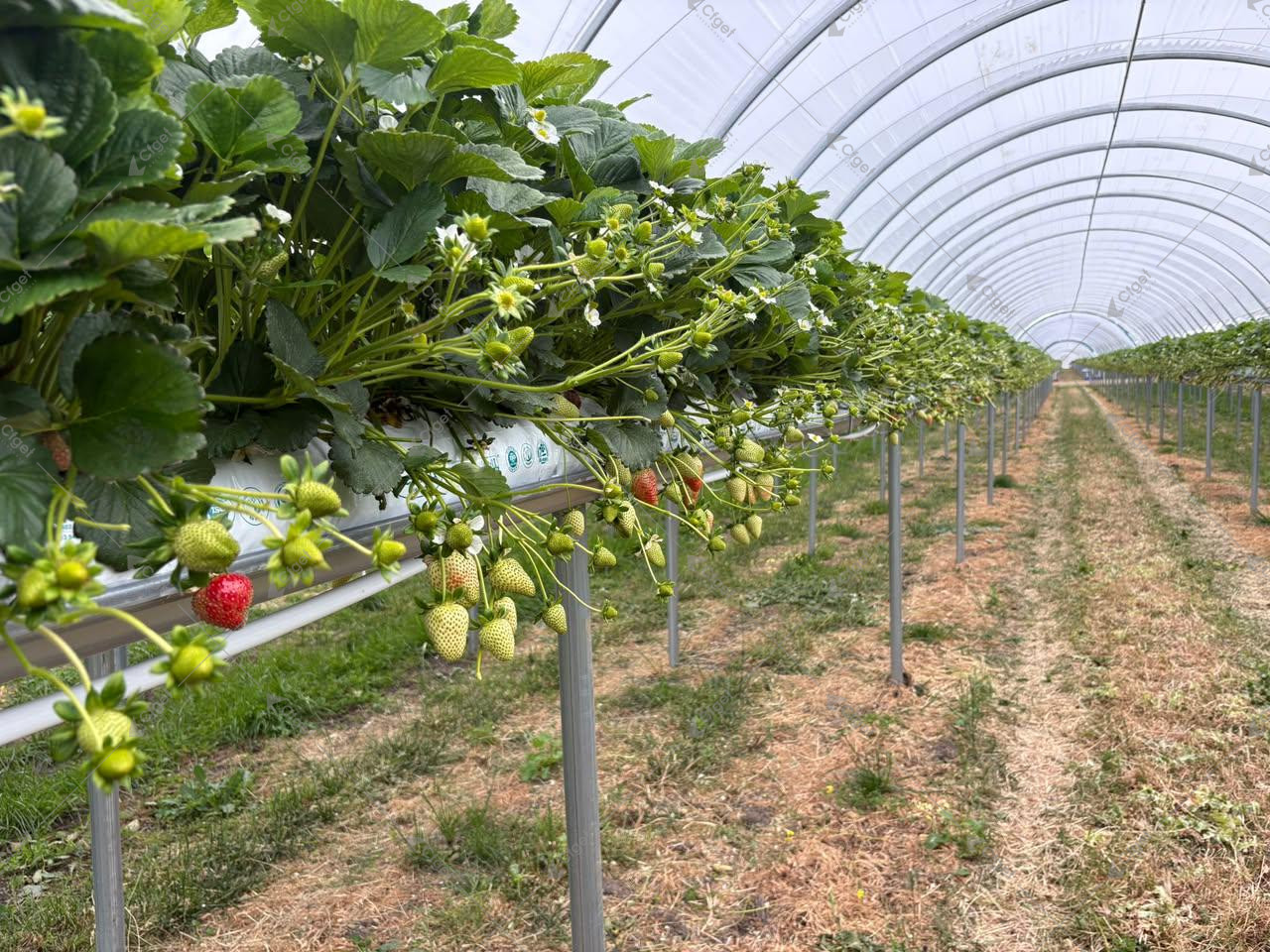
The user-identified CFGET protected blueberry video shows individually irrigated plants in repeated containers. The footage supports the layout observation. It does not identify container volume, substrate, emitter flow or cultivar.
Specify substrate function, not a fixed recipe
A substrate recipe that performs well in one climate may dry too quickly in a hotter, windier structure. The same material can also change as particles settle and organic components decompose.
Define required functions instead:
- enough readily available water for the chosen irrigation response time;
- enough air space after drainage;
- stable structure through the planned use period;
- predictable wetting after a dry-back;
- chemical compatibility with acidic blueberry management;
- acceptable salt content at installation;
- consistent batches and traceable testing.
UF/IFAS describes pine-bark-based container systems for southern highbush blueberries in Florida and stresses drainage, substrate physical properties and frequent monitoring. Those details belong to that regional production system, but the measurement principle applies widely. See Introduction to Southern Highbush Blueberry Cultivation in Containers.
Ask the substrate supplier for test methods as well as numbers. Air-filled porosity, water-holding capacity and bulk density are meaningful only when the sampling and laboratory methods are known.
Professional grower note
Keep a retained sample from each delivered batch. Record fill date, initial physical and chemical results, irrigation response and later root observations. This turns a vague “substrate problem” into a traceable lot comparison.
Water ph and alkalinity are not the same measurement
Water pH describes acidity or basicity at the moment of measurement. Alkalinity describes the water’s capacity to neutralize acid, commonly associated with bicarbonates and carbonates. Water can arrive with a tolerable pH and still push the root zone upward because its alkalinity is high.
Penn State Extension’s guide to interpreting irrigation water tests separates pH, alkalinity, soluble salts and specific-ion hazards. That distinction matters before acid injection, blending or reverse-osmosis treatment is specified.
Request a laboratory report that covers, where locally relevant:
- pH and alkalinity;
- electrical conductivity, or EC;
- major cations and anions;
- sodium and chloride;
- bicarbonate or carbonate;
- iron, manganese and suspended solids where emitters or treatment may be affected;
- sampling date, source and seasonal condition.
Do not size treatment from one handheld pH reading. Source water may also change between wet and dry seasons or between wells.
Use ph and EC as trends with a named sample point
An EC value without a sample location tells very little. Feed solution, solution inside the container and collected drainage answer different questions.
Build one sampling record:
| Sample | What it helps reveal | Common interpretation trap |
| Source water | Starting chemistry and seasonal change | Treating pH as alkalinity |
| Mixed feed | What the dosing system delivered | Assuming every emitter delivered the same solution |
| Root-zone extract | Conditions around sampled roots | Comparing results from different extraction methods |
| Drainage | What left the selected containers | Treating a mixed drain tank as every plant |
| Recirculated water | Accumulation and treatment performance | Ignoring dilution and residence time |
Use the same extraction method, irrigation timing and container position for trend samples. Record crop stage and recent weather. A change after a hot day may have a different meaning from a slow drift across several weeks.
There is no useful global EC target for every blueberry substrate. Cultivar, water composition, fertilizer form, climate, crop stage, leaching strategy and laboratory method all affect interpretation.
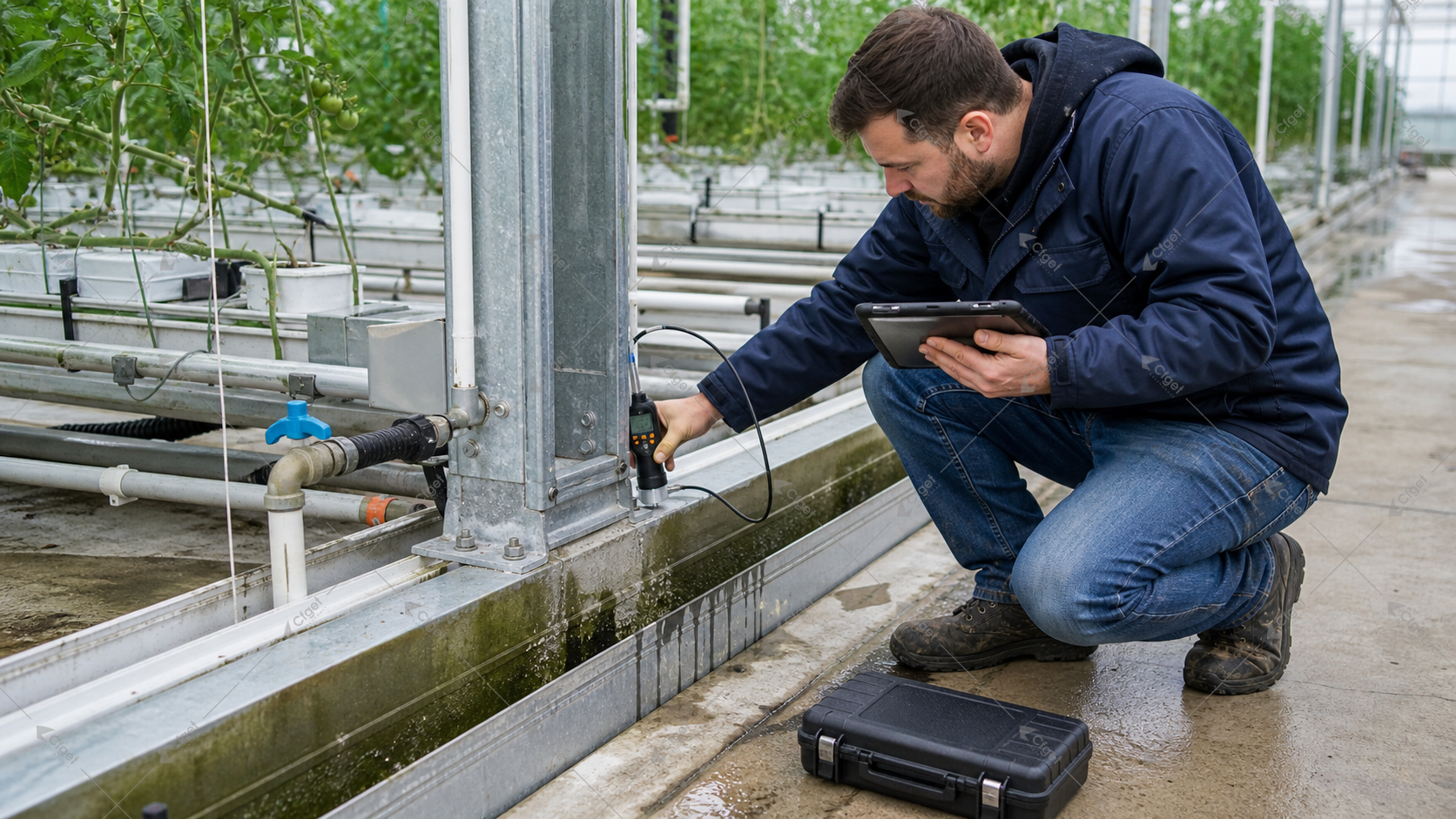
Drainage must be visible and serviceable
Drainage is both a crop function and a greenhouse-infrastructure function.
Inspect:
- whether containers sit in standing water;
- whether floor slope moves runoff away from roots and walkways;
- whether channels can be opened and cleaned;
- whether one zone’s drainage contaminates another;
- where collected water goes during a power or pump failure;
- whether a recirculation system has filtration, disinfection and a reject route.
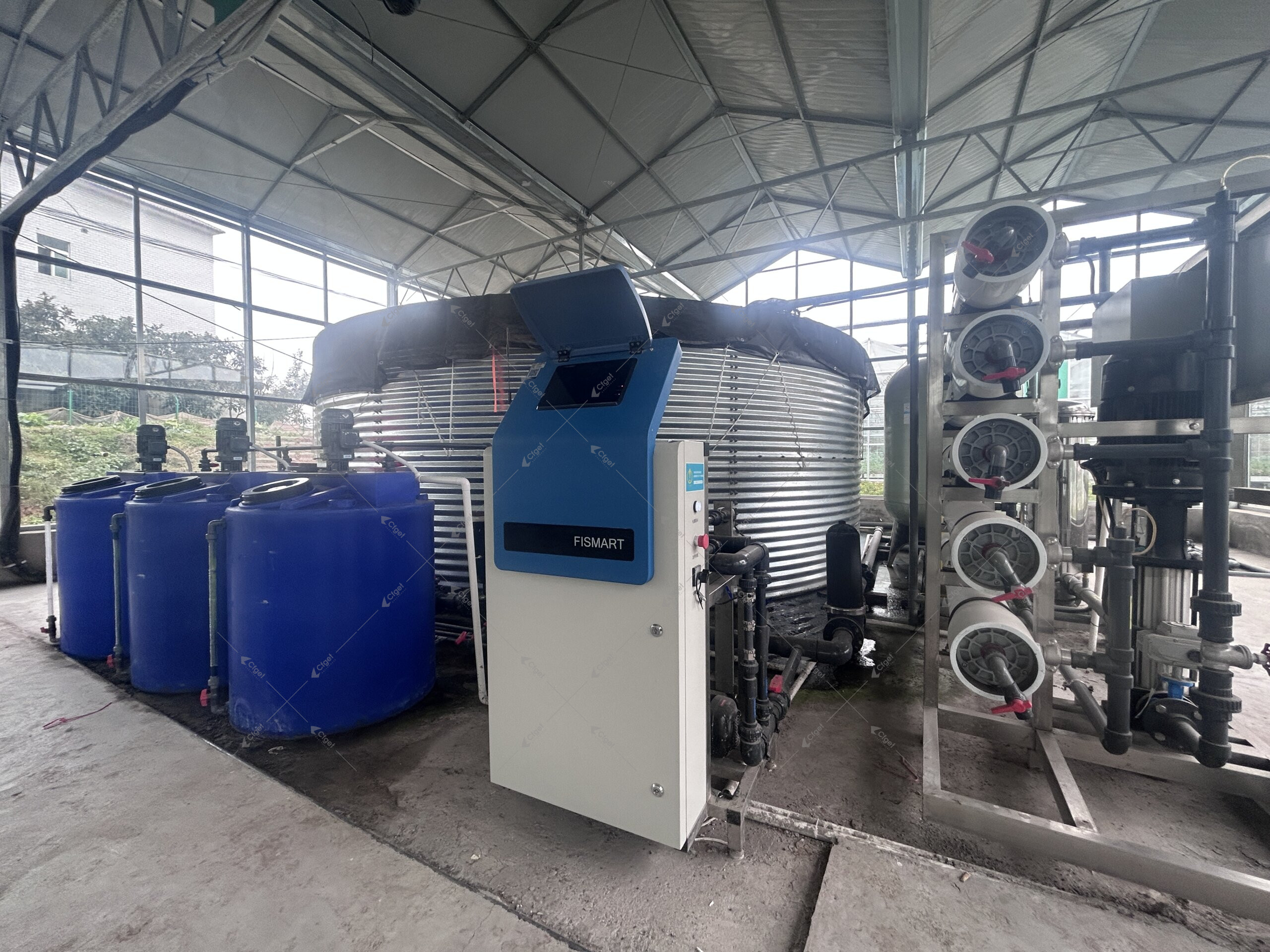
The local Chengdu footage directly shows utility equipment and a spoken reference to return-water treatment, pH, EC and fertilizer ratios. It does not reveal the treatment process, capacities or operating results. The Chengdu video-based case study keeps those facts separate from design inference.
Diagnose a root-zone complaint before changing fertilizer
Use this order when a block loses colour or uniformity:
1. Map the pattern by row, zone, cultivar and distance from the irrigation inlet.
2. Check emitter discharge and pressure at representative near, middle and far points.
3. Inspect container outlets and floor drainage.
4. Compare source, feed and drainage pH and EC with the same method used previously.
5. Open selected containers and examine moisture distribution and roots.
6. Review root-zone temperature, irrigation timing and recent weather.
7. Use tissue, water, substrate or disease testing when the evidence points there.
| Field pattern | First question |
| One irrigation zone | Did pressure, dosing or valve operation change? |
| Edge rows | Are solar load, wind or container temperatures different? |
| Random individual plants | Is the emitter, outlet or plant root system abnormal? |
| Whole block after a source change | Did water alkalinity, salinity or treatment change? |
| Symptoms after prolonged wet weather | Did drainage and root-zone oxygen recover? |
This approach prevents a fertilizer correction from hiding an irrigation or drainage fault.
About this review
Coraline Liao, CEO of CFGET, reviewed this page with attention to container, substrate, drainage and root-zone sampling decisions. Her public LinkedIn profile describes her as a Greenhouse Technical Director with more than 15 years in the greenhouse industry.
The CFGET Project Planning Team completed the technical review. Cited research, direct observations from CFGET’s Chengdu footage and professional interpretation are kept separate. Local crop advisers, laboratories, engineers and authorities must confirm decisions that depend on cultivar, site or regulation.
Project video: greenhouse project reference
This field video gives a quick project visual to read beside the specifications and RFQ checklist.
Frequently asked questions
What ph should blueberry substrate have?
Blueberries generally require acidic root conditions, but the working range depends on cultivar group, substrate, water alkalinity, fertilizer and measurement method. Use regional crop guidance and trend the same sample point rather than copying one universal number.
Is coco coir suitable for blueberries?
It can be a component in a designed substrate, but source, buffering, salinity, particle structure and irrigation behaviour need testing. The material name alone does not predict performance.
How large should a commercial blueberry container be?
Plant age, cultivar, climate, expected crop duration, substrate and irrigation capacity all matter. Trial the complete container-emitter-substrate combination before scaling.
Does drainage water EC show what every plant experienced?
No. A mixed sample can hide dry, wet or blocked containers. Pair drainage trends with emitter tests and selected root-zone samples across the block.
Your next action
Build and test a small root-zone mock-up:
1. obtain the intended container, substrate and emitter;
2. measure source-water chemistry through an accredited laboratory;
3. test wetting and drainage at several pulse sizes;
4. define fixed feed, root-zone and drainage sample points;
5. record container temperature and moisture at centre and edge positions;
6. write acceptance criteria for substrate batches and irrigation uniformity.
Then use the blueberry irrigation and fertigation guide to turn that physical design into an operating method. CFGET’s substrate systems and irrigation and fertilization systems are relevant only after the project has defined these crop-side requirements.